Medieval Islamic World
Interactive passage with audio narration, comprehension questions, and printable PDF.
By completing this purchase you agree to our Terms of Use and Privacy Policy. Your subscription renews automatically until you cancel. You can cancel anytime from your account settings. All sales are final and non-refundable. Digital content is available for download in your account immediately upon purchase.
What's included
Medieval Islamic World preview and details
About this printable Medieval Islamic World reading passage (Grades 5-8)
Sample passage and quiz from Medieval Islamic World
Reading passage and comprehension quiz preview
Medieval Islamic World
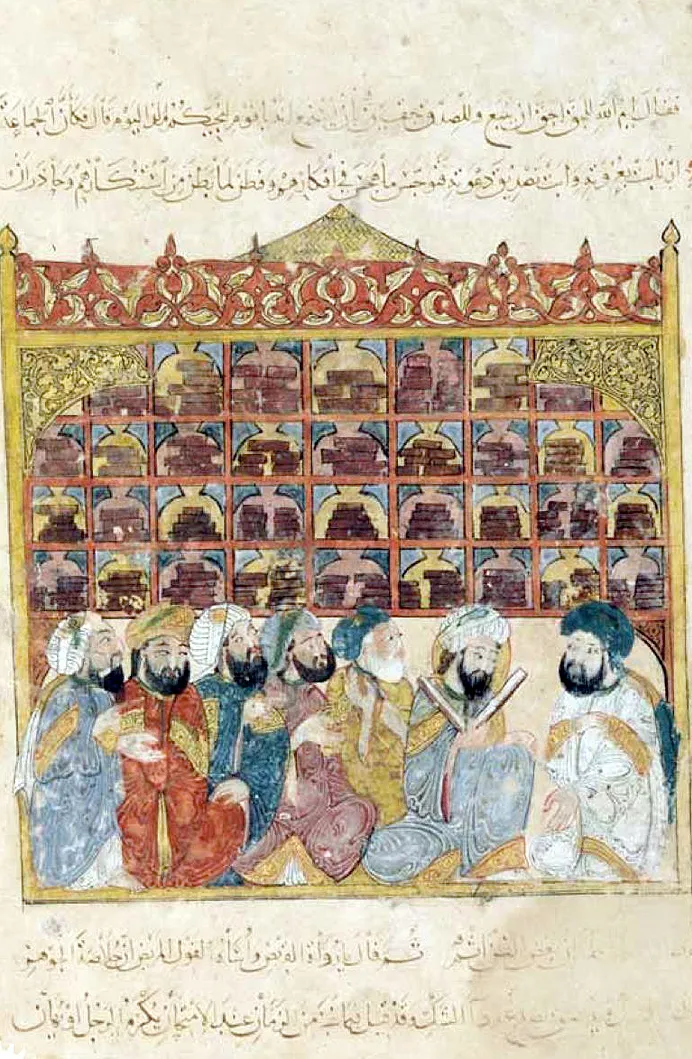
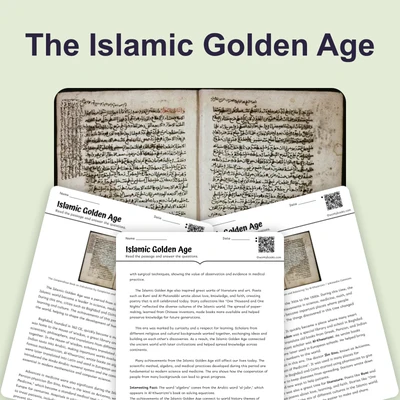
"A Library in Golden Islamic Age" by Yahya ibn Mahmud al-Wasiti / Wikimedia Commons.
The Medieval Islamic World was a powerful civilization that stretched from Spain in the west to India in the east during the Middle Ages, roughly between the 7th and 15th centuries. This period is sometimes called the Islamic Golden Age because of the many achievements in science, culture, and trade. The Islamic world's influence grew after the death of the Prophet Muhammad in 632 CE, when Muslim armies and leaders expanded their territory across North Africa, the Middle East, and beyond.
At the center of this civilization were the caliphates, powerful states ruled by caliphs, who were both political and religious leaders. The most famous caliphates were the Umayyad (661–750 CE) and the Abbasid (750–1258 CE). The Umayyad Caliphate made its capital in Damascus and later established an important presence in Córdoba, Spain, where the Great Mosque of Córdoba was built in the 8th century. The Abbasid Caliphate, centered in Baghdad, created a vibrant city known as the "City of Peace." The House of Wisdom in Baghdad became a center for learning, where scholars translated Greek, Persian, and Indian texts into Arabic and expanded knowledge in fields such as mathematics, medicine, and astronomy.
The Islamic world made major contributions to mathematics and science. The mathematician Al-Khwarizmi, working in the House of Wisdom, wrote a book in the 9th century that introduced the concept of algebra to the world. In medicine, scholars like Ibn Sina (Avicenna) wrote medical encyclopedias that were used in both the East and West for centuries. Islamic artists developed beautiful geometric patterns, calligraphy, and architecture. The use of horseshoe arches and intricate tilework in buildings like the Great Mosque of Córdoba set new standards for beauty and design. Trade and travel also connected cities such as Cairo, Baghdad, and Samarkand, spreading ideas, goods, and cultures across continents.
Social life in the Medieval Islamic World was organized by religion, class, and profession. Merchants, scholars, and artisans played important roles in the economy and culture. The Islamic legal system, or sharia, helped organize daily life and promoted learning. Cities were centers of commerce and culture, with bustling markets and libraries. Archaeological evidence, such as ancient coins and manuscripts, shows how far Islamic influence reached. Although there were differences between regions and times, the Islamic world maintained a strong tradition of education and intellectual curiosity throughout the Middle Ages.
The achievements of the Medieval Islamic World had a lasting impact on Europe and the rest of the world. Advances in science, mathematics, and the arts were passed on through trade, translation, and contact with other civilizations, helping to shape the modern world.
Interesting Fact: The word "algebra" comes from the Arabic word "al-jabr," used by Al-Khwarizmi in his famous book on solving equations.
This period connects to world history themes such as cultural exchange, technological innovation, and the rise and fall of empires.
Comprehension quiz (8 questions)
1. Where was the Abbasid capital?
2. What is the House of Wisdom?
3. Who wrote about algebra?
4. How did Islamic scholars spread knowledge?
5. Why was the Great Mosque of Córdoba important?
6. What role did merchants have?
7. The Umayyad Caliphate ruled from Damascus. True or false?
8. What does 'sharia' mean?
Perfect for the way you teach
- Build comprehension skills
- Auto-graded quiz
- Differentiated reading
- Read together at home
- Improve fluency
- Quiet reading time
- Reading curriculum support
- Independent practice
- Track Lexile growth