Life in Middle Ages
Interactive passage with audio narration, comprehension questions, and printable PDF.
By completing this purchase you agree to our Terms of Use and Privacy Policy. Your subscription renews automatically until you cancel. You can cancel anytime from your account settings. All sales are final and non-refundable. Digital content is available for download in your account immediately upon purchase.
What's included
Life in Middle Ages preview and details
About this printable Life in Middle Ages reading passage (Grades 5-8)
Sample passage and quiz from Life in Middle Ages
Reading passage and comprehension quiz preview
Life in Middle Ages
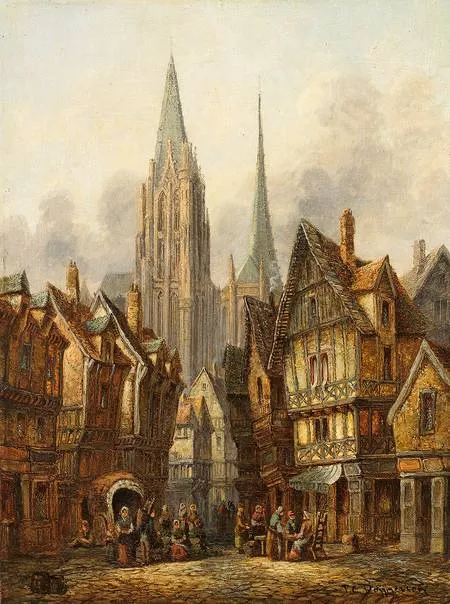
"Dommersen Gothic cathedral in a medieval city" by Pieter Cornelis Dommersen / Wikimedia Commons.
The Middle Ages, also known as the medieval period, lasted in Europe from about 500 to 1500 CE. During this time, society was organized under a system called feudalism, which shaped daily life, politics, and the economy across the continent.
Feudal society was structured like a pyramid. At the top were powerful nobles and lords, who owned large amounts of land. Below them were knights, who served as heavily armed warriors and pledged loyalty to their lords. Most people were serfs or peasants. Serfs worked the land on large estates called manors. They were not slaves, but they could not easily leave the manor without permission. Archaeological evidence, such as the remains of medieval villages found in England, shows that most people lived in simple wooden houses and worked long hours in the fields.
The Catholic Church was the most powerful institution in medieval Europe. The Church owned vast amounts of land and wealth, and its leaders, such as the pope and bishops, influenced both religious and political life. Churches and monasteries were often the only centers of learning. Monks copied ancient texts and preserved knowledge, but there were limited advances in science and art. For example, most medieval art was religious and followed strict rules. Primary sources, like illuminated manuscripts and church records, reveal that the Church held festivals and ran schools for boys training to be priests.
Despite the Church's influence, life for ordinary people was challenging. Disease, such as the Black Death in the 14th century, killed millions and changed social structures. Wars between lords and kingdoms were frequent, and most people rarely traveled far from home. However, over time, new ideas began to spread. Contact with the Islamic world through trade and the Crusades introduced Europeans to new knowledge in medicine, mathematics, and philosophy. These exchanges slowly encouraged change.
By the late Middle Ages, cities grew larger and trade increased. Some people began to question old ways of thinking. The combination of feudal society, Church authority, and new influences set the stage for the Renaissance, a period of great change in art, science, and culture that began in Italy around 1300 CE. This transition marked the end of the medieval era and the start of the modern world.
Life in the Middle Ages was shaped by strict social classes, religious authority, and limited opportunities for learning. Yet, these very conditions pushed Europeans to seek new ideas and ultimately led to the Renaissance, which changed the course of world history.
Interesting Fact: Some medieval manuscripts were decorated with gold leaf and vivid colors, making them valuable works of art even today.
Comprehension quiz (8 questions)
1. When did the Middle Ages begin?
2. Who were the main landowners?
3. What was a manor?
4. How did the Black Death affect society?
5. Why was the Church powerful?
6. What led to the Renaissance?
7. Feudalism organized society by land ownership.
8. What does 'serf' mean?
Perfect for the way you teach
- Build comprehension skills
- Auto-graded quiz
- Differentiated reading
- Read together at home
- Improve fluency
- Quiet reading time
- Reading curriculum support
- Independent practice
- Track Lexile growth