Late Middle Ages
Interactive passage with audio narration, comprehension questions, and printable PDF.
By completing this purchase you agree to our Terms of Use and Privacy Policy. Your subscription renews automatically until you cancel. You can cancel anytime from your account settings. All sales are final and non-refundable. Digital content is available for download in your account immediately upon purchase.
What's included
Late Middle Ages preview and details
About this printable Late Middle Ages reading passage (Grades 5-8)
Sample passage and quiz from Late Middle Ages
Reading passage and comprehension quiz preview
Late Middle Ages: Change, Crisis, and the Road to the Renaissance
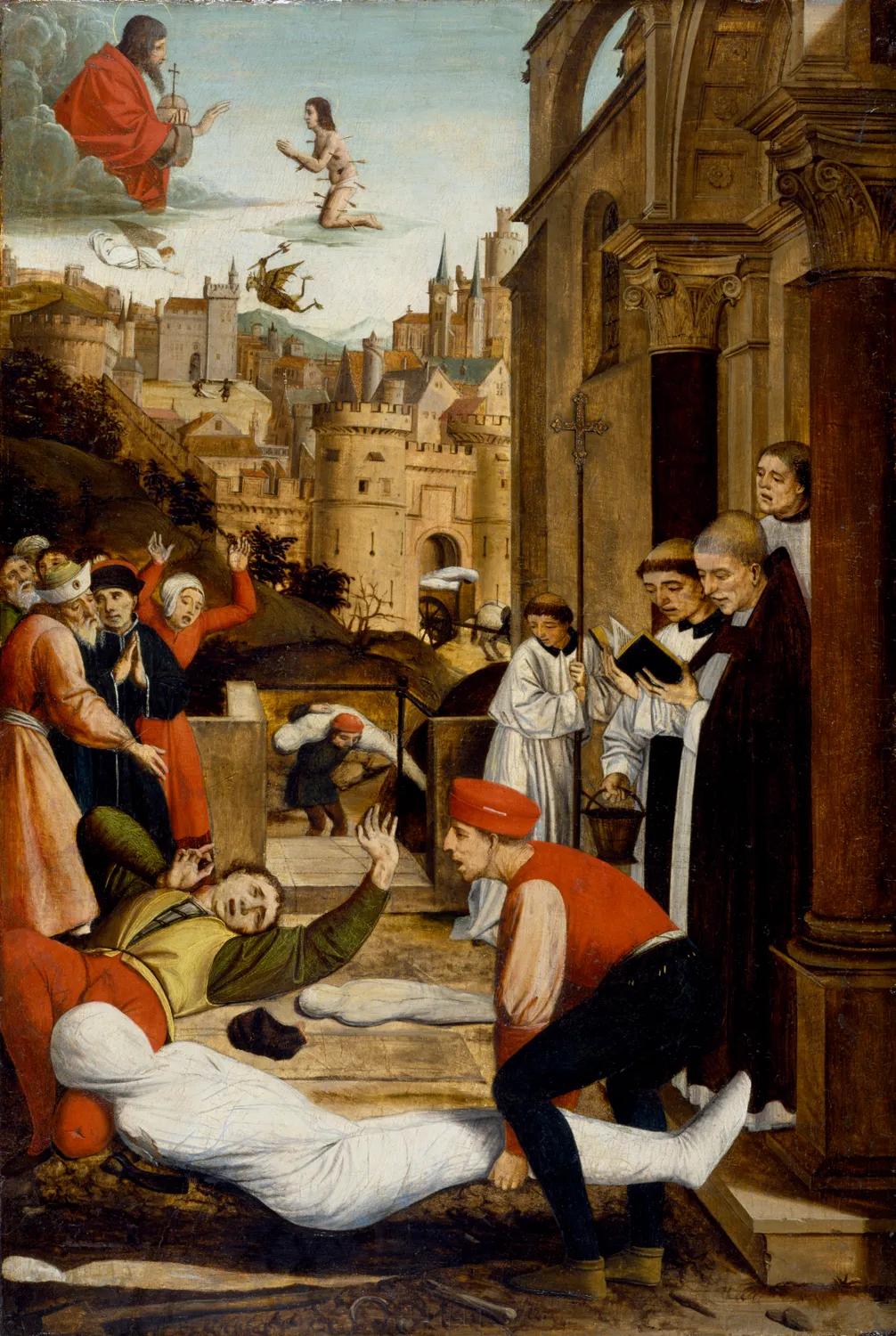
"Josse Lieferinxe - Saint Sebastian Interceding for the Plague Stricken - Walters" by Josse Lieferinxe / Wikimedia Commons.
The period known as the Late Middle Ages, from about 1300 to 1500 CE, marked a time of great change and crisis in European history. During these two centuries, Europe experienced massive population loss, devastating wars, and dramatic shifts in society. Events like the Black Death and the Hundred Years' War challenged old traditions and set the stage for the Renaissance, when new ideas began to flourish.
One of the most devastating events of the Late Middle Ages was the Black Death. This deadly plague struck Europe between 1347 and 1351, killing an estimated one-third of the population. Contemporary accounts, like those of Giovanni Boccaccio in Florence, describe entire villages wiped out and streets empty. The disease spread rapidly along trade routes and was especially deadly in crowded cities. The massive loss of life caused a severe labor shortage, which gave surviving peasants new bargaining power with landowners. This shift weakened the old feudal system, where peasants had little freedom and worked for lords in exchange for protection.
At the same time, Europe was shaken by a series of wars. The Hundred Years' War (1337–1453) between England and France changed the way wars were fought. New weapons like the longbow and gunpowder made knights on horseback less important. The war devastated the countryside and increased taxes, leading to uprisings such as the English Peasants’ Revolt of 1381. Primary sources from the time, like the chronicles of Jean Froissart, describe how ordinary people demanded more rights and better treatment. These wars and rebellions slowly forced monarchs to consider the needs of their subjects and helped shape modern governments.
Another major change was the decline of the Catholic Church’s power. Many people lost faith in church leaders after the Black Death, especially when the church could not explain or stop the disease. In the late 1300s, the Great Schism split the church into rival groups, each claiming to be the true pope. This conflict weakened the church’s authority and encouraged people to question old ideas. In cities like Florence and Venice, new wealth from trade allowed merchants and artists to support learning, art, and science. This movement led to the Renaissance, a time of rebirth in culture and ideas.
Despite hardship, the Late Middle Ages saw the beginnings of a new world. The old social order was challenged, and people started to value individual achievement. Geographic factors, like the growth of trade across the Mediterranean and the Silk Road, brought Europe into closer contact with Asia and Africa. These changes laid the foundation for the modern age.
The events of the Late Middle Ages remind us how crisis and change can create opportunities for new ideas and progress. This period connects to broader world history themes like cultural diffusion, the rise and fall of empires, and the power of human adaptation.
Interesting Fact: The word "quarantine" comes from the Italian word for forty, because ships suspected of carrying plague were kept in port for forty days before anyone could go ashore.
Comprehension quiz (8 questions)
1. When did the Black Death strike Europe?
2. What weapon changed medieval warfare?
3. Who described the Black Death in Florence?
4. How did the Black Death affect peasants?
5. Why did the church lose some power?
6. What did the Hundred Years' War cause?
7. The Late Middle Ages ended in 1500. True or false?
8. What is a primary source?
Perfect for the way you teach
- Build comprehension skills
- Auto-graded quiz
- Differentiated reading
- Read together at home
- Improve fluency
- Quiet reading time
- Reading curriculum support
- Independent practice
- Track Lexile growth