This learning resource is available in interactive and printable formats. The interactive worksheet can be played online and assigned to students. The Printable PDF version can be downloaded and printed for completion by hand.
This passage explores the life, works, and influence of Donatello, a master sculptor of the Italian Renaissance. Students will learn how Donatello revolutionized sculpture by creating naturalistic human figures, including his famous bronze David for the Medici family. The passage discusses Donatello’s innovative techniques, his relationships with powerful patrons in Florence, and how his art reflected the values of humanism and individual achievement. It highlights primary sources such as contemporary accounts and Donatello’s surviving works, while analyzing cause-and-effect relationships and changes over time in Renaissance art. Designed for middle school learners, the passage aligns with CA HSS 7.8.3 and CCSS RI.6.1, and supports world history content standards. The resource includes a glossary, differentiated passage, Spanish translations, comprehension activities, and graphic organizers. Read aloud audio and Spanish translation are provided to support diverse learners.
CONTENT PREVIEW
Expand content preview
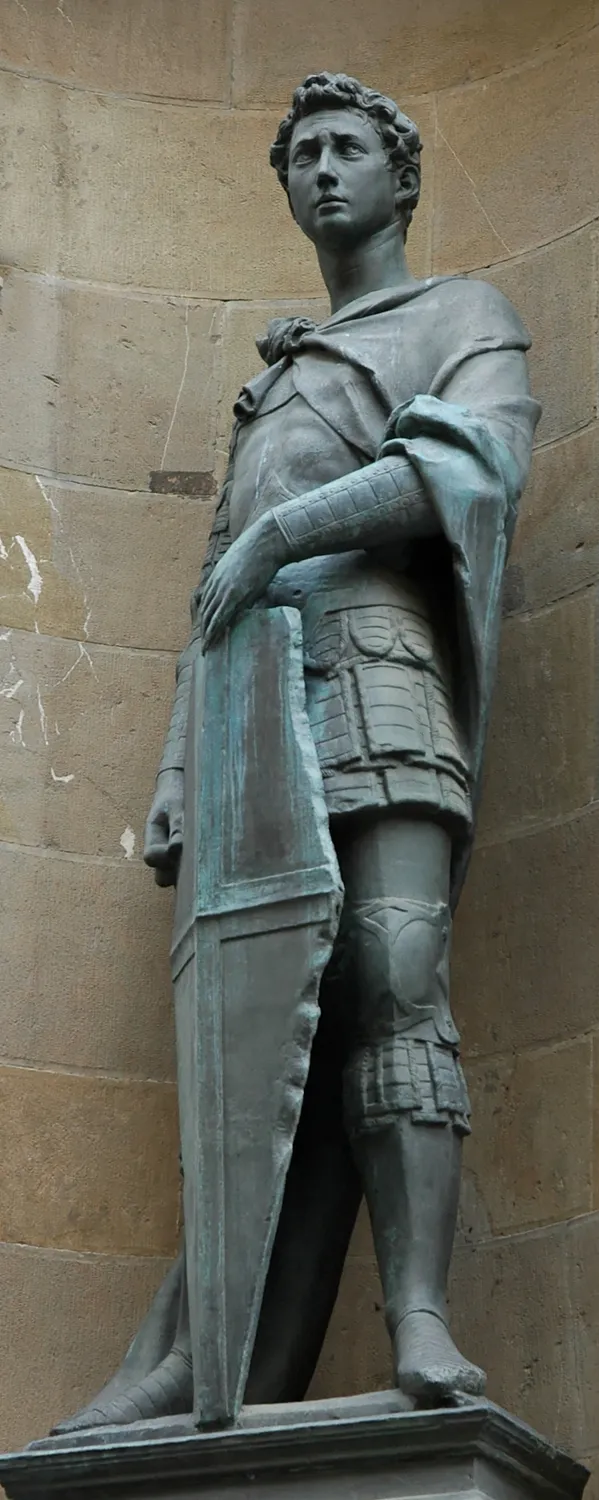
"St George Donatello Orsanmichele" by Donatello (Italian, 1386–1466) / Wikimedia Commons.
Donatello was one of the most important artists of the Italian Renaissance. Born in Florence around 1386, Donatello became famous for creating sculptures that looked extremely lifelike and showed deep emotion. Before Donatello, most European sculptures followed Medieval traditions and were often stiff or unrealistic. Donatello changed this by studying the human body and using new artistic techniques to make his figures appear more natural and alive.
Donatello’s early training took place in the bustling city-state of Florence, a center of trade, culture, and innovation. He learned from masters such as Lorenzo Ghiberti, who designed the famous bronze doors of the Florence Baptistery. Donatello also traveled to Rome, where he studied ancient Roman art and architecture. These experiences helped him develop new approaches to perspective and realistic anatomy, which became hallmarks of his work.
One of Donatello’s most famous works is the bronze statue of David, created in the 1440s for Cosimo de’ Medici, head of the powerful Medici family. This statue was the first free-standing nude male sculpture made since ancient times. David stands in a relaxed pose, called contrapposto, with one hand on his hip and a sword in the other. The sculpture shows both youthful beauty and quiet strength, and its detailed features make David seem almost alive. Primary sources, such as letters between the Medici and Donatello, reveal how important this commission was in displaying the family’s wealth and supporting the arts in Florence.
Donatello also worked in marble and wood, creating religious figures like St. George for the guild of armorers in Florence. His relief sculptures, such as the 'Feast of Herod' on the Baptistery font in Siena, used a new technique called schiacciato, or shallow carving, to create a sense of depth and space. Donatello’s art reflected the values of humanism, a Renaissance movement that focused on human achievement and individual potential. His lifelike figures challenged social hierarchies by giving realistic, emotional qualities to both saints and ordinary people.
Donatello’s influence spread beyond Florence as artists from across Europe studied his sculptures. His innovations in anatomy, movement, and perspective helped inspire later masters such as Michelangelo and Leonardo da Vinci. The Renaissance was a period of great change, and Donatello’s art played a key role in shaping a new vision of the human figure in Western art.
The story of Donatello and his masterpieces shows how geography, social class, and new ideas worked together to transform European society during the Renaissance. His sculptures connect to broader themes in world history, such as the rise of cities, the importance of individual creativity, and the impact of wealthy patrons on the arts.
Interesting Fact: Donatello’s David was once displayed in the Medici palace courtyard, where it amazed visitors with its bold style and lifelike detail.
Where was Donatello born?
FlorenceRomeVeniceMilan
Who was Donatello's famous patron?
Medici familySforza familyBorgia familyGonzaga family
What material is Donatello's David made of?
BronzeGoldMarbleWood
Why was Donatello's David important?
First free-standing nude since ancient timesIt was life-sizeIt was made of goldIt was a painting
How did Donatello influence later artists?
Through anatomy and perspectiveThrough poetryThrough musicThrough architecture
What technique did Donatello use in Siena?
schiacciatofrescomosaicenamel
Donatello was a Renaissance painter. (True/False)
TrueFalse
What does 'contrapposto' mean?
Natural standing posePainting techniqueRelief carvingAncient city
Perfect For:
👩🏫 Teachers
• Reading comprehension practice
• Auto-graded assessments
• Literacy skill development
👨👩👧👦 Parents
• Reading practice at home
• Comprehension improvement
• Educational reading time
🏠 Homeschoolers
• Reading curriculum support
• Independent reading practice
• Progress monitoring
Reading Features:
📖
Reading Passage
Engaging fiction or nonfiction text
❓
Comprehension Quiz
Auto-graded questions
📊
Instant Feedback
Immediate results and scoring
📄
Printable Version
Download for offline reading
🔊
Read Aloud
Voice-over with word highlighting
Reviews & Ratings
No reviews yet. Be the first to share your experience!
Related Content
Renaissance Clothing
This passage explores the fascinating world of Renaissance fashion clothing in Europe, focusing on how clothing reflecte...
Renaissance Poetry
This engaging world history reading passage introduces students to the Renaissance sonnet, focusing on the influential w...
Renaissance Philosophy
This passage explores the main ideas of Renaissance philosophy, which emerged in Europe during the 14th to 16th centurie...
Renaissance Art
This reading passage examines the enduring legacy of Renaissance art in world history, focusing on key techniques such a...
CA HSS 7.8.3CCSS RH.6-8.2CCSS W.6.2
Renaissance Anatomy Art
This engaging passage explores the intersection of art, science, and society during the Renaissance through the lens of ...
French Renaissance
This passage explores the rich culture of the French Renaissance, focusing on the influence of Italian art and architect...
Northern Renaissance
This passage examines the development and significance of Northern Renaissance art, focusing on how Renaissance ideas sp...
Renaissance Art and Artists
This history reading passage delves into the world of Renaissance art, focusing on the revolutionary works and lives of ...
Florence Renaissance
This history reading passage examines Florence during the Renaissance, highlighting its cultural richness, the influence...
Renaissance Humanism
This passage introduces students to the transformative concept of Renaissance Humanism, a philosophical movement that em...
Renaissance Oil Painting
This passage explores the development of oil painting techniques during the Renaissance, focusing on the comparison betw...
Renaissance Impact Today
This engaging world history passage examines the enduring impact of the Renaissance on modern society, focusing on how R...
English Renaissance
This comprehensive passage explores the English Renaissance, a transformative period in England marked by a flourishing ...
Renaissance Education
This engaging history reading passage examines the transformation of education during the Renaissance and its impact on ...
Renaissance Medicine
This engaging world history reading passage explores medical advances during the Renaissance in Europe, focusing on chan...
Renaissance Music
This world history reading passage examines the development of music during the Renaissance, a period of profound cultur...
Renaissance Festivals Celebrations
This passage explores the vibrant role of festivals and celebrations during the Renaissance, focusing on how public spec...
Catholic Church and Renaissance
This passage explores the major role the Catholic Church played as a patron of Renaissance art in Europe. It examines ho...
Renaissance Religious Art
This passage explores the dramatic changes in religious art during the Renaissance, focusing on the shift from medieval ...
Renaissance Women
This reading passage explores the lives and contributions of women during the Renaissance period in Europe. Students wil...