This learning resource is available in interactive and printable formats. The interactive worksheet can be played online and assigned to students. The Printable PDF version can be downloaded and printed for completion by hand.
This passage explores the reign of Justinian the Great, emperor of the Byzantine Empire from 527 to 565 CE, and his many contributions to world history. Students will learn about Justinian's ambitious building projects, including the Hagia Sophia, his military campaigns to reclaim lost Roman lands, and the creation of the Justinian Code—a legal system that influenced European law for centuries. The passage also highlights the important role played by his wife, Theodora, and examines key cause-and-effect relationships, evidence from historical sources, and the significance of Justinian's actions in shaping the Middle Ages. The passage is accompanied by comprehension activities, writing prompts, graphic organizers, a glossary, a Spanish translation, and a relevant public domain image. This resource aligns with history standards CA HSS 7.1, 7.2, and CCSS RH.6-8.2, RH.6-8.3, offering an engaging and rigorous history reading passage with read aloud audio and Spanish translation.
CONTENT PREVIEW
Expand content preview
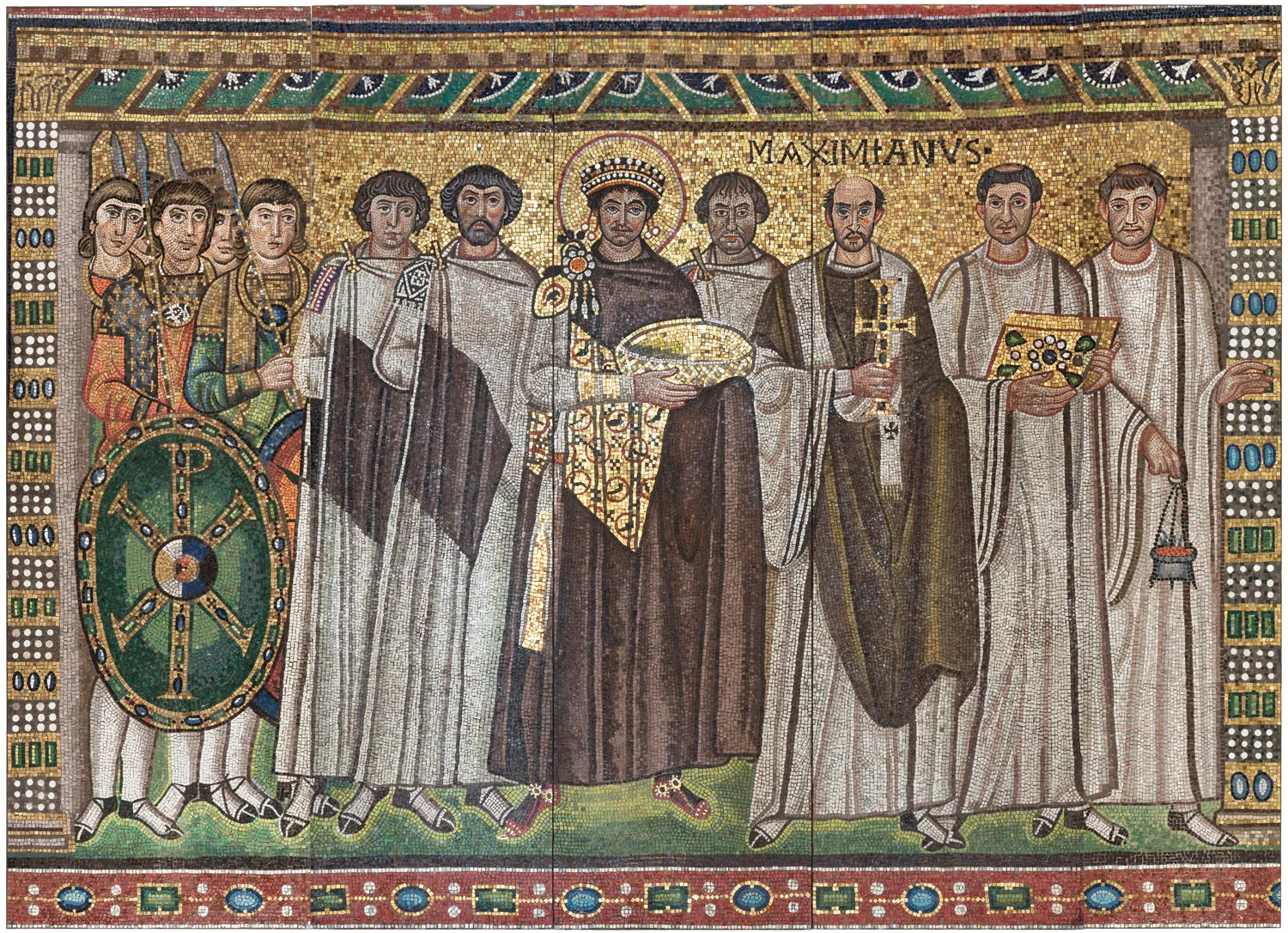
"Emperor Justinian and Members of His Court" / Wikimedia Commons.
Justinian the Great was the emperor of the Byzantine Empire from 527 to 565 CE. His reign marked a turning point in the history of Europe and the Mediterranean world. Justinian is remembered for his ambitious reforms, his efforts to restore the Roman Empire, and the vital role his wife, Theodora, played in government affairs.
One of Justinian’s most lasting achievements was the creation of the Justinian Code, a collection of laws that organized centuries of Roman legal texts. With the help of legal scholars like Tribonian, Justinian ordered the gathering and refining of existing laws in 529 CE. The new code made laws clearer, more consistent, and easier to enforce across his empire. According to primary sources, such as Procopius, the Justinian Code influenced legal systems in Europe long after Justinian’s death.
Justinian also led major military campaigns to recover lands lost to invading groups after the fall of the Western Roman Empire. Under generals like Belisarius, Byzantine armies conquered North Africa from the Vandals in 533 CE, retook Italy from the Ostrogoths, and even reclaimed parts of Spain. These victories were significant, but they also drained the empire’s resources and left some regions difficult to govern.
In Constantinople, Justinian launched building projects to strengthen and beautify his capital. His most famous project was the construction of the Hagia Sophia, a vast church with a massive dome completed in 537 CE. The Hagia Sophia was not only a religious center but also a symbol of the emperor’s power and the city’s importance. Archaeological evidence, such as mosaics and inscriptions, shows the scale and grandeur of these projects. These buildings helped make Constantinople a center of culture and trade during the Middle Ages.
Theodora, Justinian’s wife, played an important role in his reign. She advised Justinian on matters of law and policy, especially during times of crisis like the Nika Riots in 532 CE. According to Procopius, Theodora’s courage convinced Justinian to stay and restore order instead of fleeing the city. Her actions showed the significance of women in Byzantine government, even if their roles were often hidden from official records.
Justinian’s reign was significant because it blended Roman traditions with new Christian and Byzantine ideas. His legal code influenced the development of modern law, while his building projects and military campaigns changed the empire’s geography and culture. Through the actions of Justinian and Theodora, the Byzantine Empire became a bridge between the ancient and medieval worlds.
This period connects to broader themes in world history, such as the development of legal systems, the role of leadership, and the impact of geography on civilizations.
Interesting Fact: Justinian survived the deadly plague of 542 CE, which killed millions in his empire and weakened Byzantine power for years.
When did Justinian rule the Byzantine Empire?
527-565 CE476-509 CE600-650 CE400-450 CE
Who helped Justinian write the law code?
TribonianCaesarAugustusJustinian II
What was Justinian's most famous building project?
Hagia SophiaColosseumParthenonPantheon
Why was the Justinian Code important?
It organized Roman lawsIt was a military planIt was a mapIt was a poem
How did Theodora help during the Nika Riots?
Convinced Justinian to stayLed the armyWrote the Justinian CodeBuilt the Hagia Sophia
What effect did military campaigns have?
Empire grew but resources drainedEmpire disappearedNo changes happenedJustinian became a general
The Hagia Sophia was built in Constantinople. True or False?
TrueFalse
What does 'reforms' mean?
Changes to improve a systemFamous buildingsMilitary generalsTypes of mosaics
Perfect For:
👩🏫 Teachers
• Reading comprehension practice
• Auto-graded assessments
• Literacy skill development
👨👩👧👦 Parents
• Reading practice at home
• Comprehension improvement
• Educational reading time
🏠 Homeschoolers
• Reading curriculum support
• Independent reading practice
• Progress monitoring
Reading Features:
📖
Reading Passage
Engaging fiction or nonfiction text
❓
Comprehension Quiz
Auto-graded questions
📊
Instant Feedback
Immediate results and scoring
📄
Printable Version
Download for offline reading
🔊
Read Aloud
Voice-over with word highlighting
Reviews & Ratings
No reviews yet. Be the first to share your experience!
Related Content
Middle Ages Legacy
This history reading passage examines the lasting legacy of the Middle Ages, including the development of universities, ...
Early Middle Ages
This comprehensive reading passage explores the Early Middle Ages (500-1000 CE), a transformative period in European his...
High Middle Ages
This detailed world history reading passage explores the High Middle Ages (1000-1300 CE), a transformative era in Europe...
What Were the Middle Ages?
This engaging world history reading passage introduces students to the Middle Ages, the period in European history betwe...
Late Middle Ages
This rigorous world history reading passage explores the Late Middle Ages (1300-1500 CE), a time marked by the devastati...
Dark Ages
This passage offers a rigorous, engaging examination of why the early Middle Ages are often called the 'Dark Ages.' Stud...
Life in Middle Ages
This rigorous history reading passage explores life in Europe during the Middle Ages, focusing on the structure of feuda...
Medieval Islamic World
This rigorous reading passage delves into the Medieval Islamic World's golden age, when a vast civilization stretched fr...
Islamic Golden Age
This history reading passage explores the Islamic Golden Age, a period from the 8th to 14th centuries marked by outstand...
Medieval to Modern Transition
This engaging world history reading passage explores the dramatic transformation from the Middle Ages to the modern era,...
Medieval Words in English
This engaging history reading passage examines the evolution of the English language during the Middle Ages, focusing on...
Age of Exploration Begins
This engaging history reading passage explores the Age of Exploration, a turning point in world history when European po...
Italian City-States
This passage explores the rise and significance of the Italian city-states—Venice, Florence, and Genoa—during the Middle...
Attila the Hun
This engaging world history reading passage examines Attila the Hun, a powerful and feared ruler during the Middle Ages....
Medieval Guilds
This engaging world history reading passage explores the important role of guilds—worker groups that shaped the economy ...
Medieval Christian Worship
This detailed passage examines how people worshiped during the Middle Ages, focusing on essential religious practices su...
Power of the Pope
This history reading passage examines the power of the pope during the Middle Ages, focusing on his role as spiritual le...
Carolingian Renaissance
This engaging world history passage explores how Charlemagne, ruler of the Franks, transformed education and learning in...
Islamic Golden Age Inventions
This world history reading passage explores the remarkable inventions and scientific advances made in the medieval Islam...
Medieval Agricultural Innovations
This history reading passage explores how farming inventions like the heavy plow, three-field system, and horse collar r...