This learning resource is available in interactive and printable formats. The interactive worksheet can be played online and assigned to students. The Printable PDF version can be downloaded and printed for completion by hand.
This reading passage explores the life, discoveries, and legacy of Galileo Galilei, a central figure in Renaissance science. Students will learn how Galileo challenged traditional beliefs through direct observation and experimentation, including his improvements to the telescope and his support for the heliocentric model. The passage discusses Galileo’s use of the scientific method, his conflict with the Catholic Church, and the broader impact of his work on the development of modern physics. Primary sources, such as Galileo’s own writings and his trial records, are referenced to provide historical evidence. The passage is aligned with CA HSS 7.10 and CCSS RI.6.3, supporting analysis of primary sources, cause-and-effect, and change over time. Included are read aloud audio and a Spanish translation for accessibility.
CONTENT PREVIEW
Expand content preview
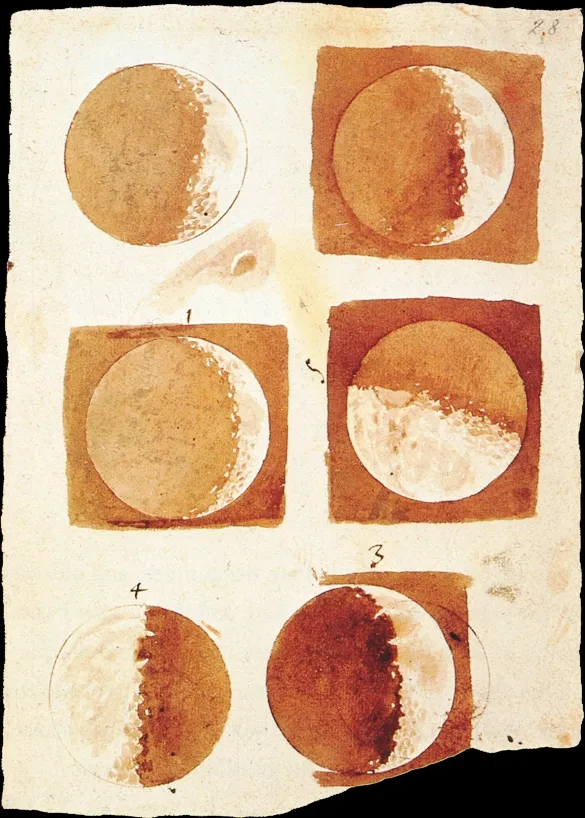
Phases of the moon by Galileo Galilei / Wikimedia Commons
Galileo Galilei was an Italian scientist whose work transformed science during the Renaissance. Born in Pisa in 1564, Galileo questioned old beliefs by using careful observations and experiments. He is remembered for his contributions to astronomy, physics, and the scientific method, as well as for his famous conflict with the Catholic Church.
Galileo’s most important tool was the telescope, which he improved in 1609 after learning about a similar device from the Netherlands. With this instrument, he observed the moons of Jupiter, the rough surface of the Moon, and the phases of Venus. These findings, recorded in his book Sidereus Nuncius (1610), challenged the ancient idea that everything in the sky revolved around the Earth. Instead, Galileo supported the heliocentric model, which placed the Sun at the center of the solar system, first described by Copernicus in 1543. Galileo’s detailed drawings and notes provided strong evidence for this new understanding of the universe.
Galileo used the scientific method by asking questions, making hypotheses, testing them through experiments, and recording his results. For example, in Pisa, he is said to have dropped spheres of different weights from the Leaning Tower to show that they fell at the same rate, contradicting what Aristotle taught. In his book Dialogue Concerning the Two Chief World Systems (1632), Galileo compared the Earth-centered and Sun-centered models, using arguments and evidence to persuade readers. His work laid the foundations for modern physics, especially the study of motion and gravity.
Galileo’s discoveries led to conflict with powerful church leaders, who believed the heliocentric model went against the Bible. In 1633, Galileo was put on trial by the Inquisition and forced to recant his views. He spent the rest of his life under house arrest. Despite this, Galileo continued to write and study, and his ideas eventually changed how people understood the natural world. Today, his methods and findings are seen as key steps in the development of science as we know it.
The story of Galileo Galilei shows how questioning old ideas and using evidence can transform knowledge. His life connects to larger themes in world history, such as the power of observation, the struggle between science and authority, and the lasting impact of the Renaissance.
Interesting Fact: Even under house arrest, Galileo invented a pendulum clock and continued to correspond with other scientists in Europe.
Where was Galileo born?
PisaFlorenceVeniceRome
What tool did Galileo improve in 1609?
TelescopeMicroscopeCompassBarometer
Who put Galileo on trial in 1633?
InquisitionRoyal SocietySenateMerchants
Why did Galileo’s findings challenge old beliefs?
Showed Sun at centerProved Earth was flatSupported old ideasDenied gravity
What is the heliocentric model?
Sun at centerEarth at centerMoon at centerJupiter at center
How did Galileo collect evidence?
Experiments and observationOnly storiesJust guessingPraying
Galileo invented the telescope. True or false?
TrueFalse
What does "scientific method" mean?
A way of learning using experimentsA type of telescopeA church ruleA moon of Jupiter
Perfect For:
👩🏫 Teachers
• Reading comprehension practice
• Auto-graded assessments
• Literacy skill development
👨👩👧👦 Parents
• Reading practice at home
• Comprehension improvement
• Educational reading time
🏠 Homeschoolers
• Reading curriculum support
• Independent reading practice
• Progress monitoring
Reading Features:
📖
Reading Passage
Engaging fiction or nonfiction text
❓
Comprehension Quiz
Auto-graded questions
📊
Instant Feedback
Immediate results and scoring
📄
Printable Version
Download for offline reading
🔊
Read Aloud
Voice-over with word highlighting
Reviews & Ratings
No reviews yet. Be the first to share your experience!
Related Content
Renaissance Clothing
This passage explores the fascinating world of Renaissance fashion clothing in Europe, focusing on how clothing reflecte...
Renaissance Poetry
This engaging world history reading passage introduces students to the Renaissance sonnet, focusing on the influential w...
Renaissance Philosophy
This passage explores the main ideas of Renaissance philosophy, which emerged in Europe during the 14th to 16th centurie...
Renaissance Art
This reading passage examines the enduring legacy of Renaissance art in world history, focusing on key techniques such a...
CA HSS 7.8.3CCSS RH.6-8.2CCSS W.6.2
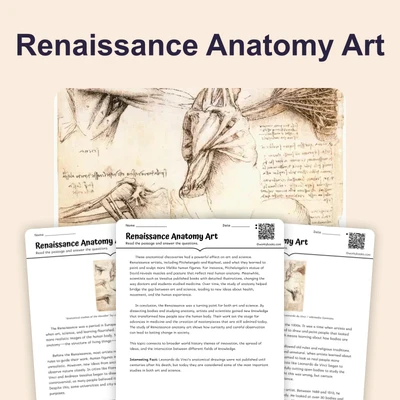
Renaissance Anatomy Art
This engaging passage explores the intersection of art, science, and society during the Renaissance through the lens of ...
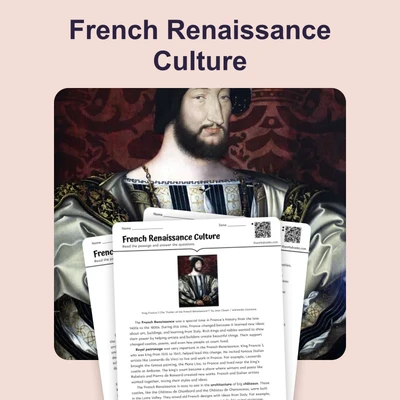
French Renaissance
This passage explores the rich culture of the French Renaissance, focusing on the influence of Italian art and architect...
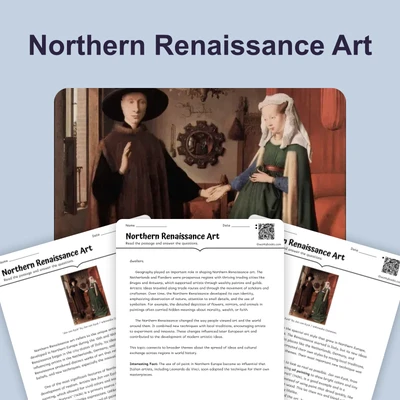
Northern Renaissance
This passage examines the development and significance of Northern Renaissance art, focusing on how Renaissance ideas sp...
Renaissance Art and Artists
This history reading passage delves into the world of Renaissance art, focusing on the revolutionary works and lives of ...
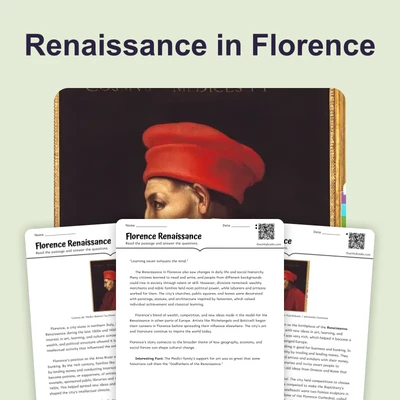
Florence Renaissance
This history reading passage examines Florence during the Renaissance, highlighting its cultural richness, the influence...
Renaissance Humanism
This passage introduces students to the transformative concept of Renaissance Humanism, a philosophical movement that em...
Renaissance Oil Painting
This passage explores the development of oil painting techniques during the Renaissance, focusing on the comparison betw...
Renaissance Impact Today
This engaging world history passage examines the enduring impact of the Renaissance on modern society, focusing on how R...
English Renaissance
This comprehensive passage explores the English Renaissance, a transformative period in England marked by a flourishing ...
Renaissance Education
This engaging history reading passage examines the transformation of education during the Renaissance and its impact on ...
Renaissance Medicine
This engaging world history reading passage explores medical advances during the Renaissance in Europe, focusing on chan...
Renaissance Music
This world history reading passage examines the development of music during the Renaissance, a period of profound cultur...
Renaissance Festivals Celebrations
This passage explores the vibrant role of festivals and celebrations during the Renaissance, focusing on how public spec...
Catholic Church and Renaissance
This passage explores the major role the Catholic Church played as a patron of Renaissance art in Europe. It examines ho...
Renaissance Religious Art
This passage explores the dramatic changes in religious art during the Renaissance, focusing on the shift from medieval ...
Renaissance Women
This reading passage explores the lives and contributions of women during the Renaissance period in Europe. Students wil...