Galileo's Telescope
Interactive passage with audio narration, comprehension questions, and printable PDF.
By completing this purchase you agree to our Terms of Use and Privacy Policy. Your subscription renews automatically until you cancel. You can cancel anytime from your account settings. All sales are final and non-refundable. Digital content is available for download in your account immediately upon purchase.
What's included
Galileo's Telescope preview and details
About this printable Galileo's Telescope reading passage (Grades 5-8)
Sample passage and quiz from Galileo's Telescope
Reading passage and comprehension quiz preview
Galileo's Telescope
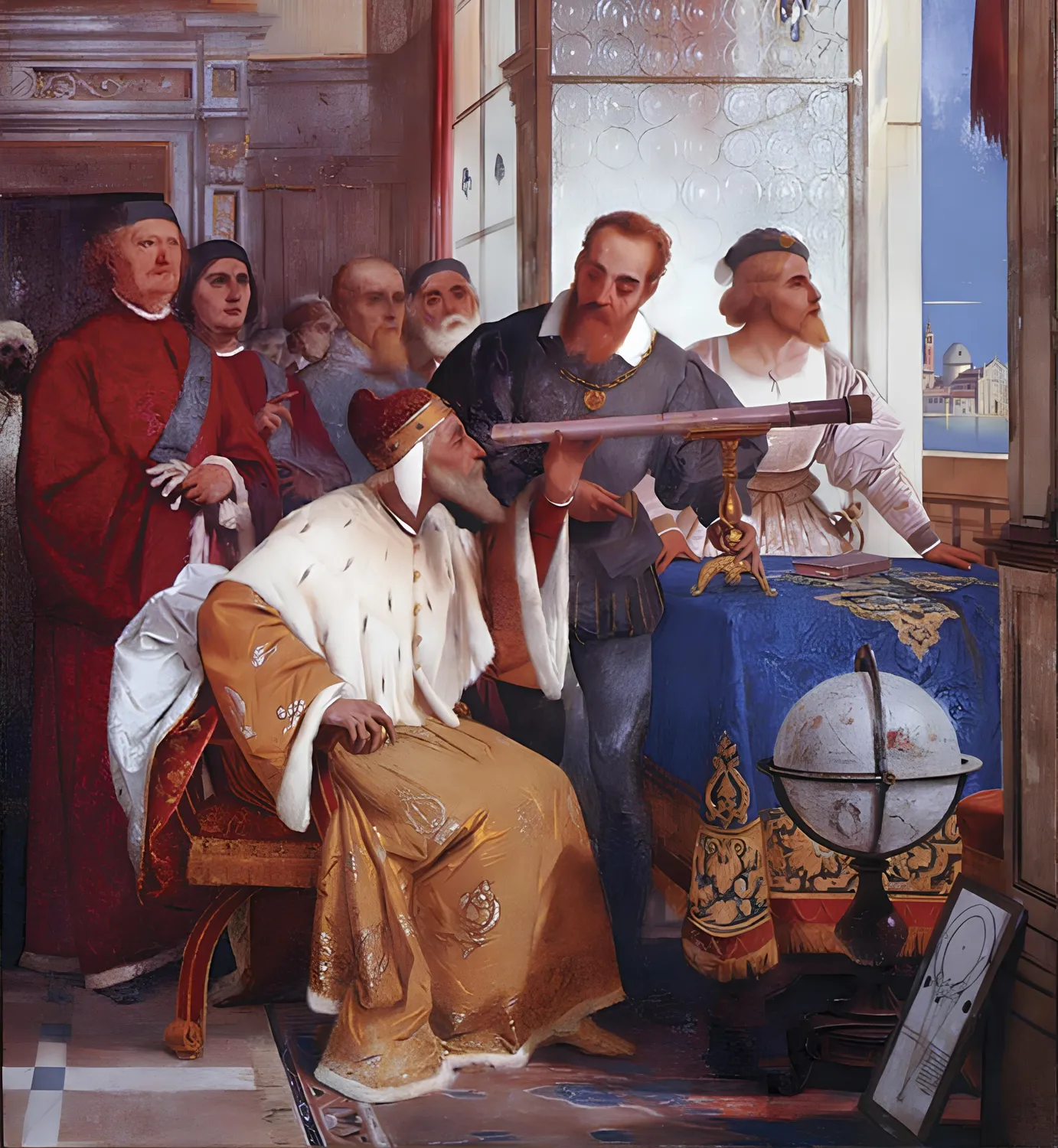
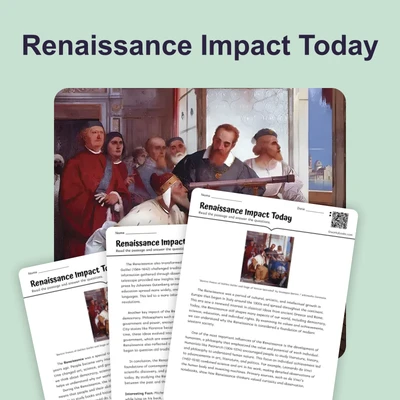
"Bertini fresco of Galileo Galilei and Doge of Venice Upscaled" by Giuseppe Bertini / Wikimedia Commons
In the early 1600s, the Italian scientist Galileo Galilei changed human understanding of the universe with his improved telescope. At that time, Europe was experiencing the Renaissance, a period marked by renewed interest in science, art, and learning. Galileo’s work not only advanced technology but also transformed ideas about Earth’s place in the cosmos.
Galileo first heard about a Dutch invention called the “spyglass” in 1609. Using his knowledge of optics, he built his own telescope, making several innovations. His telescopes could magnify objects up to 20 times, much stronger than previous models. Galileo’s improvements included using better lenses and careful calibration, which allowed him to see details never before observed by humans. He shared his designs with the Venetian Senate, who rewarded him with a lifetime professorship.
With his telescope, Galileo made several groundbreaking discoveries. In January 1610, he observed four bright “stars” near Jupiter. Over several nights, he realized these were actually moons orbiting Jupiter. These moons—Io, Europa, Ganymede, and Callisto—are now called the Galilean moons. Galileo’s detailed notes and drawings provided primary evidence that not everything in the sky revolved around Earth. Later that year, Galileo also noticed Saturn appeared to have “ears.” He had discovered Saturn’s rings, though he could not clearly see their shape with his telescope. He also observed that Venus went through phases, much like the Moon.
Galileo’s findings strongly supported the heliocentric theory, which stated that the Sun, not the Earth, was at the center of the solar system. This theory, first proposed by Nicolaus Copernicus, was controversial because it challenged the traditional geocentric view supported by the Catholic Church. Galileo’s telescopic observations provided new evidence for heliocentrism. For example, the phases of Venus could only be explained if Venus orbited the Sun. Galileo published his results in 1610 in “Sidereus Nuncius,” or “Starry Messenger.” His work marked a major change in scientific thinking.
The impact of Galileo’s telescope was immense. His discoveries inspired other scientists, like Johannes Kepler and Isaac Newton, and helped launch the Scientific Revolution. Over time, telescopes became even more powerful, allowing humans to explore distant planets and galaxies. Galileo’s willingness to question accepted beliefs and rely on careful observation changed the way people approached science and knowledge.
Galileo’s story connects to broader themes in world history, such as how new technology and evidence can challenge old ideas, and how individuals can shape the course of human understanding.
Interesting Fact: Galileo’s telescope was only about 3 feet long, but it revealed a universe far larger and more complex than anyone had imagined.
Comprehension quiz (8 questions)
1. Who improved the telescope in 1609?
2. Which planet's moons did Galileo discover?
3. What did Galileo see around Saturn?
4. How did Galileo's telescope affect science?
5. Why were Galileo's findings controversial?
6. Galileo's discoveries showed that:
7. Galileo's telescope was three feet long.
8. What does 'heliocentric' mean?
Perfect for the way you teach
- Build comprehension skills
- Auto-graded quiz
- Differentiated reading
- Read together at home
- Improve fluency
- Quiet reading time
- Reading curriculum support
- Independent practice
- Track Lexile growth