Gutenberg Bible
Interactive passage with audio narration, comprehension questions, and printable PDF.
By completing this purchase you agree to our Terms of Use and Privacy Policy. Your subscription renews automatically until you cancel. You can cancel anytime from your account settings. All sales are final and non-refundable. Digital content is available for download in your account immediately upon purchase.
What's included
Gutenberg Bible preview and details
About this printable Gutenberg Bible reading passage (Grades 5-8)
Sample passage and quiz from Gutenberg Bible
Reading passage and comprehension quiz preview
Gutenberg Bible
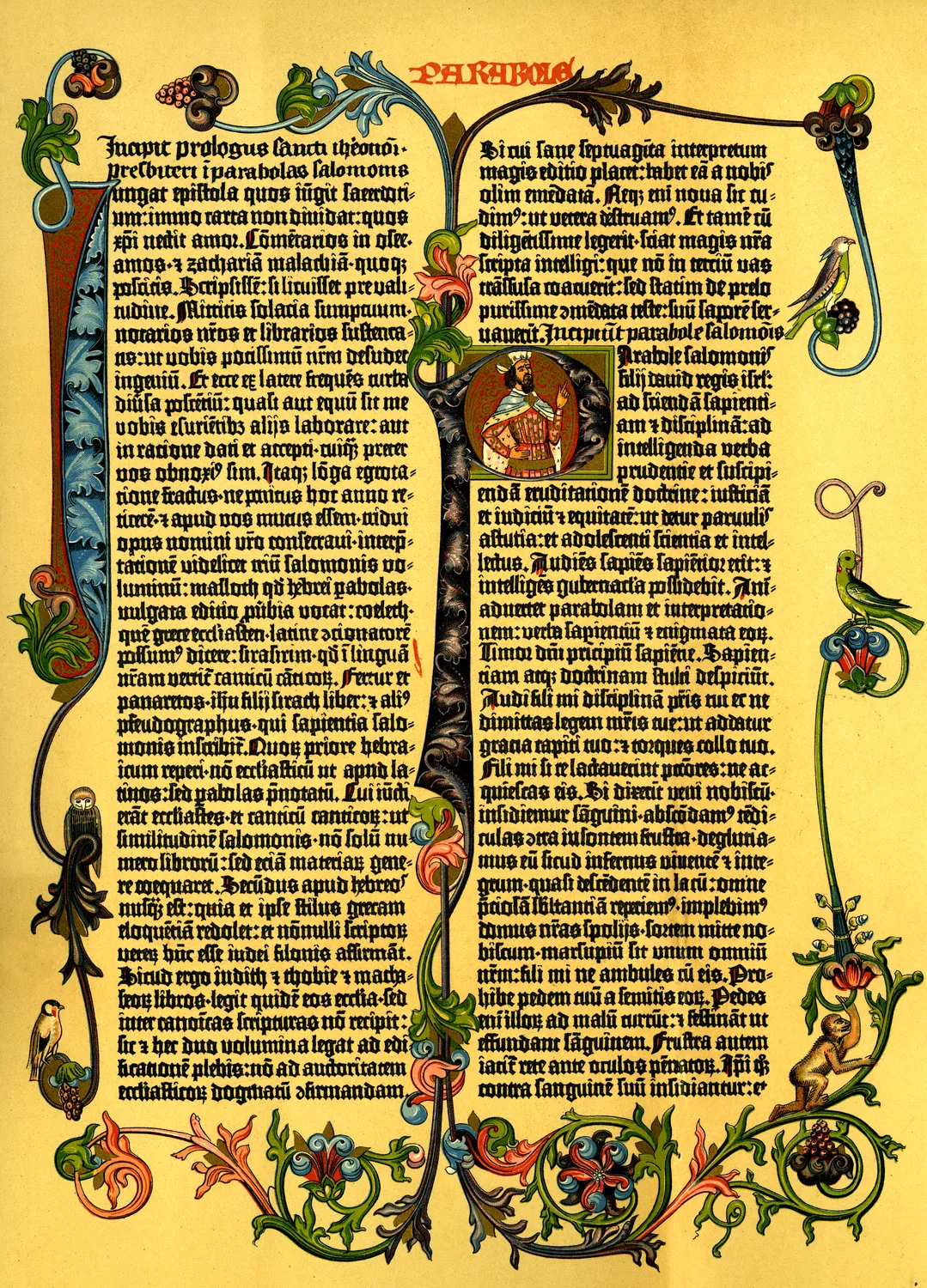
"Gutenberg-bible" by Johannes Gensfleisch zur Laden zum Gutenberg / Wikimedia Commons.
The invention of the printing press by Johannes Gutenberg in the 15th century was a turning point in world history. Before this breakthrough, most books in Europe were created by hand. Skilled workers, often monks in monasteries, copied texts with ink and quill onto parchment. This process was slow, expensive, and limited the number of books available. As a result, only wealthy nobles, religious leaders, or scholars could afford to own books, and knowledge was restricted to a small part of society.
The Renaissance was a time of great curiosity and learning in Europe, starting in the 1300s in Italian city-states like Florence. People were eager to read works from the ancient world as well as new ideas in science, literature, and art. However, because books were rare and costly, it was difficult for these ideas to spread widely. This changed after 1450, when Gutenberg, a German goldsmith in Mainz, developed a press that used movable metal type. This technology allowed printers to create pages quickly and accurately, and they could reuse the type for many different books.
One famous example is the Gutenberg Bible, printed around 1455. Surviving copies show how the new process could produce hundreds of pages that looked almost identical, a major advance over hand-copied manuscripts where every copy was unique and sometimes contained errors. Historical records from Nuremberg and Venice reveal that the number of printing workshops grew rapidly. By 1500, there were over a thousand printing presses in Europe, and millions of books had been produced. This remarkable growth meant that books became more accessible to merchants, artisans, and even some peasants. For the first time, ordinary people could learn to read, share new ideas, and even challenge old beliefs.
The printing press had lasting effects on European society. Increased literacy led to more people attending schools. Printed pamphlets helped fuel debates during the Protestant Reformation in the 16th century, as reformers like Martin Luther used the press to spread their messages. Maps, scientific treatises, and political documents could now reach a wide audience. Over time, the diffusion of information weakened the power of those who controlled knowledge and promoted the exchange of ideas across borders.
In conclusion, the printing press was not just a technical achievement but also a force for social and cultural change. By transforming how people read and learned, it helped shape the modern world. The story of the printing press is a powerful example of how technology can connect people, spread knowledge, and influence the course of history.
Interesting Fact: The first printed newspapers appeared in Germany in the early 1600s, allowing people to read about distant events soon after they happened.
This change connects to the broader theme of how inventions and ideas can shape societies throughout history.
Comprehension quiz (8 questions)
1. Who invented the printing press?
2. Where did the Renaissance begin?
3. What year was the Gutenberg Bible printed?
4. Why did books become more common after 1450?
5. How did the printing press affect literacy?
6. What was a major effect of printed pamphlets?
7. The first newspapers appeared in France. True or false?
8. What does 'accessible' mean in the passage?
Perfect for the way you teach
- Build comprehension skills
- Auto-graded quiz
- Differentiated reading
- Read together at home
- Improve fluency
- Quiet reading time
- Reading curriculum support
- Independent practice
- Track Lexile growth