Gutenberg Printing Press
Interactive passage with audio narration, comprehension questions, and printable PDF.
By completing this purchase you agree to our Terms of Use and Privacy Policy. Your subscription renews automatically until you cancel. You can cancel anytime from your account settings. All sales are final and non-refundable. Digital content is available for download in your account immediately upon purchase.
What's included
Gutenberg Printing Press preview and details
About this printable Gutenberg Printing Press reading passage (Grades 5-8)
Sample passage and quiz from Gutenberg Printing Press
Reading passage and comprehension quiz preview
Gutenberg Printing Press
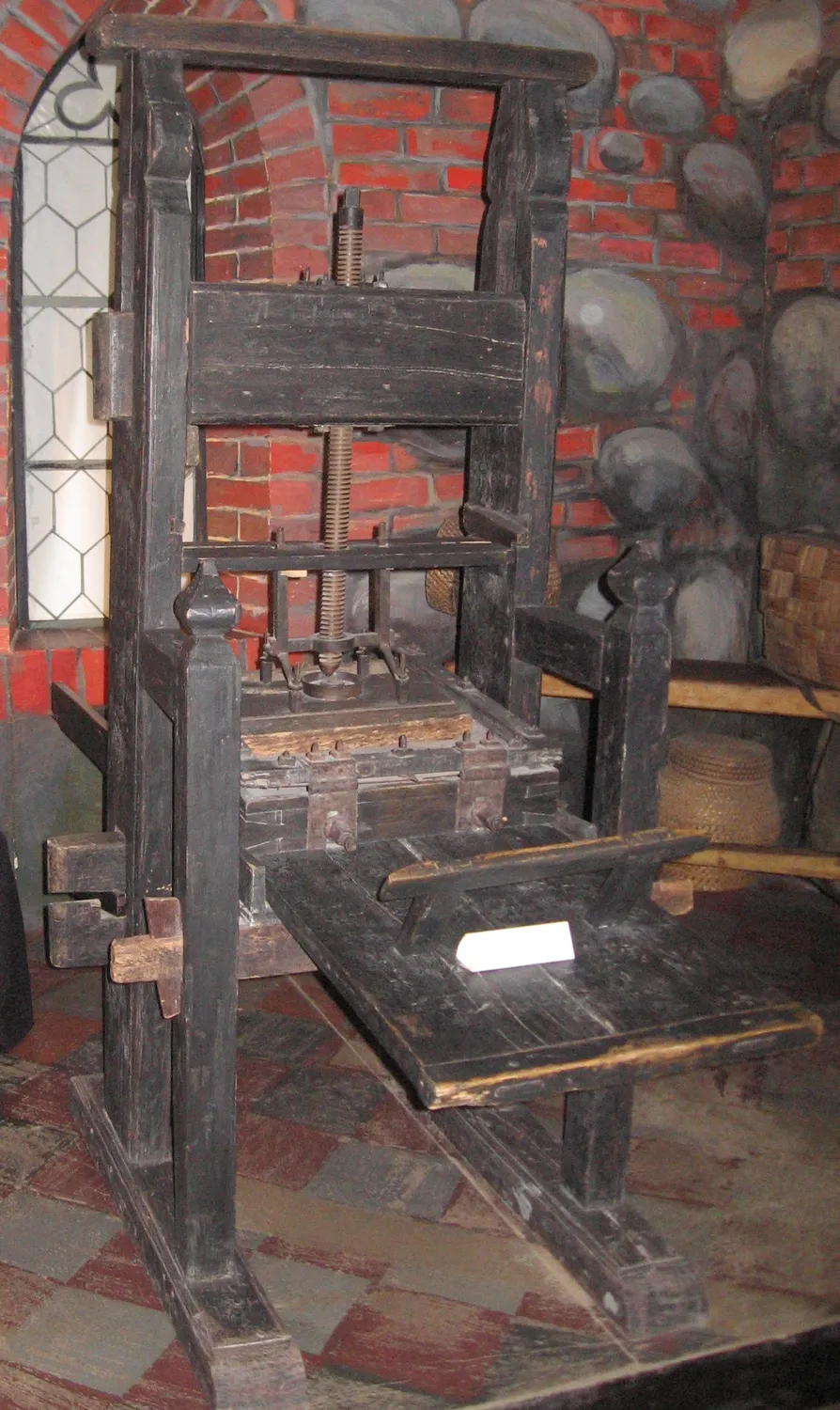
"Printing machine of Johanes Gutenbrg" by Gruszecki / Wikimedia Commons.
The Gutenberg Printing Press was invented in the 1450s in Mainz, Germany by Johannes Gutenberg. This device used a new technology called movable type to print books much faster than before. Before the printing press, books were copied by hand, which was slow, expensive, and only available to the rich or the church. The printing press made it possible to produce many copies of books quickly and changed how people shared information in Europe.
Johannes Gutenberg was a skilled metalworker and inventor. He developed metal letter molds that could be arranged and reused to form words and sentences. This process is called movable type. Gutenberg’s workshop used a special oil-based ink and a press modeled after a wine press. The first major book printed with this method was the Gutenberg Bible, completed around 1455. Surviving copies of the Gutenberg Bible are now treasured historical artifacts. Historians have studied these books to understand how the press worked and how it improved over time.
The impact of the printing press was enormous. It allowed for the rapid spread of new ideas, especially during the Renaissance, a period of great cultural and scientific change in Europe. Books became more affordable, so people from different social classes could learn to read. This led to a wider spread of literacy and knowledge. Information was no longer controlled only by the church or a small group of scholars. As a result, people were able to challenge old ideas and discuss new discoveries. For example, Martin Luther’s ideas during the Reformation spread quickly thanks to printed pamphlets.
The printing press also changed daily life in European cities. Bookshops and printing workshops appeared in many places, such as Venice, Paris, and London. Literacy rates increased, and people began to read newspapers and almanacs. The press influenced education, science, and politics. Printed maps helped explorers, and scientific works could be shared more easily. The invention also led to new jobs for printers, typesetters, and bookbinders, changing the economy and social hierarchy.
In conclusion, the Gutenberg Printing Press transformed European society by making books cheaper and spreading knowledge. Movable type technology allowed new ideas to travel rapidly across different regions. This invention helped spark the modern age by encouraging curiosity and communication among people of all backgrounds.
This development connects to broader world history themes such as technological innovation and the spread of ideas across cultures and continents.
Interesting Fact: The Gutenberg Bible is sometimes called the “42-line Bible” because each page has 42 lines of text, and only about 48 copies are known to exist today.
Comprehension quiz (8 questions)
1. Who invented the printing press?
2. When was the Gutenberg Bible completed?
3. Where was the printing press invented?
4. What did movable type allow printers to do?
5. How did the press affect literacy?
6. Why were Martin Luther’s ideas important?
7. The printing press made books cheaper. True or false?
8. What is an artifact?
Perfect for the way you teach
- Build comprehension skills
- Auto-graded quiz
- Differentiated reading
- Read together at home
- Improve fluency
- Quiet reading time
- Reading curriculum support
- Independent practice
- Track Lexile growth