How Ancient Seas Form Petroleum Deposits
Interactive passage with audio narration, comprehension questions, and printable PDF.
By completing this purchase you agree to our Terms of Use and Privacy Policy. Your subscription renews automatically until you cancel. You can cancel anytime from your account settings. All sales are final and non-refundable. Digital content is available for download in your account immediately upon purchase.
What's included
How Ancient Seas Form Petroleum Deposits preview and details
About this printable How Ancient Seas Form Petroleum Deposits science reading passage, NGSS-aligned (Grades 6-8)
Sample passage and quiz from How Ancient Seas Form Petroleum Deposits
Reading passage and comprehension quiz preview
How Petroleum Forms
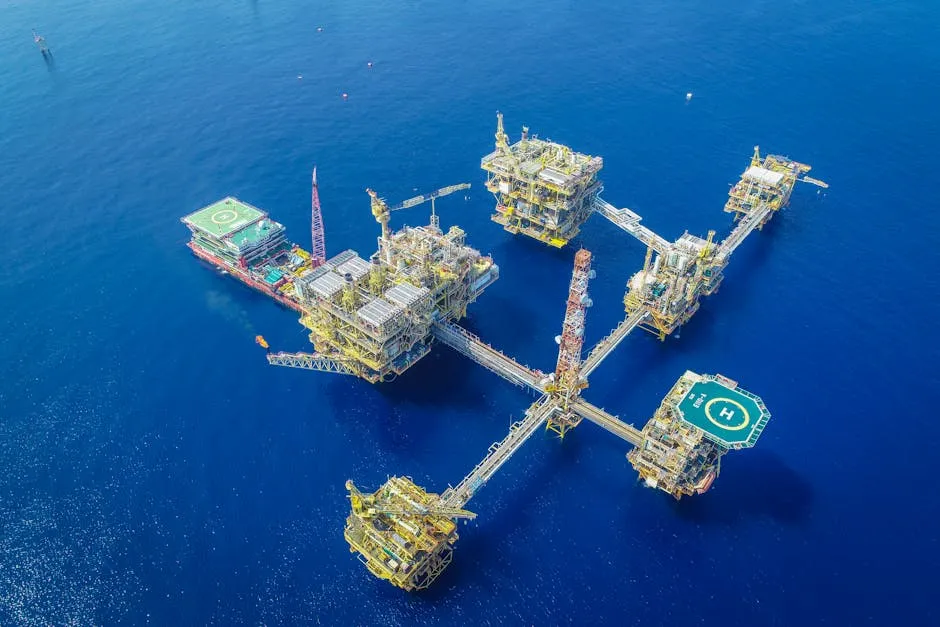
"An offshore oil platform extracting petroleum from deep seabed deposits." Image by Aron Razif / Pexels.
Petroleum is a fossil fuel that forms from the remains of ancient marine organisms. This process takes millions of years and requires specific conditions deep beneath Earth's surface. The petroleum we pump from underground wells today began as microscopic life in ancient oceans hundreds of millions of years ago.
The formation of petroleum begins with marine microorganisms such as plankton and algae that live in ocean waters. When these tiny organisms die, their bodies sink to the ocean floor. Over time, layers of sediment like mud and sand cover the dead organisms. This sediment protects the organic matter from being completely broken down by bacteria and oxygen. The layers continue to build up, with newer sediment burying older material deeper and deeper.
As millions of years pass, the weight of accumulating sediment creates enormous pressure on the buried organic matter. This pressure, combined with heat from Earth's interior, begins to transform the material. The temperature typically needs to reach between 50 and 150 degrees Celsius for petroleum to form. At these temperatures, the complex molecules in the dead organisms break apart and rearrange into simpler hydrocarbon molecules. Hydrocarbons are compounds made only of hydrogen and carbon atoms, and they form the basis of petroleum.
The transformation process occurs within sedimentary rocks that form from the compressed sediment layers. Not all organic matter becomes petroleum. If temperatures get too high, the organic matter may become natural gas instead, or if temperatures are too low, it may remain as a waxy substance. The conditions must be just right. The petroleum that forms is less dense than water and can migrate through tiny pores in the rock, moving upward through permeable layers.
For petroleum to accumulate in useful quantities, it must become trapped in underground formations. Reservoir rocks with many pores can hold petroleum like a sponge holds water. Above these reservoir rocks, cap rocks made of impermeable materials like shale prevent the petroleum from escaping to the surface. These geological traps can hold petroleum for millions of years until humans drill wells to extract it. The petroleum we use today for gasoline, plastics, and other products represents solar energy captured by ancient organisms and stored in chemical bonds.
Understanding petroleum formation helps scientists locate new oil deposits and explains why petroleum is a non-renewable resource. Since the process takes millions of years, we cannot create new petroleum on human timescales. The petroleum deposits we use today formed during specific periods in Earth's history when conditions were ideal for preservation and transformation of marine organisms.
Interesting Fact: Most of the world's petroleum formed during two specific time periods: the Jurassic Period (about 150 million years ago) and the Cretaceous Period (about 90 million years ago), when Earth's oceans were particularly rich with marine life.
Comprehension quiz (10 questions)
1. What are the main organisms that petroleum forms from?
2. What protects dead marine organisms from being completely broken down?
3. What temperature range is needed for petroleum to form?
4. What are hydrocarbons made of?
5. Why can petroleum move upward through rock layers?
6. What is the function of cap rocks in petroleum formation?
7. If temperatures are too high during petroleum formation, what forms instead?
8. Why is petroleum considered a non-renewable resource?
9. True or False: Petroleum formation takes only a few thousand years.
10. True or False: Reservoir rocks hold petroleum in their pores like a sponge holds water.
Perfect for the way you teach
- Build comprehension skills
- Auto-graded quiz
- Differentiated reading
- Read together at home
- Improve fluency
- Quiet reading time
- Reading curriculum support
- Independent practice
- Track Lexile growth