How Do Uranium Deposits Form
Interactive passage with audio narration, comprehension questions, and printable PDF.
By completing this purchase you agree to our Terms of Use and Privacy Policy. Your subscription renews automatically until you cancel. You can cancel anytime from your account settings. All sales are final and non-refundable. Digital content is available for download in your account immediately upon purchase.
What's included
How Do Uranium Deposits Form preview and details
About this printable How Do Uranium Deposits Form science reading passage, NGSS-aligned (Grades 6-8)
Sample passage and quiz from How Do Uranium Deposits Form
Reading passage and comprehension quiz preview
How Do Uranium Deposits Form
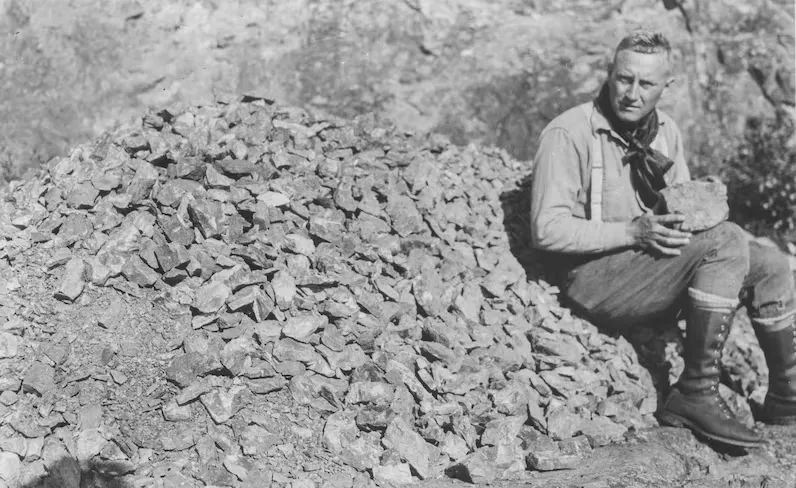
"Gilbert Labine examining uranium ore at the Eldorado Mine located at Great Bear Lake, Northwest Territories" by Wilfred Leigh Brintnell / Wikimedia Commons
Uranium is a naturally occurring radioactive element found in Earth's crust, but it does not distribute evenly across all rock types. Instead, uranium concentrates in specific rocks, particularly granitic rocks and hydrothermal deposits. Understanding why uranium accumulates in these locations requires examining geological processes that have operated over billions of years.
The story of uranium concentration begins deep underground where molten rock, called magma, forms beneath Earth's surface. Magma contains many different elements mixed together in a hot liquid state. As magma slowly cools, minerals begin to form through a process called crystallization. Different minerals crystallize at different temperatures, and this sequence matters greatly for uranium distribution. Early-forming minerals, such as olivine and pyroxene, generally do not incorporate uranium atoms into their crystal structures because uranium atoms are too large to fit comfortably. As these minerals solidify and separate from the remaining liquid magma, the uranium stays behind in the liquid portion.
As cooling continues, the remaining magma becomes increasingly enriched in uranium and other elements that did not fit into the early minerals. Eventually, this uranium-rich magma crystallizes into granitic rocks, which are light-colored rocks composed mainly of quartz, feldspar, and mica. Granite forms the foundation of continents and contains significantly more uranium than darker rocks like basalt. The average granite contains about 4 parts per million uranium, while basalt typically contains less than 1 part per million. This difference exists because of the crystallization sequence that separates compatible elements from incompatible elements like uranium.
Hydrothermal deposits represent another important concentration mechanism for uranium. These deposits form when hot, mineral-rich fluids move through cracks and fractures in rocks. The fluids, heated by magma or by Earth's internal heat, dissolve uranium from surrounding rocks as they travel. When these hydrothermal fluids encounter changes in temperature, pressure, or chemical conditions, uranium minerals precipitate out of solution and accumulate in concentrated zones. Some of the world's richest uranium deposits formed this way, with uranium minerals filling fractures and creating veins within rocks.
The element uranium itself contributes to its own concentration through radioactive decay. Uranium atoms slowly break down over billions of years, releasing energy and transforming into other elements. This decay process generates heat within rocks, which can drive further fluid circulation and uranium redistribution. Additionally, when uranium decays, it produces daughter isotopes like thorium and radium, which also concentrate in uranium-rich rocks. Scientists use these decay products to determine the age of rocks and understand geological history.
The uneven distribution of uranium in Earth's crust has practical implications for human society. Uranium serves as fuel for nuclear power plants and has various industrial and medical applications. Geologists search for uranium deposits by understanding the geological processes that concentrate this element. They look for granitic rocks, ancient hydrothermal systems, and specific geological settings where uranium concentration was likely. This knowledge connects directly to resource management and energy planning, as societies must understand where natural resources exist and how they formed to use them responsibly.
Interesting Fact: The oldest known uranium deposit on Earth formed approximately 2 billion years ago in Oklo, Gabon, Africa, where natural nuclear fission reactions occurred spontaneously when uranium concentrations and groundwater conditions were just right.
Comprehension quiz (10 questions)
1. What are the two main types of rocks where uranium concentrates?
2. Why does uranium remain in liquid magma when early minerals like olivine and pyroxene form?
3. What does the term 'crystallization' mean in the context of this passage?
4. What is the approximate uranium content in average granite compared to basalt?
5. Based on the passage, what can be inferred about why geologists look for granitic rocks when searching for uranium deposits?
6. How do hydrothermal fluids contribute to uranium concentration?
7. What role does radioactive decay play in uranium concentration?
8. Which statement best explains why understanding uranium distribution is important for society?
9. True or False: Uranium distributes evenly across all rock types in Earth's crust.
10. True or False: The oldest known uranium deposit formed approximately 2 billion years ago in Oklo, Gabon, Africa, where natural nuclear fission reactions occurred.
Perfect for the way you teach
- Build comprehension skills
- Auto-graded quiz
- Differentiated reading
- Read together at home
- Improve fluency
- Quiet reading time
- Reading curriculum support
- Independent practice
- Track Lexile growth