How Scientists Monitor Volcanoes — Reading Comprehension
Rate this
Premium Resource
Present
Present in classroom. No work saved
Assign
Classroom with student accounts, Track progress
Quick Play
No student accounts, assign with a link
Grades
3
4
5
Standards
NGSS 4-ESS3-2
PRINT+DIGITAL RESOURCE
This learning resource is available in interactive and printable formats. The interactive worksheet can be played online and assigned to students. The Printable PDF version can be downloaded and printed for completion by hand.
This engaging 250-word reading passage introduces fourth-grade students to the important work of volcano monitoring, aligned with NGSS standard 4-ESS3-2 (ESS3.B: Natural Hazards). Students discover how scientists use seismometers to detect underground earthquakes, measure changes in volcano shape, monitor gases, and track temperature changes. The passage emphasizes that while monitoring cannot stop eruptions, it provides critical warning time for communities to evacuate safely. Audio-integrated content supports diverse learners with read-aloud functionality. The passage includes age-appropriate vocabulary with bold key terms, real-world applications, and relatable examples. Supplementary activities include multiple-choice comprehension questions testing recall and application, short-answer writing prompts requiring explanation and connection-making, and graphic organizers for analyzing cause-and-effect relationships. A simplified differentiated version ensures accessibility for students reading below grade level. Spanish translations of both versions support English language learners. This comprehensive resource builds foundational understanding of how science and technology help reduce natural hazard impacts on human populations.
CONTENT PREVIEW
Expand content preview
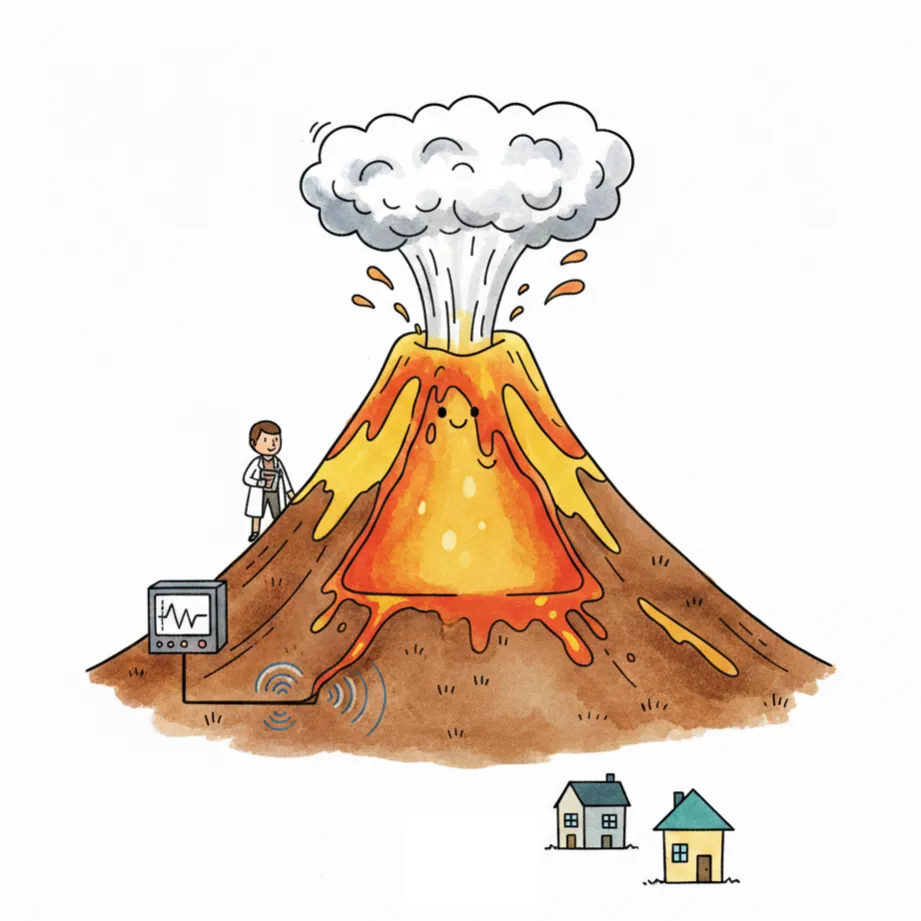
Scientists study volcanoes to predict eruptions and protect lives.
Volcanoes are openings in Earth's surface where hot, melted rock can escape from underground. Scientists study volcanoes carefully to predict when they might erupt. Monitoring volcanoes helps protect people who live nearby by giving them time to move to safety.
Scientists use a tool called a seismometer to watch for small earthquakes. A seismometer is an instrument that detects and measures ground movement. When melted rock, called magma, moves underground, it causes tiny earthquakes. These earthquakes tell scientists that magma is rising toward the surface.
Another important sign is when a volcano changes shape. Scientists use special instruments to measure if a volcano is swelling or bulging. A volcano that is getting bigger may be filling with magma and could erupt soon. This is like a balloon filling with air—when it gets too full, something has to give.
Scientists also check the gases coming out of a volcano and measure temperature changes. When more gas escapes or the temperature rises, an eruption may be coming. An eruption happens when magma, gases, and ash burst out of a volcano.
When scientists see warning signs, they alert communities so people can evacuate, or leave the area and go somewhere safe. Monitoring does not stop eruptions, but it saves lives by giving people time to escape danger.
Interesting Fact: The island of Hawaii has some of the most closely watched volcanoes in the world, with scientists checking them 24 hours a day, 7 days a week!
What does a seismometer detect?
Ground movement and earthquakesTemperature changes onlyGas coming from volcanoesChanges in weather patterns
What is magma?
Cold rock on Earth's surfaceHot, melted rock undergroundGas from a volcanoAsh from an eruption
What does it mean when a volcano swells?
It is getting smallerIt is cooling downIt is filling with magmaIt will never erupt
Why do scientists alert communities about eruptions?
To stop the volcano from eruptingSo people have time to evacuateTo make the volcano smallerTo cool down the magma
What causes tiny earthquakes near a volcano?
People walking on the groundRain falling on the volcanoMagma moving undergroundWind blowing across the surface
How is a swelling volcano like a balloon?
Both float in the airBoth fill up until something givesBoth are made of rubberBoth are the same color
Monitoring volcanoes can stop eruptions from happening.
TrueFalse
What does evacuate mean?
To stay in one placeTo leave and go somewhere safeTo watch a volcano eruptTo measure ground movement
Perfect For:
👩🏫 Teachers
• Reading comprehension practice
• Auto-graded assessments
• Literacy skill development
👨👩👧👦 Parents
• Reading practice at home
• Comprehension improvement
• Educational reading time
🏠 Homeschoolers
• Reading curriculum support
• Independent reading practice
• Progress monitoring
Reading Features:
📖
Reading Passage
Engaging fiction or nonfiction text
❓
Comprehension Quiz
Auto-graded questions
📊
Instant Feedback
Immediate results and scoring
📄
Printable Version
Download for offline reading
🔊
Read Aloud
Voice-over with word highlighting
Reviews & Ratings
No reviews yet. Be the first to share your experience!
Related Content
What Are Tsunamis
This Grade 4 science reading passage introduces students to tsunamis, aligning with NGSS standard 4-ESS3-2. Students lea...
NGSS 4-ESS3-2
How Tsunamis Affect People
This engaging 250-word reading passage introduces fourth-grade students to the devastating impacts of tsunamis on coasta...
NGSS 4-ESS3-2
What Are Avalanches
This engaging 250-word reading passage introduces fourth-grade students to avalanches and their impact on mountain commu...
NGSS 4-ESS3-2
Landslides
This engaging 350-word reading passage introduces Grade 4-5 students to landslides as powerful natural events where soil...
NGSS 4-ESS3-2
What Are Earthquakes
This engaging 250-word reading passage introduces fourth-grade students to the concept of earthquakes as natural hazards...
NGSS 4-ESS3-2
How Earthquakes Affect People
This 250-word informational reading passage introduces Grade 4 students to the ways earthquakes affect people and commun...
NGSS 4-ESS3-2ESS3.B
What Are Volcanoes
This engaging 250-word reading passage introduces fourth-grade students to volcanoes and volcanic activity, aligned with...
NGSS 4-ESS3-2
How Volcanoes Affect People
This 250-word reading passage introduces fourth-grade students to the ways volcanic eruptions affect people and communit...
NGSS 4-ESS3-2
What Are Weather Hazards
This Grade 4 science reading passage introduces students to weather hazards as part of the NGSS 4-ESS3-2 standard focusi...
NGSS 4-ESS3-2ESS3.B
What Are Tornadoes
This engaging Grade 4 science reading passage introduces students to tornadoes, one of nature's most powerful and danger...
NGSS 4-ESS3-2
What Are Hurricanes
This Grade 4 science reading passage introduces students to hurricanes and their impact on coastal communities, aligned ...
NGSS 4-ESS3-2
What Are Floods
This engaging 250-word reading passage introduces fourth-grade students to floods as natural hazards, aligned with NGSS ...
NGSS 4-ESS3-2
What Are Wildfires
This 250-word reading passage explains what wildfires are and introduces Grade 4 students to key concepts about these na...
NGSS 4-ESS3-2
What Are Droughts
This 250-word reading passage introduces fourth-grade students to the concept of droughts as defined in NGSS 4-ESS3-2. S...
NGSS 4-ESS3-2
What Are Natural Hazards
This audio-integrated reading passage introduces fourth-grade students to natural hazards as part of the NGSS 4-ESS3-2 s...
NGSS 4-ESS3-2ESS3.B
Why We Cannot Stop Natural Hazards
This 250-word reading passage introduces fourth-grade students to the concept that natural hazards are caused by natural...
NGSS 4-ESS3-2
Reducing Natural Hazard Impacts
This Grade 4 science reading passage introduces students to the concept of reducing natural hazard impacts, aligned with...
NGSS 4-ESS3-2
How Buildings Resist Earthquakes
This 250-word reading passage introduces fourth-grade students to earthquake-resistant building design, aligned with NGS...
NGSS 4-ESS3-2
How Tsunami Warnings Work
This engaging 250-word reading passage introduces fourth-grade students to tsunami warning systems and how they protect ...