How Cities Create Heat Islands — Reading Comprehension
Rate this
Premium Resource
Present
Present in classroom. No work saved
Assign
Classroom with student accounts, Track progress
Quick Play
No student accounts, assign with a link
Grades
6
7
8
Standards
MS-ESS3-3
PRINT+DIGITAL RESOURCE
This learning resource is available in interactive and printable formats. The interactive worksheet can be played online and assigned to students. The Printable PDF version can be downloaded and printed for completion by hand.
This comprehensive 650-word passage explores the urban heat island effect for middle school students in grades 6-8. Students learn how cities create localized areas of higher temperatures compared to surrounding rural regions through three main mechanisms: dark surfaces with low albedo that absorb solar radiation, reduced vegetation that limits evaporative cooling, and waste heat from human activities. The passage connects these concepts to real-world impacts including human health risks, increased energy consumption, and local climate modification. Aligned with NGSS standard MS-ESS3-3, this audio-integrated reading helps students understand how human activities influence natural systems and provides context for evaluating solutions to reduce urban heat islands. The passage includes practical examples, scientific vocabulary in context, and applications to environmental problem-solving, making it ideal for science curriculum focused on human impacts on Earth systems.
CONTENT PREVIEW
Expand content preview
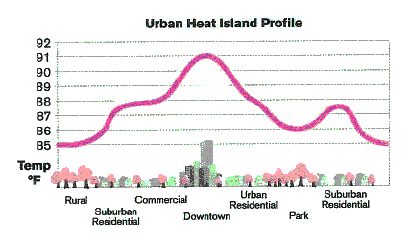
Cities are often several degrees warmer than the countryside surrounding them. Urban heat island profile by National Oceanic and Atmospheric Administration / Wikimedia Commons
Cities are often several degrees warmer than the countryside surrounding them. This phenomenon is called the urban heat island effect. An urban heat island forms when a city absorbs and retains more thermal energy than nearby rural areas. The temperature difference can range from 2 to 10 degrees Fahrenheit, with the greatest differences occurring at night. Understanding why cities trap heat helps us address problems related to human health, energy use, and local climate.
Dark surfaces are the primary cause of urban heat islands. Cities contain large amounts of asphalt, concrete, and dark roofing materials. These surfaces have low albedo, which means they reflect very little sunlight and absorb most of it instead. When surfaces absorb solar radiation, they convert light energy into heat. During the day, dark city surfaces can reach temperatures 50 to 90 degrees Fahrenheit hotter than the air around them. These heated surfaces then release their stored thermal energy slowly throughout the evening, keeping cities warm long after sunset.
Vegetation plays a critical cooling role that cities often lack. Plants cool the air through evapotranspiration, a process where water evaporates from leaves and soil. This evaporation requires energy, which comes from heat in the surrounding air. Rural areas with abundant trees, grass, and crops benefit from this natural air conditioning. Cities, however, replace vegetation with buildings and pavement. A typical city block might have only 10 to 20 percent vegetation cover, compared to 70 to 90 percent in rural areas. Without plants to provide evaporative cooling, city air stays warmer.
Human activities generate additional heat that intensifies urban heat islands. Buildings, vehicles, and industrial processes all release waste heat as a byproduct of energy use. Air conditioners remove heat from buildings and pump it outside, warming the outdoor air. Cars and trucks release heat from their engines and exhaust systems. Even the electricity flowing through power lines generates some heat. In densely populated cities, this waste heat can raise air temperatures by 2 to 3 degrees Fahrenheit on its own.
The urban heat island effect creates serious consequences for city residents. Higher temperatures increase the risk of heat-related illness, particularly for elderly people, children, and those with health conditions. During heat waves, cities experience more deaths than surrounding areas. Urban heat islands also drive up energy consumption because people use more air conditioning to stay comfortable. This creates a feedback loop: more air conditioning means more electricity use, which produces more waste heat and greenhouse gases. Additionally, warmer cities can alter local weather patterns, sometimes increasing the intensity of thunderstorms.
Scientists and city planners are developing strategies to reduce urban heat islands. Installing cool roofs with light-colored or reflective materials increases albedo and reduces heat absorption. Planting trees along streets and creating parks adds vegetation that cools through evapotranspiration. Some cities are even painting streets with light-colored pavement coatings. These solutions demonstrate how understanding the science of heat islands helps communities modify their local climate and improve quality of life.
Interesting Fact: Tokyo, Japan, has reduced temperatures in some neighborhoods by up to 3 degrees Fahrenheit by painting roads with special heat-reflective paint and installing misting systems that mimic evaporative cooling.
What is the urban heat island effect?
When cities are cooler than rural areasWhen cities absorb and retain more heat than surrounding rural areasWhen islands near cities become warmerWhen rural areas trap more heat than cities
Why do dark surfaces in cities contribute to higher temperatures?
They have high albedo and reflect most sunlightThey produce their own heatThey have low albedo and absorb most sunlight, converting it to heatThey block sunlight from reaching the ground
What does the term 'albedo' mean?
The amount of heat a surface producesThe measure of how much sunlight a surface reflectsThe temperature of a surfaceThe color of a surface
How do plants help cool the air in rural areas?
By blocking sunlight with their leavesBy producing oxygenThrough evapotranspiration, where water evaporates from leaves and soilBy absorbing heat into their roots
Which human activity generates waste heat that intensifies urban heat islands?
Planting treesUsing air conditioners, driving vehicles, and running industrial processesPainting roofs whiteCreating parks
What is one serious consequence of the urban heat island effect on human health?
Decreased risk of illnessImproved air qualityIncreased risk of heat-related illness, especially for elderly and childrenLower energy costs
How can cool roofs help reduce urban heat islands?
By absorbing more heatBy using light-colored or reflective materials that increase albedo and reduce heat absorptionBy trapping heat inside buildingsBy blocking all sunlight
What creates a feedback loop in urban heat islands related to energy use?
Planting more trees leads to cooler temperaturesMore air conditioning use increases electricity consumption, producing more waste heat and greenhouse gasesPainting streets white reduces temperaturesRural areas become warmer
Cities have significantly more vegetation cover than rural areas.
TrueFalse
The greatest temperature differences between cities and rural areas occur during the daytime.
TrueFalse
Perfect For:
👩🏫 Teachers
• Reading comprehension practice
• Auto-graded assessments
• Literacy skill development
👨👩👧👦 Parents
• Reading practice at home
• Comprehension improvement
• Educational reading time
🏠 Homeschoolers
• Reading curriculum support
• Independent reading practice
• Progress monitoring
Reading Features:
📖
Reading Passage
Engaging fiction or nonfiction text
❓
Comprehension Quiz
Auto-graded questions
📊
Instant Feedback
Immediate results and scoring
📄
Printable Version
Download for offline reading
🔊
Read Aloud
Voice-over with word highlighting
Reviews & Ratings
No reviews yet. Be the first to share your experience!
Related Content
Natural Disaster: Volcanic Eruptions
Volcanoes can erupt with lava and ash, changing the landscape. While dangerous, they also create fertile land and new la...
RI.3.1RI.4.4RI.4.2RI.5.2
Human Impacts: Pollution
This middle school science reading passage, aligned with NGSS standards MS-LS2-4 and MS-ESS3-3, examines the mechanisms ...
MS-LS2-4MS-ESS3-3
Human Impacts: Habitat Destruction
This grade 6-8 science passage explores human impacts on ecosystems, focusing on habitat destruction as the leading caus...
MS-LS2-4MS-LS2-5MS-ESS3-3
Ecosystem Services
This engaging middle school science passage introduces students to the concept of ecosystem services, the vital benefits...
MS-LS2-5MS-ESS3-3
Environmental Problems and Solutions
This passage for grades 6-8 introduces major environmental problems such as habitat loss, pollution, climate change, inv...
MS-LS2-4MS-ESS3-3MS-ESS3-4
Remote Sensing
This middle school science passage introduces students to the concept of remote sensing—the collection of information ab...
MS-ESS3-3MS-PS4-2MS-ETS1-1MS-ETS1-3
Geographic Information Systems (GIS)
This engaging middle school science passage introduces students to Geographic Information Systems (GIS), aligning with N...
MS-ESS3-3MS-ETS1-1MS-ETS1-2MS-ETS1-3
Renewable vs. Nonrenewable Energy
This engaging passage, aligned with NGSS standards MS-PS3-4, MS-ESS3-3, and MS-ESS3-4, helps middle school students diff...
MS-PS3-4MS-ESS3-3MS-ESS3-4
Fossil Fuels: Coal
This middle school science reading passage explores the science behind coal, a major fossil fuel. Students will learn ho...
MS-PS3-4MS-ESS3-3MS-ESS3-4
Solar Energy
This engaging passage for grades 6-8 explores the science of solar energy, focusing on how sunlight is converted into el...
MS-PS3-4MS-ESS3-3MS-ESS3-4
Wind Energy
This comprehensive middle school science passage explores the scientific principles behind wind energy and how wind turb...
MS-PS3-4MS-ESS3-3MS-ESS3-4
Hydroelectric Energy
This comprehensive passage introduces middle school students to the science behind hydroelectric energy, directly aligni...
MS-PS3-4MS-ESS3-3MS-ESS3-4
Geothermal Energy
This comprehensive science passage introduces middle school students to the mechanisms and applications of geothermal en...
MS-PS3-4MS-ESS3-3MS-ESS3-4
Biomass and Biofuels
This NGSS-aligned passage introduces grades 6-8 students to the science of biomass and biofuels, explaining how organic ...
MS-PS3-4MS-ESS3-3MS-ESS3-4
Nuclear Energy as a Resource
This NGSS-aligned informational science passage, designed for grades 6-8, explores nuclear energy as a resource in the c...
MS-PS3-4MS-ESS3-3MS-ESS3-4
Water Quality
This middle school science reading passage covers the topic of water quality, aligned with NGSS standards MS-ESS3-1 and ...
MS-ESS3-1MS-ESS3-3
Florida Everglades
This comprehensive passage introduces middle school students to the Florida Everglades, a distinctive wetland ecosystem ...
MS-LS2-1MS-LS2-4MS-ESS3-3MS-ESS3-4
Congo Rainforest
This middle school science passage explores the Congo Rainforest—Earth’s second-largest rainforest, located in Central A...
MS-LS2-1MS-ESS3-3
Nuclear Power Plants
This comprehensive reading passage introduces middle school students (grades 6-8) to the science of nuclear power plants...
MS-PS3-4MS-ESS3-3
Nuclear Safety and Waste
This middle school science passage explores the critical topic of nuclear safety and waste management, aligned with NGSS...