How Do Birth and Death Rates Shape Population — Reading Comprehension
Rate this
Premium Resource
Present
Present in classroom. No work saved
Assign
Classroom with student accounts, Track progress
Quick Play
No student accounts, assign with a link
Grades
6
7
8
Standards
MS-ESS3-4
PRINT+DIGITAL RESOURCE
This learning resource is available in interactive and printable formats. The interactive worksheet can be played online and assigned to students. The Printable PDF version can be downloaded and printed for completion by hand.
This comprehensive middle school science passage examines how birth and death rates affect population dynamics, aligned with NGSS standard MS-ESS3-4. Students explore the concepts of birth rate, death rate, and natural increase to understand whether populations grow, shrink, or stabilize. The passage connects demographic transitions to resource consumption patterns across different world regions, helping students understand how developed and developing nations experience different population growth stages. Through real-world examples and clear explanations, learners discover how migration impacts population size and why some countries face rapid growth while others see declining populations. The audio-integrated content includes differentiated versions for struggling readers, Spanish translations, comprehension activities, and graphic organizers to reinforce understanding of these critical environmental science concepts.
CONTENT PREVIEW
Expand content preview
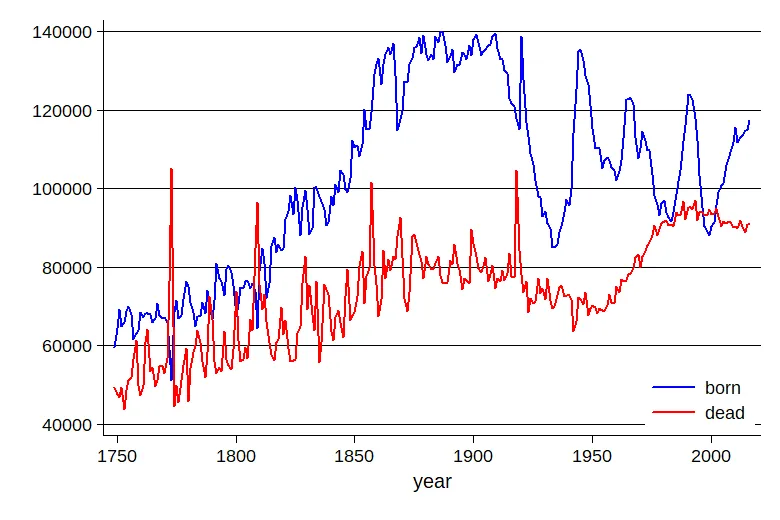
"2017 Sweden Death and birth rates 1735-2016-en" by Moralist / Wikimedia Commons
A population is all the individuals of one species living in a specific area. The size of any population changes over time based on three main factors: births, deaths, and migration. Understanding these factors helps scientists predict how populations will change and what resources they will need.
The birth rate measures how many babies are born per 1,000 people in one year. The death rate measures how many people die per 1,000 people in one year. When the birth rate is higher than the death rate, the population grows. When the death rate is higher than the birth rate, the population shrinks. The difference between these two rates is called natural increase. For example, if a country has a birth rate of 25 per 1,000 and a death rate of 10 per 1,000, the natural increase is 15 per 1,000, meaning the population is growing.
Migration is the third factor that affects population size. Migration occurs when people move into or out of an area. Immigration means people moving into a region, which increases the population. Emigration means people moving out of a region, which decreases the population. A country might have a low natural increase but still grow rapidly if many people immigrate there.
Different regions of the world experience different patterns of population change called demographic transitions. In many developing countries, birth rates remain high while death rates have decreased due to better healthcare and nutrition. This creates rapid population growth. In developed countries, both birth rates and death rates are typically low, leading to slow growth or even population decline. Japan, for instance, has more deaths than births each year, causing its population to shrink.
Population growth directly affects resource consumption. Resources include water, food, energy, and living space. Countries with rapidly growing populations often struggle to provide enough resources for everyone. A country with 2% annual population growth will double its population in about 35 years, requiring twice as much food, water, and energy. Developed countries with stable populations may consume more resources per person but grow more slowly. Understanding these patterns helps governments plan for housing, schools, hospitals, and environmental protection.
Population changes also create different age structures. Countries with high birth rates have many young people, while countries with low birth rates have aging populations. An aging population means fewer workers to support more retired people. This affects economic growth and the types of services a country needs to provide.
Interesting Fact: If current trends continue, Nigeria's population will exceed 400 million by 2050, while Japan's population will shrink by about 25 million people during the same period.
What is the natural increase if a country has a birth rate of 30 per 1,000 and a death rate of 12 per 1,000?
18 per 1,00042 per 1,00012 per 1,00030 per 1,000
Which term describes people moving OUT of a region?
According to the passage, what happens to a population when the death rate is higher than the birth rate?
The population grows rapidlyThe population stays the sameThe population shrinksThe population doubles
What does 'resource consumption' mean in the passage?
The movement of people between countriesThe difference between birth and death ratesThe use of water, food, energy, and living spaceThe number of babies born each year
Why do many developing countries experience rapid population growth?
Birth rates are low and death rates are highBirth rates are high and death rates have decreasedMore people are emigrating than immigratingBoth birth and death rates are very low
If a country's population grows at 2% per year, approximately how long will it take to double?
10 years20 years35 years50 years
What is one effect of an aging population mentioned in the passage?
More workers to support retired peopleRapid population growthFewer workers to support more retired peopleIncreased birth rates
A country can have low natural increase but still grow rapidly if many people immigrate there.
TrueFalse
Japan's population is growing rapidly because it has more births than deaths each year.
TrueFalse
Based on the passage, which statement best describes the relationship between population growth and resources?
Population growth has no effect on resource needsRapidly growing populations require more resourcesShrinking populations need more resources than growing onesAll countries consume the same amount of resources
Perfect For:
👩🏫 Teachers
• Reading comprehension practice
• Auto-graded assessments
• Literacy skill development
👨👩👧👦 Parents
• Reading practice at home
• Comprehension improvement
• Educational reading time
🏠 Homeschoolers
• Reading curriculum support
• Independent reading practice
• Progress monitoring
Reading Features:
📖
Reading Passage
Engaging fiction or nonfiction text
❓
Comprehension Quiz
Auto-graded questions
📊
Instant Feedback
Immediate results and scoring
📄
Printable Version
Download for offline reading
🔊
Read Aloud
Voice-over with word highlighting
Reviews & Ratings
No reviews yet. Be the first to share your experience!
Related Content
Natural Disaster: Tornadoes
Tornadoes are dangerous spinning columns of air. Knowing the signs and having safety plans can help protect you from the...
RI.3.1RI.4.4RI.4.2RI.5.2
Conservation Strategies
This comprehensive passage introduces students in grades 6-8 to the major strategies used in conservation biology, such ...
MS-LS2-5MS-ESS3-4
Environmental Problems and Solutions
This passage for grades 6-8 introduces major environmental problems such as habitat loss, pollution, climate change, inv...
MS-LS2-4MS-ESS3-3MS-ESS3-4
Sustainability and Individual Action
This reading passage for grades 6-8 introduces the concept of sustainability, defined as meeting current needs without c...
MS-ESS3-4
Restoration Ecology
This passage introduces middle school students to the vital field of restoration ecology, aligning with NGSS standards M...
MS-LS2-4MS-ESS3-4
Climate Change: Solutions and Mitigation
This passage explores scientific solutions and mitigation strategies for climate change, designed for middle school scie...
MS-ESS3-4MS-ESS3-5
Renewable vs. Nonrenewable Energy
This engaging passage, aligned with NGSS standards MS-PS3-4, MS-ESS3-3, and MS-ESS3-4, helps middle school students diff...
MS-PS3-4MS-ESS3-3MS-ESS3-4
Fossil Fuels: Coal
This middle school science reading passage explores the science behind coal, a major fossil fuel. Students will learn ho...
MS-PS3-4MS-ESS3-3MS-ESS3-4
Solar Energy
This engaging passage for grades 6-8 explores the science of solar energy, focusing on how sunlight is converted into el...
MS-PS3-4MS-ESS3-3MS-ESS3-4
Wind Energy
This comprehensive middle school science passage explores the scientific principles behind wind energy and how wind turb...
MS-PS3-4MS-ESS3-3MS-ESS3-4
Hydroelectric Energy
This comprehensive passage introduces middle school students to the science behind hydroelectric energy, directly aligni...
MS-PS3-4MS-ESS3-3MS-ESS3-4
Soil Conservation
This passage for grades 6-8 explains soil conservation, aligning with NGSS standard MS-ESS3-4. Students will learn about...
MS-ESS3-4
Minerals and Rocks as Resources
This middle school science passage, aligned to NGSS standards MS-ESS3-1 and MS-ESS3-4, explores the critical role that m...
MS-ESS3-1MS-ESS3-4
Galápagos Islands
This engaging science passage explores the Galápagos Islands, a volcanic archipelago located off the coast of Ecuador in...
MS-LS2-1MS-LS4-4MS-ESS3-4
Geothermal Energy
This comprehensive science passage introduces middle school students to the mechanisms and applications of geothermal en...
MS-PS3-4MS-ESS3-3MS-ESS3-4
Biomass and Biofuels
This NGSS-aligned passage introduces grades 6-8 students to the science of biomass and biofuels, explaining how organic ...
MS-PS3-4MS-ESS3-3MS-ESS3-4
Nuclear Energy as a Resource
This NGSS-aligned informational science passage, designed for grades 6-8, explores nuclear energy as a resource in the c...
MS-PS3-4MS-ESS3-3MS-ESS3-4
Water as a Resource
This middle school science passage examines water as a critical resource, focusing on how it is used, managed, and conse...
MS-ESS3-1MS-ESS3-4
Florida Everglades
This comprehensive passage introduces middle school students to the Florida Everglades, a distinctive wetland ecosystem ...
MS-LS2-1MS-LS2-4MS-ESS3-3MS-ESS3-4
Nuclear Safety and Waste
This middle school science passage explores the critical topic of nuclear safety and waste management, aligned with NGSS...