Reading Passage

How Do Plate Boundaries Differ

Interactive passage with audio narration, comprehension questions, and printable PDF.

No ratings yet
Grades 5–8ScienceElaEnglish · SpanishInteractive · Printable
Aligned toMS-ESS2-2

What's included

Reading passage
Audio narration
Comprehension quiz
Writing activity
Glossary & flashcards
Differentiated version
Spanish translation

How Do Plate Boundaries Differ preview and details

About this printable How Do Plate Boundaries Differ science reading passage, NGSS-aligned (Grades 5-8)

This comprehensive 400-500 word reading passage for grades 6-8 explains how plate boundaries differ based on the direction of plate movement. Students learn about divergent boundaries where plates move apart and new crust forms, convergent boundaries where plates collide and crust is destroyed or folded, and transform boundaries where plates slide past each other. The passage is aligned to NGSS MS-ESS2-2 and the Disciplinary Core Idea MS-ESS2.B: Plate Tectonics and Large-Scale System Interactions. The lesson includes audio integration, vocabulary development with 8-10 key science terms, a simplified differentiated version for struggling readers and English Language Learners, Spanish translations, multiple-choice comprehension questions, writing activities, and graphic organizers. Students explore real-world examples and learn to predict geological features at different boundary types, building foundational understanding of Earth's dynamic surface processes.
Written by Workybooks TeamPublished by Workybooks
Preview

Sample passage and quiz from How Do Plate Boundaries Differ

Reading passage and comprehension quiz preview

How Do Plate Boundaries Differ
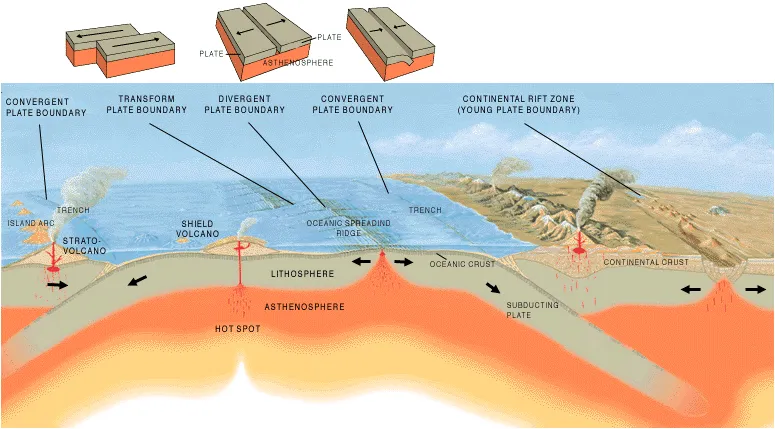
Tectonic plate boundaries

"Tectonic plate boundaries" by Jose F. Vigil. USGS / Wikimedia Commons.

Earth's outer shell is broken into massive slabs called tectonic plates. These plates move slowly across the planet's surface. Where two plates meet, they form a plate boundary. Scientists have identified three main types of plate boundaries based on how the plates move relative to each other.

At divergent boundaries, plates move apart from each other. As the plates separate, hot magma rises from below to fill the gap. The magma cools and hardens, creating new crust. This process builds features like mid-ocean ridges on the seafloor. The Mid-Atlantic Ridge is a well-known example where the North American and Eurasian plates pull apart. On land, divergent boundaries can form rift valleys where the continent begins to split.

At convergent boundaries, plates move toward each other and collide. When this happens, crust can be destroyed or folded. If one plate is denser, it sinks beneath the other in a process called subduction. The sinking plate melts, and magma may rise to form volcanoes. The Pacific Plate subducts beneath the North American Plate along the coast of Alaska, creating the Aleutian volcanic chain. When two continental plates collide, neither subducts. Instead, the crust crumples upward to form massive mountain ranges like the Himalayas.

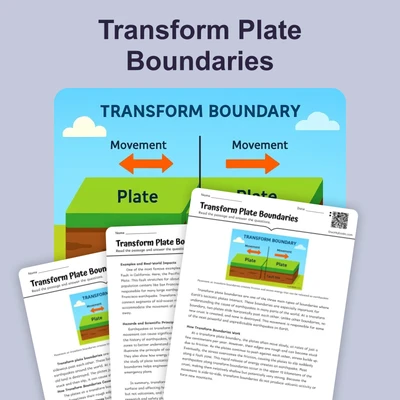
At transform boundaries, plates slide horizontally past each other. Crust is neither created nor destroyed at these boundaries. However, the plates can get stuck as they grind against each other. When the stress becomes too great, the plates suddenly slip, releasing energy as earthquakes. The San Andreas Fault in California is a transform boundary where the Pacific Plate slides past the North American Plate. Evidence shows that this fault produces frequent earthquakes.

Understanding plate boundaries helps scientists predict geological activity. Divergent boundaries build new crust and create ridges. Convergent boundaries destroy crust through subduction or fold it into mountains. Transform boundaries generate earthquakes as plates grind past each other. The direction of plate movement determines what features form and what hazards may occur.

Interesting Fact: The Mid-Atlantic Ridge is spreading at about 2.5 centimeters per year, roughly the same rate that your fingernails grow!

Comprehension quiz (10 questions)

1. What are the three main types of plate boundaries?

Divergent, convergent, and transform
Continental, oceanic, and volcanic
Subduction, collision, and separation
Horizontal, vertical, and diagonal

2. At divergent boundaries, what happens as plates move apart?

Mountains are formed
Earthquakes always occur
Magma rises to fill the gap and creates new crust
One plate sinks beneath the other

3. What is subduction?

When plates slide past each other horizontally
When one plate sinks beneath another plate
When magma rises to the surface
When two plates pull apart

4. Which boundary type is the San Andreas Fault in California?

Divergent boundary
Convergent boundary
Transform boundary
Subduction zone

5. Based on the passage, what geological feature forms when two continental plates collide at a convergent boundary?

Mid-ocean ridges
Rift valleys
Volcanic islands
Mountain ranges

6. Why do earthquakes commonly occur at transform boundaries?

Because new crust is being created
Because plates get stuck and then suddenly slip, releasing energy
Because magma is rising to the surface
Because one plate is sinking beneath another

7. If you wanted to find an area where new oceanic crust is being formed, which type of boundary would you look for?

Transform boundary
Convergent boundary
Divergent boundary
Subduction zone

8. A scientist observes a plate boundary where volcanoes are forming and one plate is sinking. What type of boundary is this most likely?

Divergent boundary
Transform boundary
Convergent boundary with subduction
Rift valley

9. True or False: At transform boundaries, crust is neither created nor destroyed.

True
False

10. True or False: The Mid-Atlantic Ridge is an example of a convergent boundary.

True
False
Who it's for

Perfect for the way you teach

Teachers
  • Build comprehension skills
  • Auto-graded quiz
  • Differentiated reading
Parents
  • Read together at home
  • Improve fluency
  • Quiet reading time
Homeschoolers
  • Reading curriculum support
  • Independent practice
  • Track Lexile growth
Topics

Reviews & Ratings

No reviews yet. Be the first to share your experience!

More reading you might love

20 more
Passage
Talus Slopes: Formation and Features - reading educational content
Grades 5–8

Talus Slopes: Formation and Features

science · MS-ESS2-1+2

Free
Passage
Stratigraphic Columns: Decoding Earth’s Geological Layers - reading educational content
Grades 5–8

Stratigraphic Columns: Decoding Earth’s Geological Layers

science · MS-ESS2-2+2

Free
Passage
Frost Wedging: How Ice Splits Rock - reading educational content
Grades 5–8

Frost Wedging: How Ice Splits Rock

earth and space science · MS-ESS2-1+2

$1.50
Passage
Chemical Weathering: The Breakdown of Rocks Through Chemical Reactions - reading educational content
Grades 5–8

Chemical Weathering: The Breakdown of Rocks Through Chemical Reactions

earth and space science · MS-ESS2-1+2

Free
Passage
What Is Space Weather and How Does It Affect the Earth? - reading educational content
Grades 3–7

What Is Space Weather and How Does It Affect the Earth?

earth and space science · MS-ESS2-2

$1.50
Passage
When Was The Last Ice Age - reading educational content
Grade 6

When Was The Last Ice Age

earth and space science · MS-ESS2-2

$1.50
Passage
Tools and Technology in Earth Science - reading educational content
Grades 5–8

Tools and Technology in Earth Science

science · MS-ESS2-2+4

$1.50
Passage
Maps and Mapping - reading educational content
Grades 5–8

Maps and Mapping

earth and space science · MS-ESS2-2

$1.50
Passage
Latitude and Longitude - reading educational content
Grades 5–8

Latitude and Longitude

earth and space science · MS-ESS2-2

$1.50
Passage
Topographic Maps - reading educational content
Grades 5–8

Topographic Maps

earth and space science · MS-ESS2-2+3

$1.50
Passage
Contour Lines and Elevation - reading educational content
Grades 5–8

Contour Lines and Elevation

earth and space science · MS-ESS2-2+3

$1.50
Passage
Maps and Their Uses - reading educational content
Grades 5–8

Maps and Their Uses

earth and space science · MS-ESS2-2+5

$1.50
Passage
Mountains and Mountain Building - reading educational content
Grades 5–8

Mountains and Mountain Building

earth and space science · MS-ESS2-1+1

$1.50
Passage
Earth's Interior - reading educational content
Grades 5–8

Earth's Interior

earth and space science · MS-ESS2-1+1

$1.50
Passage
Continental Drift Theory - reading educational content
Grades 5–8

Continental Drift Theory

earth and space science · MS-ESS2-2+1

Free
Passage
Seafloor Spreading - reading educational content
Grades 5–8

Seafloor Spreading

science · MS-ESS2-2+1

$1.50
Passage
Theory of Plate Tectonics - reading educational content
Grades 5–8

Theory of Plate Tectonics

earth and space science · MS-ESS2-2

$1.50
Passage
Divergent Plate Boundaries - reading educational content
Grades 5–8

Divergent Plate Boundaries

earth and space science · MS-ESS2-2

$1.50
Passage
Convergent Plate Boundaries - reading educational content
Grades 5–8

Convergent Plate Boundaries

earth and space science · MS-ESS2-2

$1.50
Passage
Transform Plate Boundaries - reading educational content
Grades 5–8

Transform Plate Boundaries

earth and space science · MS-ESS2-2

$1.50
Copyright © 2026 Workybooks Classroom. Made with ♥ in California.