How Do Silicate and Nonsilicate Minerals Differ — Reading Comprehension
Rate this
Premium Resource
Present
Present in classroom. No work saved
Assign
Classroom with student accounts, Track progress
Quick Play
No student accounts, assign with a link
Grades
6
7
8
Standards
MS-ESS3-1
PRINT+DIGITAL RESOURCE
This learning resource is available in interactive and printable formats. The interactive worksheet can be played online and assigned to students. The Printable PDF version can be downloaded and printed for completion by hand.
This comprehensive 650-word reading passage is designed for middle school students in grades 6-8 and explores the fundamental differences between silicate and nonsilicate minerals. The passage aligns with NGSS science standard MS-ESS3-1 and provides students with a clear understanding of how silicate minerals, built around silicon-oxygen tetrahedra, make up the most abundant mineral group in Earth's crust. Students will learn to contrast silicate minerals with nonsilicate minerals including carbonates, oxides, and sulfides, understanding their different compositions and where each group is commonly found in Earth's systems. The passage includes audio integration for enhanced accessibility, bold key vocabulary terms with definitions in context, and real-world examples that help students connect abstract concepts to concrete applications. Supplementary activities include multiple-choice questions, writing prompts, and graphic organizers that reinforce learning and assess comprehension at various depth-of-knowledge levels. This resource is ideal for earth science units focusing on minerals, rocks, and Earth's materials.
CONTENT PREVIEW
Expand content preview
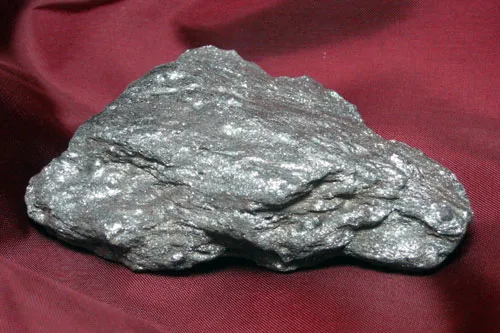
Nonsilicate minerals serve as important ore minerals.For example, hematite provides iron for steel production. "Hematite grise terrestre" by NASA / Wikimedia Commons
Earth's crust contains thousands of different minerals, but scientists group them into two main categories based on their chemical composition. Silicate minerals are the most abundant mineral group, making up about 90 percent of Earth's crust. Nonsilicate minerals form the remaining 10 percent but are still important in many Earth systems and human activities.
Silicate minerals all share a common building block called a silicon-oxygen tetrahedron. This structure consists of one silicon atom surrounded by four oxygen atoms arranged in a pyramid shape. The silicon atom sits in the center, bonded to the four oxygen atoms at the corners. These tetrahedra can link together in different ways to form various silicate minerals. Some silicate minerals have single tetrahedra, while others have tetrahedra arranged in chains, sheets, or three-dimensional frameworks. Common silicate minerals include quartz, which is made of tightly bonded silicon-oxygen tetrahedra, and feldspar, which contains aluminum along with silicon and oxygen.
Nonsilicate minerals have different chemical compositions and do not contain the silicon-oxygen tetrahedron structure. Scientists divide nonsilicate minerals into several groups based on their chemical makeup. Carbonates contain carbon and oxygen combined with other elements, such as calcium in the mineral calcite. Oxides form when oxygen combines with metals like iron or aluminum, producing minerals such as hematite and magnetite. Sulfides contain sulfur combined with metals, creating minerals like pyrite, also known as fool's gold.
The different structures and compositions of silicate and nonsilicate minerals determine where they form and where we find them in Earth's systems. Silicate minerals dominate igneous rocks, which form from cooling magma or lava. They also make up most metamorphic rocks and many sedimentary rocks. Because silicate minerals are so abundant in Earth's crust, they form the foundation of most landscapes, from mountains to ocean floors. Nonsilicate minerals, while less common overall, concentrate in specific environments. Carbonate minerals like calcite form thick layers of limestone in ancient ocean beds. Oxide minerals often form when rocks weather at Earth's surface or in areas with high oxygen levels. Sulfide minerals typically form deep underground where hot fluids interact with rocks.
Understanding the differences between silicate and nonsilicate minerals helps scientists interpret Earth's history and locate valuable resources. Silicate minerals provide clues about the formation of igneous and metamorphic rocks, revealing information about temperature and pressure conditions deep in Earth's crust. Nonsilicate minerals serve as important ore minerals, meaning humans mine them to extract useful metals. For example, hematite provides iron for steel production, while sulfide minerals yield copper, lead, and zinc. The distribution of these mineral groups across Earth's surface reflects the complex geological processes that have shaped our planet over billions of years.
Interesting Fact: A single grain of sand is usually made of quartz, a silicate mineral. This means that beaches around the world are largely composed of silicon-oxygen tetrahedra that have weathered from rocks and been transported by water.
What percentage of Earth's crust is made up of silicate minerals?
About 90 percentAbout 50 percentAbout 10 percentAbout 75 percent
What is the basic building block of all silicate minerals?
A carbon-oxygen chainA silicon-oxygen tetrahedronA metal-sulfur compoundA calcium carbonate structure
Based on the passage, what does the term 'ore minerals' mean?
Minerals that form only in ocean environmentsMinerals that are the most abundant on EarthMinerals that humans mine to extract useful metalsMinerals that contain silicon and oxygen
Which of the following is an example of a carbonate mineral?
QuartzHematiteCalcitePyrite
Why are silicate minerals so important in forming Earth's landscapes?
They are the hardest minerals on EarthThey make up about 90 percent of Earth's crustThey only form in volcanic areasThey contain valuable metals for mining
Where do sulfide minerals typically form?
On beaches and shorelinesIn ancient ocean bedsDeep underground where hot fluids interact with rocksAt Earth's surface in high oxygen areas
How can scientists use silicate minerals to understand Earth's history?
They reveal information about temperature and pressure conditions deep in Earth's crustThey show how much oxygen was in ancient atmospheresThey indicate the age of ocean waterThey measure the amount of rainfall in the past
What makes nonsilicate minerals different from silicate minerals in terms of structure?
Nonsilicate minerals are always harderNonsilicate minerals do not contain the silicon-oxygen tetrahedron structureNonsilicate minerals only form at high temperaturesNonsilicate minerals contain more oxygen atoms
True or False: Feldspar is a nonsilicate mineral that contains carbon and oxygen.
TrueFalse
True or False: A single grain of sand is usually made of quartz, a silicate mineral.
TrueFalse
Perfect For:
👩🏫 Teachers
• Reading comprehension practice
• Auto-graded assessments
• Literacy skill development
👨👩👧👦 Parents
• Reading practice at home
• Comprehension improvement
• Educational reading time
🏠 Homeschoolers
• Reading curriculum support
• Independent reading practice
• Progress monitoring
Reading Features:
📖
Reading Passage
Engaging fiction or nonfiction text
❓
Comprehension Quiz
Auto-graded questions
📊
Instant Feedback
Immediate results and scoring
📄
Printable Version
Download for offline reading
🔊
Read Aloud
Voice-over with word highlighting
Reviews & Ratings
No reviews yet. Be the first to share your experience!
Related Content
How Do Solar Panels Work?
This middle school reading passage explains how solar panels work by turning sunlight into electricity. The passage desc...
MS-ESS3-1
How Do Wind Turbines Work?
This NGSS-aligned reading passage for middle school students explains how wind turbines convert the energy of moving air...
MS-ESS3-1
How Does a Hydroelectric Dam Work?
This NGSS-aligned science passage for middle school students explains how hydroelectric dams work to produce clean, rene...
MS-ESS3-1
What Is Biofuel?
This NGSS-aligned middle school science passage explains what biofuel is, how it is made, and why it is important as a c...
MS-ESS3-1
What Is Tidal Energy?
This engaging reading passage for middle school students introduces tidal energy, a form of renewable energy that uses t...
MS-ESS3-1
What Is Wave Energy?
This passage introduces middle school students to wave energy—a clean, renewable energy source that comes from the movem...
MS-ESS3-1
What Is Green Energy?
This science passage introduces middle school students to the concept of green energy—clean, renewable energy that comes...
MS-ESS3-1
Igneous Rocks
This comprehensive passage introduces middle school students to igneous rocks, focusing on how these rocks form from mol...
MS-ESS2-1MS-ESS3-1
Sedimentary Rocks
This comprehensive middle school science passage introduces students to sedimentary rocks, detailing their step-by-step ...
MS-ESS2-1MS-ESS2-3MS-ESS3-1
Metamorphic Rocks
This engaging middle school science passage introduces students to the fascinating world of metamorphic rocks. Aligned w...
MS-ESS2-1MS-ESS3-1
Topographic Maps
This comprehensive passage introduces middle school students to topographic maps, with a focus on how these maps represe...
MS-ESS2-2MS-ESS3-1SEP.4SEP.7
Minerals and Rocks as Resources
This middle school science passage, aligned to NGSS standards MS-ESS3-1 and MS-ESS3-4, explores the critical role that m...
MS-ESS3-1MS-ESS3-4
Benefits of Volcanic Activity
This middle school science passage explores the many positive impacts of volcanic activity, aligning with NGSS standards...
MS-ESS2-2MS-ESS3-1
Groundwater
This middle school science passage explores the essential topic of groundwater, aligned to NGSS standards MS-ESS2-4 and ...
MS-ESS2-4MS-ESS3-1
Distribution of Water on Earth
This middle school science reading passage explores the distribution of water on Earth, aligned with NGSS standards MS-E...
MS-ESS2-4MS-ESS3-1
Water as a Resource
This middle school science passage examines water as a critical resource, focusing on how it is used, managed, and conse...
MS-ESS3-1MS-ESS3-4
Water Quality
This middle school science reading passage covers the topic of water quality, aligned with NGSS standards MS-ESS3-1 and ...
MS-ESS3-1MS-ESS3-3
Why Is Uranium Found in Certain Rock Types
This informative science reading passage for middle school students (grades 6-8) explains why uranium concentrates in ce...
MS-ESS3-1
How Minerals Are Mined
This comprehensive 650-word informational science reading passage teaches middle school students (grades 6-8) about mine...
MS-ESS3-1
Why Are Resources Unevenly Distributed on Earth
This comprehensive 650-word reading passage explains why natural resources are unevenly distributed across Earth's surfa...