How Does Land Turn Into Desert — Reading Comprehension
Rate this
Premium Resource
Present
Present in classroom. No work saved
Assign
Classroom with student accounts, Track progress
Quick Play
No student accounts, assign with a link
Grades
6
7
8
Standards
MS-ESS3-3
PRINT+DIGITAL RESOURCE
This learning resource is available in interactive and printable formats. The interactive worksheet can be played online and assigned to students. The Printable PDF version can be downloaded and printed for completion by hand.
This 650-word informational science passage for grades 6-8 explains desertification as the process by which productive land degrades into desert. Students learn how overgrazing removes protective vegetation, deforestation exposes soil to erosion, and drought accelerates natural drying processes. The passage connects human land use practices to environmental consequences including food security challenges and community displacement. Aligned with NGSS MS-ESS3-3, the content includes real-world examples from the Sahel region of Africa and explores both natural and human-caused factors in land degradation. Audio-integrated learning supports diverse learners. Activities include reading comprehension questions, writing prompts, and graphic organizers that help students analyze cause-and-effect relationships and compare natural versus human-accelerated processes. The passage emphasizes the connection between human activities and Earth systems, preparing students to understand complex environmental challenges.
CONTENT PREVIEW
Expand content preview
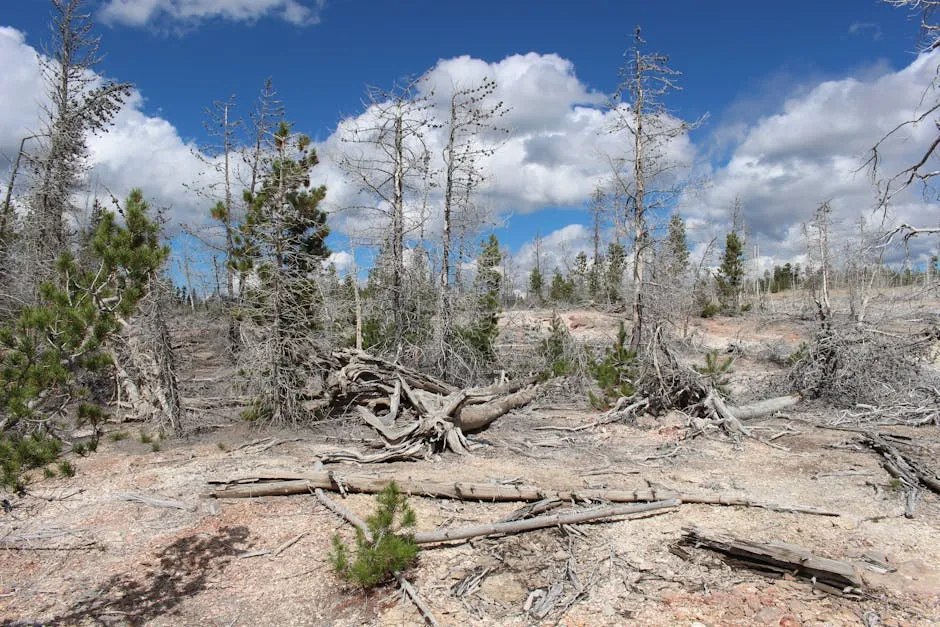
"Sparse vegetation and dead trees illustrate severe land degradation and soil erosion." Image by Gary Cassel / Pexels.
Desertification is the process by which productive land becomes desert. This environmental problem affects millions of people around the world, particularly in regions where rainfall is already limited. When land turns into desert, it can no longer support crops, livestock, or the communities that depend on these resources. Understanding desertification helps us recognize how human activities can accelerate natural processes and harm Earth's systems.
Several factors work together to cause desertification. Drought, a natural period of low rainfall, makes land drier and more vulnerable to damage. However, human activities often speed up this process significantly. Overgrazing occurs when too many animals feed on plants in an area, removing the protective vegetation that holds soil in place. Without plants, wind and occasional rain can easily wash away the exposed topsoil. Deforestation, the clearing of trees and forests, removes another layer of protection for soil. Tree roots normally anchor soil and help it retain moisture, but when trees are cut down for fuel or farmland, the land becomes much more susceptible to erosion.
The process of land degradation follows a predictable pattern. First, vegetation becomes sparse as plants are removed or die from lack of water. Next, the exposed soil begins to lose its nutrients and structure. Without plant roots to hold it together, the soil becomes loose and powdery. Wind carries away the finest particles, while heavy rains wash away larger pieces. Eventually, the soil becomes so degraded that it cannot support plant growth, even when rain does fall. This creates a cycle where lack of vegetation leads to more soil loss, which prevents new plants from growing.
The Sahel region of Africa provides a clear example of desertification in action. This area lies just south of the Sahara Desert and has experienced severe land degradation over the past 50 years. Growing populations have led to increased farming and livestock grazing. Trees have been cut down for firewood and to clear land for crops. When droughts occur in this region, the already stressed land cannot recover. The desert expands southward, forcing farming communities to abandon their land and relocate. This demonstrates how food security, the reliable access to sufficient food, becomes threatened when productive land turns to desert.
Desertification creates serious consequences for human communities. When land can no longer produce food, people face hunger and poverty. Farmers lose their livelihoods, and entire villages may need to move to find productive land. This displacement of communities can lead to conflicts over remaining resources and puts pressure on cities as rural populations migrate seeking opportunities. The loss of productive land also affects biodiversity, as plant and animal species lose their habitats. Once-fertile regions become barren landscapes that support very little life.
Scientists and communities are working to prevent and reverse desertification through better land management practices. Planting trees, rotating grazing areas to allow vegetation to recover, and using farming techniques that protect soil can all help maintain land productivity. International organizations support projects that teach sustainable land use practices in vulnerable regions. While desertification remains a serious global challenge, understanding the connection between human activities and land degradation helps us make better choices about how we use Earth's resources.
Interesting Fact: The Great Green Wall project in Africa aims to plant an 8,000-kilometer belt of trees across the Sahel region to combat desertification. When complete, it will be the largest living structure on Earth, three times the size of the Great Barrier Reef.
What is desertification?
The process by which productive land becomes desertThe natural expansion of existing desertsA type of weather pattern that causes sandstormsThe creation of new oases in desert regions
Which human activity removes protective vegetation that holds soil in place?
Building citiesOvergrazing by livestockMining for mineralsCreating parks
What does the term 'erosion' mean in the context of the passage?
The growth of new plant speciesThe addition of nutrients to soilThe removal of soil by wind or waterThe formation of rocks
According to the passage, what happens to soil when plant roots are removed?
It becomes more fertile and productiveIt becomes loose and can be easily blown or washed awayIt hardens and becomes like rockIt automatically grows new plants
Why does the Sahel region of Africa serve as an example of desertification?
It has always been a desert with no vegetationIt receives too much rainfall every yearIt has experienced severe land degradation from overuse and droughtIt is located north of the Sahara Desert
What is food security?
Keeping food locked in a safe placeReliable access to sufficient foodGrowing only one type of cropStoring food for emergencies
Which of the following is NOT mentioned as a way to prevent desertification?
Planting treesRotating grazing areasBuilding more citiesUsing farming techniques that protect soil
How do tree roots help prevent desertification?
They create more rainfall in the areaThey anchor soil and help it retain moistureThey produce oxygen for animalsThey provide shade for crops
Desertification only occurs due to natural causes like drought, not human activities.
TrueFalse
Once land becomes degraded through desertification, it can never support plant growth again, even with proper management.
TrueFalse
Perfect For:
👩🏫 Teachers
• Reading comprehension practice
• Auto-graded assessments
• Literacy skill development
👨👩👧👦 Parents
• Reading practice at home
• Comprehension improvement
• Educational reading time
🏠 Homeschoolers
• Reading curriculum support
• Independent reading practice
• Progress monitoring
Reading Features:
📖
Reading Passage
Engaging fiction or nonfiction text
❓
Comprehension Quiz
Auto-graded questions
📊
Instant Feedback
Immediate results and scoring
📄
Printable Version
Download for offline reading
🔊
Read Aloud
Voice-over with word highlighting
Reviews & Ratings
No reviews yet. Be the first to share your experience!
Related Content
Natural Disaster: Volcanic Eruptions
Volcanoes can erupt with lava and ash, changing the landscape. While dangerous, they also create fertile land and new la...
RI.3.1RI.4.4RI.4.2RI.5.2
Human Impacts: Pollution
This middle school science reading passage, aligned with NGSS standards MS-LS2-4 and MS-ESS3-3, examines the mechanisms ...
MS-LS2-4MS-ESS3-3
Human Impacts: Habitat Destruction
This grade 6-8 science passage explores human impacts on ecosystems, focusing on habitat destruction as the leading caus...
MS-LS2-4MS-LS2-5MS-ESS3-3
Ecosystem Services
This engaging middle school science passage introduces students to the concept of ecosystem services, the vital benefits...
MS-LS2-5MS-ESS3-3
Environmental Problems and Solutions
This passage for grades 6-8 introduces major environmental problems such as habitat loss, pollution, climate change, inv...
MS-LS2-4MS-ESS3-3MS-ESS3-4
Remote Sensing
This middle school science passage introduces students to the concept of remote sensing—the collection of information ab...
MS-ESS3-3MS-PS4-2MS-ETS1-1MS-ETS1-3
Geographic Information Systems (GIS)
This engaging middle school science passage introduces students to Geographic Information Systems (GIS), aligning with N...
MS-ESS3-3MS-ETS1-1MS-ETS1-2MS-ETS1-3
Renewable vs. Nonrenewable Energy
This engaging passage, aligned with NGSS standards MS-PS3-4, MS-ESS3-3, and MS-ESS3-4, helps middle school students diff...
MS-PS3-4MS-ESS3-3MS-ESS3-4
Fossil Fuels: Coal
This middle school science reading passage explores the science behind coal, a major fossil fuel. Students will learn ho...
MS-PS3-4MS-ESS3-3MS-ESS3-4
Solar Energy
This engaging passage for grades 6-8 explores the science of solar energy, focusing on how sunlight is converted into el...
MS-PS3-4MS-ESS3-3MS-ESS3-4
Wind Energy
This comprehensive middle school science passage explores the scientific principles behind wind energy and how wind turb...
MS-PS3-4MS-ESS3-3MS-ESS3-4
Hydroelectric Energy
This comprehensive passage introduces middle school students to the science behind hydroelectric energy, directly aligni...
MS-PS3-4MS-ESS3-3MS-ESS3-4
Geothermal Energy
This comprehensive science passage introduces middle school students to the mechanisms and applications of geothermal en...
MS-PS3-4MS-ESS3-3MS-ESS3-4
Biomass and Biofuels
This NGSS-aligned passage introduces grades 6-8 students to the science of biomass and biofuels, explaining how organic ...
MS-PS3-4MS-ESS3-3MS-ESS3-4
Nuclear Energy as a Resource
This NGSS-aligned informational science passage, designed for grades 6-8, explores nuclear energy as a resource in the c...
MS-PS3-4MS-ESS3-3MS-ESS3-4
Water Quality
This middle school science reading passage covers the topic of water quality, aligned with NGSS standards MS-ESS3-1 and ...
MS-ESS3-1MS-ESS3-3
Florida Everglades
This comprehensive passage introduces middle school students to the Florida Everglades, a distinctive wetland ecosystem ...
MS-LS2-1MS-LS2-4MS-ESS3-3MS-ESS3-4
Congo Rainforest
This middle school science passage explores the Congo Rainforest—Earth’s second-largest rainforest, located in Central A...
MS-LS2-1MS-ESS3-3
Nuclear Power Plants
This comprehensive reading passage introduces middle school students (grades 6-8) to the science of nuclear power plants...
MS-PS3-4MS-ESS3-3
Nuclear Safety and Waste
This middle school science passage explores the critical topic of nuclear safety and waste management, aligned with NGSS...