How Does Hydropower Work
Interactive passage with audio narration, comprehension questions, and printable PDF.
By completing this purchase you agree to our Terms of Use and Privacy Policy. Your subscription renews automatically until you cancel. You can cancel anytime from your account settings. All sales are final and non-refundable. Digital content is available for download in your account immediately upon purchase.
What's included
How Does Hydropower Work preview and details
About this printable How Does Hydropower Work science reading passage, NGSS-aligned (Grades 6-8)
Sample passage and quiz from How Does Hydropower Work
Reading passage and comprehension quiz preview
How Does Moving Water Generate Electricity
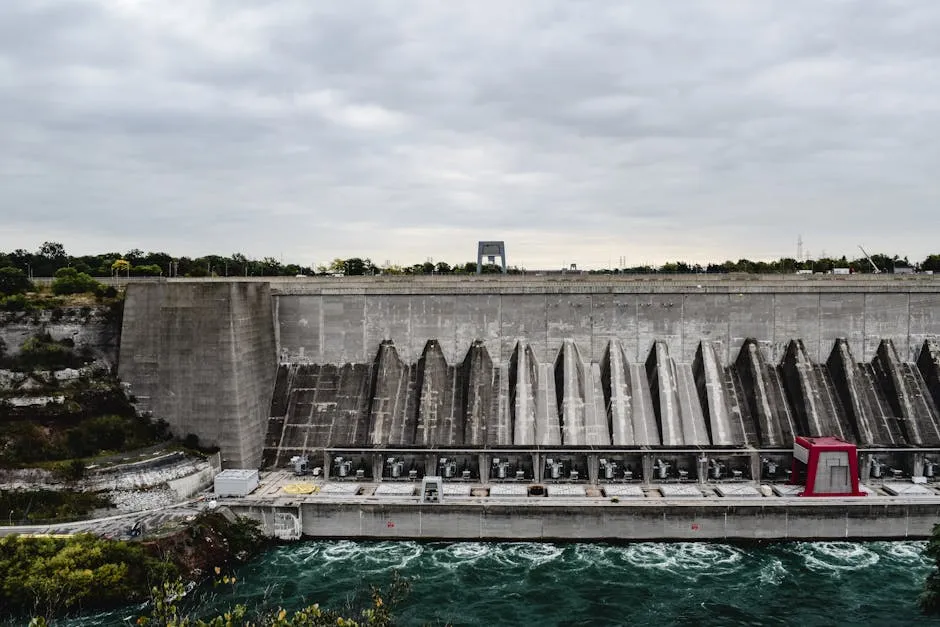
"Aerial view of hydroelectric power plant at Niagara Falls, showcasing renewable energy." by Eva Bronzini / Pexels.
Hydroelectric power plants generate electricity by using the energy of falling water. These facilities, built on rivers with significant elevation changes, convert the potential energy of water stored behind dams into electrical energy. Hydroelectric power is a renewable energy source because the water cycle continuously replenishes river systems, making it a sustainable option for electricity generation.
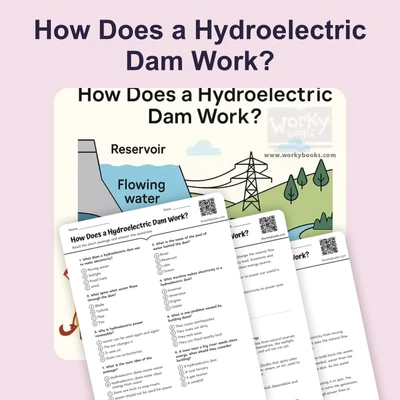
The process begins when water accumulates in a reservoir behind a dam. The dam creates an artificial lake by blocking the natural flow of a river. Water in the reservoir sits at a higher elevation than the river below, giving it potential energy due to gravity. When operators open gates in the dam, water flows downward through large pipes called penstocks. As the water descends, its potential energy transforms into kinetic energy, the energy of motion. The faster the water moves, the more kinetic energy it possesses.
At the bottom of the penstock, the rushing water strikes the blades of a turbine, a wheel-like device designed to spin when water pushes against it. This is similar to how wind turns a pinwheel, except water is much denser than air and carries more energy. The force of the water causes the turbine to rotate rapidly. The turbine connects to a shaft that extends upward into a generator, a machine that converts mechanical energy into electrical energy.
Inside the generator, the rotating shaft spins large magnets around coils of copper wire. This motion creates electromagnetic induction, a process discovered by scientist Michael Faraday in 1831. When magnets move past wire coils, they generate an electric current in the wire. The electricity produced travels through transformers that increase its voltage, making it suitable for long-distance transmission. Power lines then carry the electricity to homes, schools, and businesses.
River geography plays a critical role in determining hydropower potential. Rivers with steep gradients, or slopes, allow water to fall greater distances and gain more kinetic energy. The volume of water flow, measured in cubic meters per second, also matters significantly. A river with high flow rates can generate more electricity than one with low flow rates. The Columbia River in Washington State, for example, produces substantial hydroelectric power because it combines high water volume with favorable elevation changes. Climate patterns affect hydropower generation too, since rainfall and snowmelt determine how much water fills reservoirs.
Hydroelectric power provides approximately 16 percent of the world's electricity and represents the largest source of renewable electricity globally. Unlike fossil fuel plants, hydroelectric facilities produce no air pollution during operation. However, dam construction can alter river ecosystems and affect fish migration patterns. Modern dam designs include fish ladders and other features to minimize environmental impacts while maintaining clean energy production.
Interesting Fact: The Three Gorges Dam in China is the world's largest hydroelectric power station, with a generating capacity of 22,500 megawatts—enough electricity to power over 15 million homes simultaneously.
Comprehension quiz (10 questions)
1. What type of energy does water stored behind a dam possess?
2. What are the large pipes called that carry water from the reservoir to the turbines?
3. How does a generator produce electricity?
4. In the context of the passage, what does 'electromagnetic induction' mean?
5. Why do rivers with steep gradients produce more hydroelectric power?
6. Based on the passage, what can you infer about the relationship between water volume and electricity generation?
7. If a region experiences a severe drought, what would likely happen to its hydroelectric power generation?
8. Which scientist discovered the principle of electromagnetic induction in 1831?
9. True or False: Hydroelectric power plants produce air pollution during operation.
10. True or False: Hydroelectric power is considered a renewable energy source because the water cycle continuously replenishes river systems.
Perfect for the way you teach
- Build comprehension skills
- Auto-graded quiz
- Differentiated reading
- Read together at home
- Improve fluency
- Quiet reading time
- Reading curriculum support
- Independent practice
- Track Lexile growth