Reading PassagePremium

How Does the Sun Affect Tides

Interactive passage with audio narration, comprehension questions, and printable PDF.

No ratings yet
Grades 5–8ScienceElaEnglish · SpanishInteractive · Printable
Aligned toMS-ESS1-2
Just this resource
$1.50
One-time purchase
Best value
Unlock everything
$49.99$29.99/yr
40% off until Aug 1 — 10,000+ resources
Renews at $49.99/year.
Unlock above to use these actions

What's included

Reading passage
Audio narration
Comprehension quiz
Writing activity
Glossary & flashcards
Differentiated version
Spanish translation

How Does the Sun Affect Tides preview and details

About this printable How Does the Sun Affect Tides science reading passage, NGSS-aligned (Grades 5-8)

This comprehensive middle school science reading passage examines how the Sun affects tides on Earth, aligned with NGSS standard MS-ESS1-2 and disciplinary core idea MS-ESS1.B: Earth and the Solar System. Students explore the Sun's gravitational influence on ocean water and learn how the Sun works with the Moon to create different types of tides. The passage includes audio integration for accessibility, a simplified version for English Language Learners, Spanish translations, vocabulary glossary, multiple-choice questions, writing activities, and graphic organizers. Through cause-and-effect reasoning, students discover how the positions of the Sun, Moon, and Earth determine tide patterns. The content addresses grade 6-8 learners with appropriate scientific terminology and real-world examples, helping students understand the complex interactions within the Earth-Sun-Moon system and their observable effects on our planet's oceans.
Written by Workybooks TeamPublished by Workybooks
Preview

Sample passage and quiz from How Does the Sun Affect Tides

Reading passage and comprehension quiz preview

How Does the Sun Affect Tides
Earth's Tides
The Sun affects tides through its gravitational pull on Earth's oceans. 

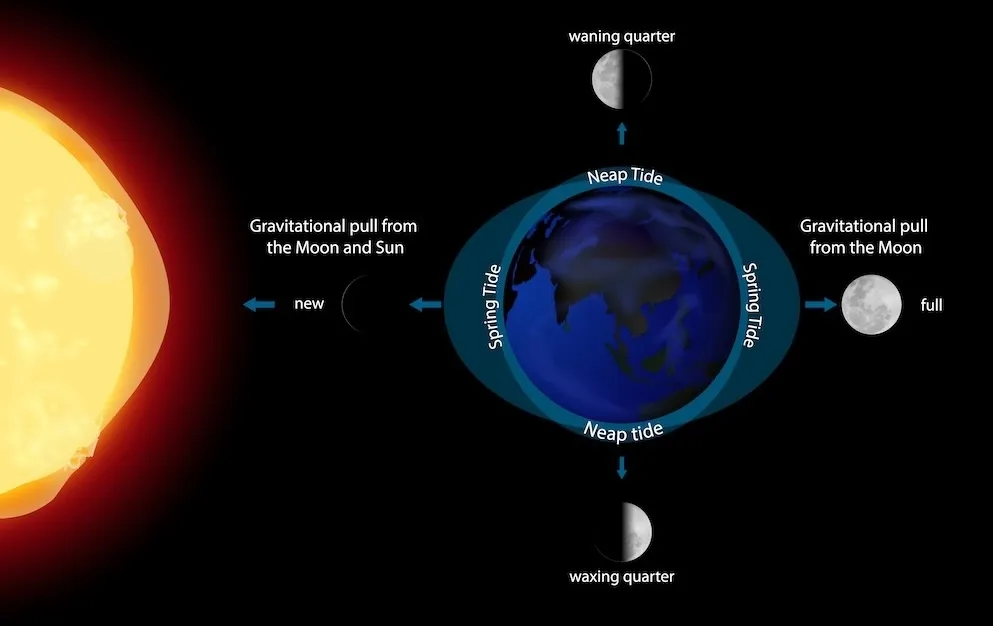
The Sun affects tides through its gravitational pull on Earth's oceans. While the Moon has a stronger effect because it is closer, the Sun still plays an important role. Tides are the regular rise and fall of ocean water levels. The Sun's gravity pulls on ocean water just as it pulls on Earth itself. This pull creates a bulge of water on the side of Earth facing the Sun.

Scientists observe that the Sun and Moon work together to create different types of tides. When the Sun, Moon, and Earth line up, their gravitational forces combine. This alignment creates spring tides, which are the highest high tides and lowest low tides. Spring tides happen twice each month during the new moon and full moon. When the Sun and Moon form a right angle with Earth, their gravitational pulls work against each other. This position creates neap tides, which are less extreme. Neap tides occur during the first and third quarter moons.

Evidence shows that the Sun's influence on tides can be measured and predicted. The Sun's gravitational pull is about 46 percent as strong as the Moon's pull on Earth's oceans. In the Bay of Fundy in Canada, spring tides can create water level changes of more than 16 meters. During neap tides, the same location experiences smaller changes of about 10 meters. Scientists use data about the positions of the Sun, Moon, and Earth to predict tide times and heights accurately.

Understanding how the Sun affects tides matters for coastal communities and marine ecosystems. Fishermen use tide predictions to plan safe trips. Ships need to know tide levels to navigate harbors. Many ocean animals depend on tidal cycles for feeding and reproduction. The Sun's role in creating tides demonstrates how objects in space can influence conditions on Earth. This connection shows that Earth is part of a larger system where celestial bodies interact through gravity across vast distances.

Interesting Fact: The Sun's gravity is so strong that it holds all the planets in our solar system in their orbits, yet the Moon has a greater effect on Earth's tides simply because it is much closer to our planet.

Comprehension quiz (10 questions)

1. What causes tides on Earth?

Only the Moon's gravitational pull
The gravitational pull of both the Sun and Moon
Wind pushing ocean water
Earth's rotation only

2. When do spring tides occur?

During quarter moons
Only in the spring season
During new moon and full moon
When the Sun is farthest from Earth

3. What does the term 'gravitational pull' mean in the passage?

The distance between two objects
The force of attraction between objects with mass
The speed at which water moves
The temperature of ocean water

4. According to the passage, how strong is the Sun's gravitational pull on Earth's oceans compared to the Moon's pull?

The Sun's pull is stronger than the Moon's
About 46 percent as strong as the Moon's pull
Exactly the same strength
The Sun has no effect on tides

5. Why does the Moon have a stronger effect on tides than the Sun?

The Moon is larger than the Sun
The Moon is much closer to Earth
The Moon has stronger gravity
The Sun only affects tides at night

6. What happens during neap tides?

The highest and lowest tides occur
Tides stop happening completely
Less extreme tides occur
Only high tides happen

7. How do scientists predict tide times and heights?

By measuring ocean temperature
By using data about positions of the Sun, Moon, and Earth
By watching fish behavior
By measuring wind speed

8. Which group of people would benefit from understanding tide predictions?

Mountain climbers
Airplane pilots
Fishermen and ship captains
Desert travelers

9. True or False: Spring tides only happen during the spring season.

True
False

10. True or False: The Sun's gravity is strong enough to hold planets in orbit but the Moon has a greater effect on Earth's tides because it is closer.

True
False
Who it's for

Perfect for the way you teach

Teachers
  • Build comprehension skills
  • Auto-graded quiz
  • Differentiated reading
Parents
  • Read together at home
  • Improve fluency
  • Quiet reading time
Homeschoolers
  • Reading curriculum support
  • Independent practice
  • Track Lexile growth
Topics

Reviews & Ratings

No reviews yet. Be the first to share your experience!

More reading you might love

20 more
Passage
Comets - reading educational content
Grades 5–8

Comets

science · MS-ESS1-2

$1.50
Passage
Mercury: Closest to the Sun - reading educational content
Grades 5–8

Mercury: Closest to the Sun

science · MS-ESS1-2

$1.50
Passage
Venus: Earth's Twin? - reading educational content
Grades 5–8

Venus: Earth's Twin?

science · MS-ESS1-2

$1.50
Passage
Earth: Our Home Planet - reading educational content
Grades 5–8

Earth: Our Home Planet

science · MS-ESS1-2

Free
Passage
Mars: The Red Planet - reading educational content
Grades 5–8

Mars: The Red Planet

science · MS-ESS1-2

$1.50
Passage
Kepler's Laws of Planetary Motion - reading educational content
Grades 5–8

Kepler's Laws of Planetary Motion

science · MS-ESS1-2

$1.50
Passage
Tides and Tidal Forces - reading educational content
Grades 5–8

Tides and Tidal Forces

science · MS-ESS1-1

$1.50
Passage
Escape Velocity and Space Travel - reading educational content
Grades 5–8

Escape Velocity and Space Travel

science · MS-ESS1-2

$1.50
Passage
Weightlessness and Microgravity - reading educational content
Grades 5–8

Weightlessness and Microgravity

science · MS-PS2-4

$1.50
Passage
Orbits and Orbital Motion - reading educational content
Grades 5–8

Orbits and Orbital Motion

science · MS-ESS1-2

$1.50
Passage
What Is the Solar System? - reading educational content
Grades 5–8

What Is the Solar System?

science · MS-ESS1-2

$1.50
Passage
Structure of the Solar System - reading educational content
Grades 5–8

Structure of the Solar System

science · MS-ESS1-2

$1.50
Passage
Moons of the Solar System - reading educational content
Grades 5–8

Moons of the Solar System

science · MS-ESS1-2

Free
Passage
Defining Life: What Are We Looking For? - reading educational content
Grades 5–8

Defining Life: What Are We Looking For?

science · MS-LS1-1

$1.50
Passage
 Astronomy - reading educational content
Grades 5–8

Astronomy

earth science · MS-ESS1-2

$1.50
Passage
The Solar System - reading educational content
Grades 5–8

The Solar System

science · MS-ESS1-2

$1.50
Passage
Gravity and Orbits - reading educational content
Grades 5–8

Gravity and Orbits

science · MS-ESS1-2

$1.50
Passage
The Inner Planets - reading educational content
Grades 5–8

The Inner Planets

science · MS-ESS1-2

$1.50
Passage
The Outer Planets - reading educational content
Grades 5–8

The Outer Planets

science · MS-ESS1-2

$1.50
Passage
The Moon's Characteristics - reading educational content
Grades 5–8

The Moon's Characteristics

science · MS-ESS1-1

$1.50
Copyright © 2026 Workybooks. Made with ♥ in California.