How Human Population Has Grown — Reading Comprehension
Rate this
Premium Resource
Present
Present in classroom. No work saved
Assign
Classroom with student accounts, Track progress
Quick Play
No student accounts, assign with a link
Grades
6
7
8
Standards
MS-ESS3-4
PRINT+DIGITAL RESOURCE
This learning resource is available in interactive and printable formats. The interactive worksheet can be played online and assigned to students. The Printable PDF version can be downloaded and printed for completion by hand.
This comprehensive middle school science reading passage examines how human population has grown from small scattered settlements to over 8 billion people today. Students explore the role of industrialization, advances in medicine, and agricultural developments in accelerating population growth. The passage connects population size to increasing pressure on Earth's natural systems and resources. Aligned with NGSS standard MS-ESS3-4, this audio-integrated resource includes a main passage, simplified differentiated version, Spanish translations, glossary of key terms, multiple-choice questions, writing activities, and graphic organizers. The materials help students understand the relationship between human population growth and environmental impacts, making complex demographic and environmental concepts accessible through clear explanations and real-world examples. Perfect for grades 6-8 science curriculum covering human impacts on Earth's systems.
CONTENT PREVIEW
Expand content preview
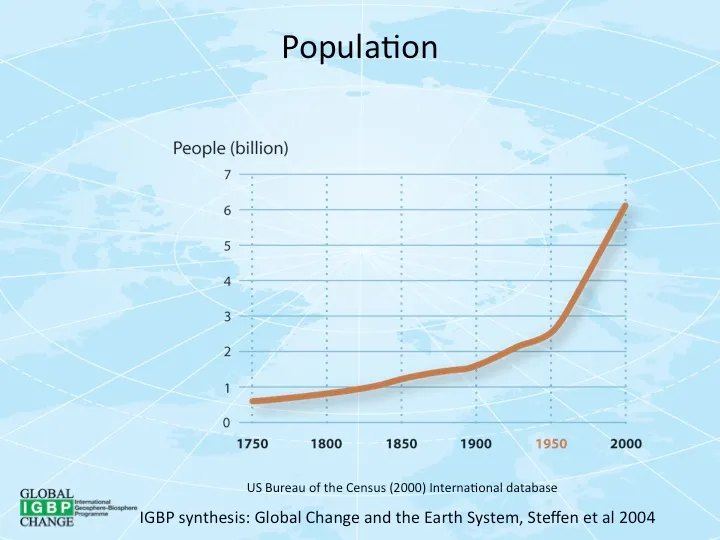
Scientists and policymakers study population trends to understand future challenges. Populationgrowth" by Owengaffney / Wikimedia Commons
The human population is the total number of people living on Earth. For most of human history, this number remained quite small. Around 10,000 years ago, only about 5 million people lived on the planet. These early humans lived in small, scattered groups as hunters and gatherers. They moved from place to place to find food and resources. The population grew very slowly because food was limited, diseases were common, and many children did not survive to adulthood.
A major change occurred when humans developed agriculture, the practice of growing crops and raising animals for food. This happened around 10,000 years ago in different parts of the world. Agriculture allowed people to settle in one place and produce more food than they could by hunting and gathering. With a more reliable food supply, more children survived and the population began to grow faster. By the year 1800, Earth's population had reached about 1 billion people. This growth took thousands of years.
The pace of population growth changed dramatically during the Industrial Revolution, which began in the late 1700s. During this period, people invented machines that could do work faster than humans or animals. Factories produced goods in large quantities, and new farming equipment made agriculture more efficient. These changes created more jobs and wealth, allowing families to support more children. The population doubled to 2 billion by 1927, taking only 127 years instead of thousands.
Advances in medicine and public health accelerated population growth even more. Scientists discovered that germs cause diseases and developed vaccines to prevent illnesses like smallpox and polio. Doctors learned how to treat infections with antibiotics. Clean water systems and better sanitation reduced the spread of deadly diseases. These improvements meant that more babies survived infancy and people lived longer lives. The mortality rate, or the number of deaths in a population, decreased significantly while the birth rate remained high.
Today, Earth's population exceeds 8 billion people. This rapid growth has created enormous pressure on the planet's natural resources and systems. Humans need food, water, energy, and materials for shelter. We extract resources from the Earth, clear forests for farmland, and release pollution into the air and water. As the population grows, we use more resources and produce more waste. This affects Earth's climate, reduces biodiversity, and depletes resources like fresh water and fertile soil. The challenge facing humanity is how to meet the needs of billions of people while protecting the natural systems that support all life on Earth.
Scientists and policymakers study population trends to understand future challenges. In some countries, birth rates have declined as education and healthcare improve. However, the global population continues to grow, though at a slower rate than in the past. Understanding how and why human population has grown helps us make better decisions about resource use, conservation, and sustainable development.
Interesting Fact: If you could travel back in time to the year 1800, you would find that it took all of human history to reach 1 billion people. Today, the global population increases by about 1 billion people every 12-15 years.
What was the approximate human population 10,000 years ago?
5 million people1 billion people2 billion people8 billion people
How did agriculture affect human population growth?
It caused the population to decreaseIt allowed people to produce more food and settle in one place, leading to faster growthIt had no effect on population sizeIt only affected population in cities
What does the term 'mortality rate' mean?
The number of births in a populationThe total population sizeThe number of deaths in a populationThe rate of disease spread
Which of the following is NOT mentioned as a factor that accelerated population growth?
Development of vaccinesInvention of machines during the Industrial RevolutionDiscovery of new planetsImprovements in sanitation
Based on the passage, what can you infer about the relationship between medicine and population growth?
Better medicine decreased population growthMedicine had no impact on population sizeBetter medicine helped more people survive, leading to population growthMedicine only helped adults, not children
Why does rapid population growth create pressure on Earth's natural systems?
More people need more resources like food, water, and energyPeople take up too much physical spacePopulation growth makes the Earth spin fasterIt causes the sun to produce more heat
If a country wants to reduce its environmental impact, which action would be most effective based on the passage?
Increase factory productionUse resources more efficiently and practice conservationClear more forests for farmingProduce more waste
It increases the number of plant and animal speciesIt has no effect on other speciesIt reduces biodiversity as humans use more land and resourcesIt only affects ocean species
True or False: The global population doubled from 1 billion to 2 billion in less than 150 years.
TrueFalse
True or False: Birth rates have increased in all countries as education and healthcare improve.
TrueFalse
Perfect For:
👩🏫 Teachers
• Reading comprehension practice
• Auto-graded assessments
• Literacy skill development
👨👩👧👦 Parents
• Reading practice at home
• Comprehension improvement
• Educational reading time
🏠 Homeschoolers
• Reading curriculum support
• Independent reading practice
• Progress monitoring
Reading Features:
📖
Reading Passage
Engaging fiction or nonfiction text
❓
Comprehension Quiz
Auto-graded questions
📊
Instant Feedback
Immediate results and scoring
📄
Printable Version
Download for offline reading
🔊
Read Aloud
Voice-over with word highlighting
Reviews & Ratings
No reviews yet. Be the first to share your experience!
Related Content
Natural Disaster: Tornadoes
Tornadoes are dangerous spinning columns of air. Knowing the signs and having safety plans can help protect you from the...
RI.3.1RI.4.4RI.4.2RI.5.2
Conservation Strategies
This comprehensive passage introduces students in grades 6-8 to the major strategies used in conservation biology, such ...
MS-LS2-5MS-ESS3-4
Environmental Problems and Solutions
This passage for grades 6-8 introduces major environmental problems such as habitat loss, pollution, climate change, inv...
MS-LS2-4MS-ESS3-3MS-ESS3-4
Sustainability and Individual Action
This reading passage for grades 6-8 introduces the concept of sustainability, defined as meeting current needs without c...
MS-ESS3-4
Restoration Ecology
This passage introduces middle school students to the vital field of restoration ecology, aligning with NGSS standards M...
MS-LS2-4MS-ESS3-4
Climate Change: Solutions and Mitigation
This passage explores scientific solutions and mitigation strategies for climate change, designed for middle school scie...
MS-ESS3-4MS-ESS3-5
Renewable vs. Nonrenewable Energy
This engaging passage, aligned with NGSS standards MS-PS3-4, MS-ESS3-3, and MS-ESS3-4, helps middle school students diff...
MS-PS3-4MS-ESS3-3MS-ESS3-4
Fossil Fuels: Coal
This middle school science reading passage explores the science behind coal, a major fossil fuel. Students will learn ho...
MS-PS3-4MS-ESS3-3MS-ESS3-4
Solar Energy
This engaging passage for grades 6-8 explores the science of solar energy, focusing on how sunlight is converted into el...
MS-PS3-4MS-ESS3-3MS-ESS3-4
Wind Energy
This comprehensive middle school science passage explores the scientific principles behind wind energy and how wind turb...
MS-PS3-4MS-ESS3-3MS-ESS3-4
Hydroelectric Energy
This comprehensive passage introduces middle school students to the science behind hydroelectric energy, directly aligni...
MS-PS3-4MS-ESS3-3MS-ESS3-4
Soil Conservation
This passage for grades 6-8 explains soil conservation, aligning with NGSS standard MS-ESS3-4. Students will learn about...
MS-ESS3-4
Minerals and Rocks as Resources
This middle school science passage, aligned to NGSS standards MS-ESS3-1 and MS-ESS3-4, explores the critical role that m...
MS-ESS3-1MS-ESS3-4
Galápagos Islands
This engaging science passage explores the Galápagos Islands, a volcanic archipelago located off the coast of Ecuador in...
MS-LS2-1MS-LS4-4MS-ESS3-4
Geothermal Energy
This comprehensive science passage introduces middle school students to the mechanisms and applications of geothermal en...
MS-PS3-4MS-ESS3-3MS-ESS3-4
Biomass and Biofuels
This NGSS-aligned passage introduces grades 6-8 students to the science of biomass and biofuels, explaining how organic ...
MS-PS3-4MS-ESS3-3MS-ESS3-4
Nuclear Energy as a Resource
This NGSS-aligned informational science passage, designed for grades 6-8, explores nuclear energy as a resource in the c...
MS-PS3-4MS-ESS3-3MS-ESS3-4
Water as a Resource
This middle school science passage examines water as a critical resource, focusing on how it is used, managed, and conse...
MS-ESS3-1MS-ESS3-4
Florida Everglades
This comprehensive passage introduces middle school students to the Florida Everglades, a distinctive wetland ecosystem ...
MS-LS2-1MS-LS2-4MS-ESS3-3MS-ESS3-4
Nuclear Safety and Waste
This middle school science passage explores the critical topic of nuclear safety and waste management, aligned with NGSS...