How Humans Crossed the Bering Land Bridge
Interactive passage with audio narration, comprehension questions, and printable PDF.
By completing this purchase you agree to our Terms of Use and Privacy Policy. Your subscription renews automatically until you cancel. You can cancel anytime from your account settings. All sales are final and non-refundable. Digital content is available for download in your account immediately upon purchase.
What's included
How Humans Crossed the Bering Land Bridge preview and details
About this printable How Humans Crossed the Bering Land Bridge science reading passage, NGSS-aligned (Grades 5-8)
Sample passage and quiz from How Humans Crossed the Bering Land Bridge
Reading passage and comprehension quiz preview
How Humans Crossed the Bering Land Bridge
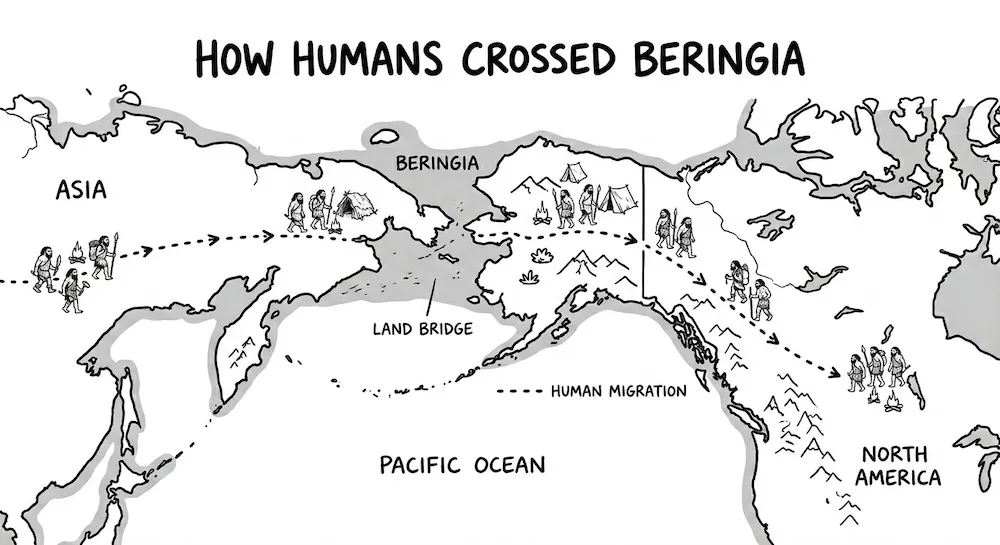
The Bering Land Bridge was a wide strip of land that once connected Asia and North America. This ancient land connection existed during the Ice Ages, which occurred between about 100,000 and 11,000 years ago. Scientists call this land bridge Beringia. It formed when Earth's climate cooled and massive glaciers grew across the northern continents.
A land bridge forms when sea levels drop significantly. During the Ice Ages, huge amounts of water became trapped in glaciers. These ice sheets could be more than a mile thick. As water was locked away in ice, ocean levels fell by as much as 400 feet. This exposed land that normally sat beneath the ocean. The shallow seafloor between Siberia and Alaska became dry land. At its widest point, Beringia stretched about 1,000 miles from north to south.
Many animals crossed the Bering Land Bridge in both directions. Large mammals like woolly mammoths, steppe bison, and wild horses traveled between the continents. Smaller animals like foxes and rabbits also made the journey. These animals followed the grasses and plants that grew on Beringia. The land bridge was not just a narrow path. It was a vast grassland ecosystem where animals could live and feed.
The most significant crossing involved humans. Evidence shows that the first peoples reached the Americas by traveling across Beringia. Scientists estimate this migration occurred at least 15,000 to 20,000 years ago. These early humans became the ancestors of Native American and Indigenous peoples throughout North and South America. They likely followed animal herds across the land bridge while hunting for food.
About 11,000 years ago, Earth's climate began to warm. The glaciers started melting and releasing their trapped water. Sea levels rose gradually over thousands of years. The rising ocean waters slowly flooded Beringia. Eventually, the land bridge disappeared completely beneath the waves. Today, this area is covered by the Bering Strait, a body of water about 55 miles wide that separates Russia and Alaska.
Scientists have gathered strong evidence to support the Bering Land Bridge theory. DNA analysis shows genetic connections between Indigenous peoples of the Americas and populations in Asia. Archaeological discoveries include ancient tools and campsites along the migration route. Fossil evidence reveals that the same animal species lived on both continents during the Ice Ages. These multiple lines of evidence help scientists understand how life spread across Earth's continents.
Understanding the Bering Land Bridge matters because it explains how humans and animals populated the Americas. It demonstrates how Earth's changing climate can reshape entire continents. The rise and fall of sea levels continues to affect coastlines today. Studying ancient migrations helps us understand human history and how species adapt to environmental changes.
Interesting Fact: Some scientists think humans may have also traveled along the coast of Beringia by boat, not just by walking across the land bridge. Underwater archaeological sites may still hold evidence of these ancient coastal communities.
Comprehension quiz (10 questions)
1. What caused the Bering Land Bridge to form during the Ice Ages?
2. According to the passage, when did the first humans likely cross the Bering Land Bridge to reach the Americas?
3. What does the term 'migration' mean in the context of this passage?
4. Which type of evidence do scientists use to show genetic connections between Indigenous peoples of the Americas and populations in Asia?
5. Why did the Bering Land Bridge disappear about 11,000 years ago?
6. Based on the passage, what can you infer about why early humans crossed the Bering Land Bridge?
7. If another Ice Age occurred today and sea levels dropped 400 feet, what would likely happen to coastal areas?
8. How does studying the Bering Land Bridge help scientists understand Earth's climate history?
9. True or False: The Bering Land Bridge was a narrow path that only allowed small animals to cross.
10. True or False: Scientists use multiple types of evidence, including DNA, archaeology, and fossils, to support the Bering Land Bridge theory.
Perfect for the way you teach
- Build comprehension skills
- Auto-graded quiz
- Differentiated reading
- Read together at home
- Improve fluency
- Quiet reading time
- Reading curriculum support
- Independent practice
- Track Lexile growth