What Does the Grand Canyon Reveal
Interactive passage with audio narration, comprehension questions, and printable PDF.
By completing this purchase you agree to our Terms of Use and Privacy Policy. Your subscription renews automatically until you cancel. You can cancel anytime from your account settings. All sales are final and non-refundable. Digital content is available for download in your account immediately upon purchase.
What's included
What Does the Grand Canyon Reveal preview and details
About this printable What Does the Grand Canyon Reveal science reading passage, NGSS-aligned (Grades 5-8)
Sample passage and quiz from What Does the Grand Canyon Reveal
Reading passage and comprehension quiz preview
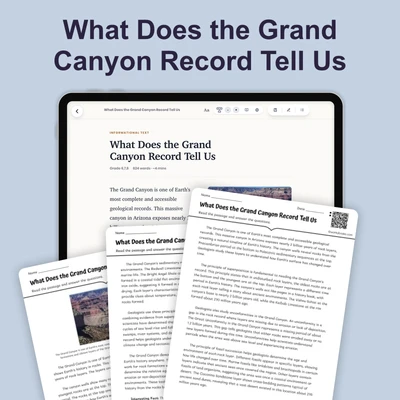
What Does the Grand Canyon Reveal
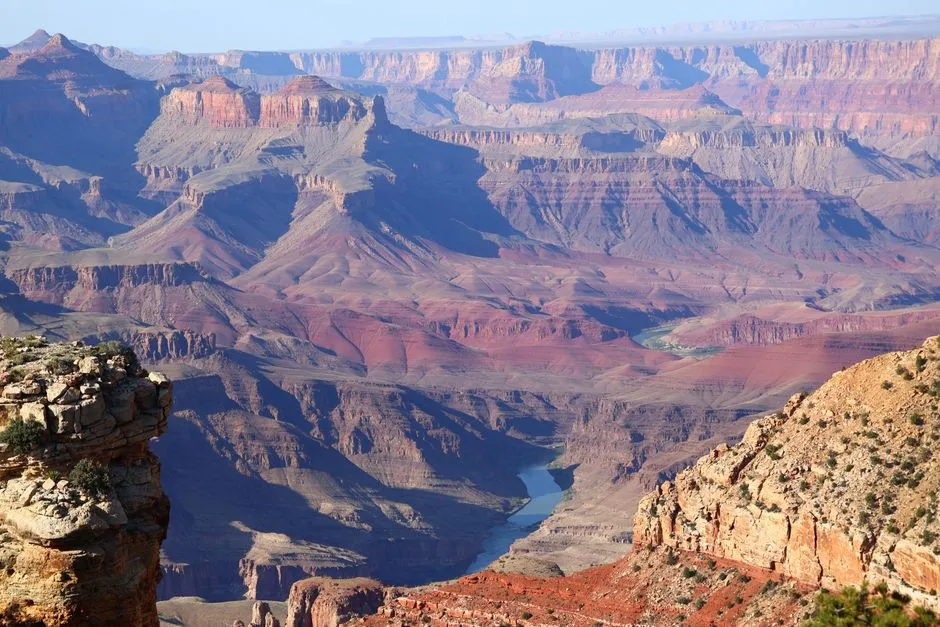
"Breathtaking panoramic view of the Grand Canyon, showcasing its vast layers and vibrant colors." by Raziella R / Pexels.
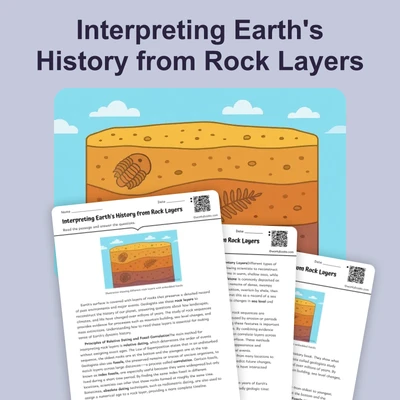
The Grand Canyon reveals nearly 2 billion years of Earth's history in its colorful rock layers. Each layer acts like a page in a natural history book. Scientists study these layers to understand how Earth changed over time. The canyon walls expose ancient environments that once existed where the canyon stands today.
The rock layers formed through a process called deposition. Sediments such as sand, mud, and shells settled in horizontal layers over millions of years. These sediments hardened into sedimentary rocks through pressure and chemical changes. The oldest rocks at the bottom formed nearly 2 billion years ago. Younger rocks sit on top in a pattern geologists call superposition. Evidence shows that different layers represent different ancient environments. Some layers contain fossils of sea creatures, indicating ancient oceans once covered the area. Other layers show signs of ancient deserts with sand dune patterns preserved in stone.
The Colorado River carved the Grand Canyon through these layers over approximately 6 million years. The river cut downward through a process called erosion. Water, sand, and rocks acted like natural cutting tools. The river removed about 1,000 cubic miles of rock material over time. Scientists observe that the canyon deepened as the Colorado Plateau slowly rose. This uplift gave the river more cutting power. The combination of river erosion and plateau uplift created the mile-deep canyon we see today.
Geologists have identified major rock layers with distinct characteristics. The Kaibab Limestone at the rim formed in a shallow sea 270 million years ago. The Coconino Sandstone below it preserves ancient sand dunes from a desert environment. The Vishnu Schist at the canyon bottom represents some of Earth's oldest exposed rocks. Each layer provides clues about temperature, climate, and life forms from different time periods. The fossil record in these layers shows how life evolved over hundreds of millions of years.
The Grand Canyon matters because it helps scientists understand Earth's dynamic history. The exposed layers show that Earth's surface constantly changes through natural processes. Mountains rise, seas advance and retreat, and climates shift over geological time. This knowledge helps scientists predict how Earth may change in the future. The canyon also demonstrates how water shapes landscapes over long time periods through persistent erosion.
Interesting Fact: The rocks at the bottom of the Grand Canyon are so old that they formed before complex life existed on Earth. These ancient rocks contain no fossils because only simple single-celled organisms lived at that time.
Comprehension quiz (10 questions)
1. How many years of Earth's history does the Grand Canyon reveal in its rock layers?
2. What process caused sediments to settle in horizontal layers over millions of years?
3. According to the principle of superposition, where are the oldest rock layers found?
4. What does the term 'erosion' mean in the context of the passage?
5. What does the term 'uplift' refer to in the passage?
6. Based on the passage, what can scientists infer from rock layers containing fossils of sea creatures?
7. How did the combination of river erosion and plateau uplift affect the Grand Canyon?
8. If a geologist finds a rock layer with preserved sand dune patterns, what ancient environment does this suggest?
9. Why is the Grand Canyon important for predicting future changes to Earth?
10. True or False: The rocks at the bottom of the Grand Canyon contain many fossils of complex life forms.
Perfect for the way you teach
- Build comprehension skills
- Auto-graded quiz
- Differentiated reading
- Read together at home
- Improve fluency
- Quiet reading time
- Reading curriculum support
- Independent practice
- Track Lexile growth