What Is the Phanerozoic Eon
Interactive passage with audio narration, comprehension questions, and printable PDF.
What's included
What Is the Phanerozoic Eon preview and details
About this printable What Is the Phanerozoic Eon science reading passage, NGSS-aligned (Grades 5-8)
Sample passage and quiz from What Is the Phanerozoic Eon
Reading passage and comprehension quiz preview
What Is the Phanerozoic Eon
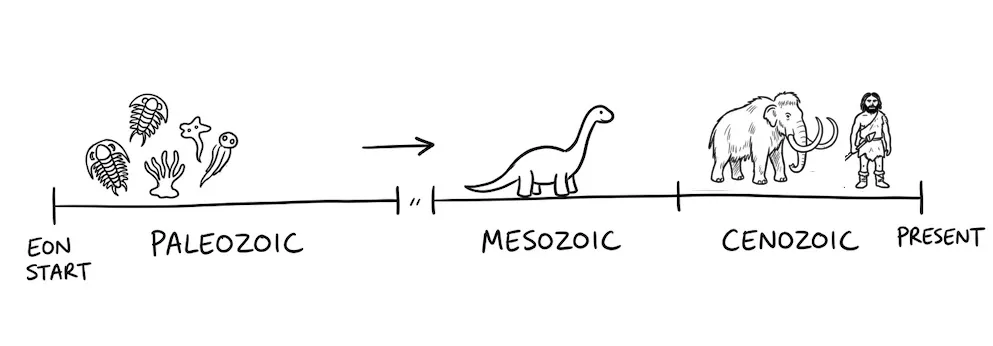
The Phanerozoic Eon is the most recent major division of Earth's history. It began about 540 million years ago and continues today. The name means "visible life" in Greek. Scientists use this name because fossils from this time period show clear evidence of complex organisms. Before the Phanerozoic Eon, most life on Earth was microscopic and left few fossils.
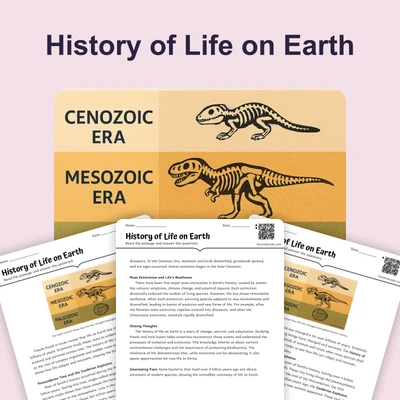
The Phanerozoic Eon includes three major eras: the Paleozoic, Mesozoic, and Cenozoic. Each era represents a distinct chapter in Earth's biological history. The Paleozoic Era saw the rise of early fish, insects, and the first land plants. The Mesozoic Era is often called the Age of Dinosaurs. The Cenozoic Era began 66 million years ago and includes the rise of mammals and humans. Evidence shows that each era ended with significant changes in Earth's life forms.
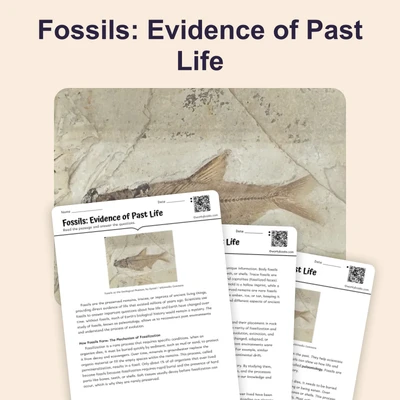
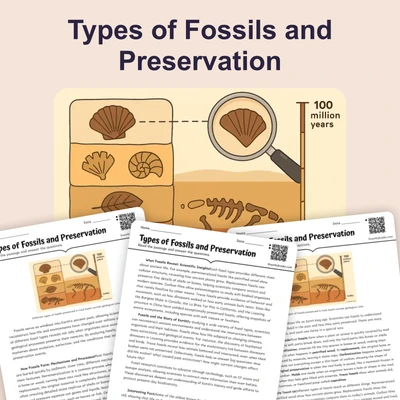
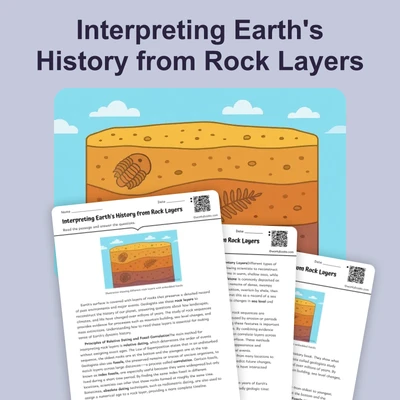
Scientists study the Phanerozoic Eon by examining fossils preserved in rock layers. Most fossils displayed in museums come from this eon. These fossils include shells, bones, teeth, and impressions of ancient organisms. The fossil record from this time is much more complete than earlier periods. This abundance of fossils helps scientists understand how life evolved over millions of years. For example, the Burgess Shale in Canada contains exceptionally preserved fossils from the early Paleozoic Era. These fossils show the diversity of ocean life 508 million years ago.
Understanding the Phanerozoic Eon helps scientists explain patterns in Earth's history. The eon represents only about 12 percent of Earth's total age. However, it contains most of the biological diversity we can observe in rocks. The previous 4 billion years, called Precambrian time, had mostly single-celled organisms. The transition to complex life marks a major turning point. Scientists continue to study this eon to understand how organisms adapt to environmental changes. This knowledge can help us predict how modern ecosystems may respond to current climate conditions.
Interesting Fact: During the Cambrian Period at the start of the Phanerozoic Eon, the number of major animal groups increased dramatically in just 20 million years. Scientists call this rapid diversification the Cambrian Explosion.
Comprehension quiz (10 questions)
1. When did the Phanerozoic Eon begin?
2. What does the name 'Phanerozoic' mean?
3. Which term refers to large divisions of geologic time that are subdivisions of eons?
4. Based on the passage, what can scientists learn from the Burgess Shale fossils?
5. Why is the fossil record from the Phanerozoic Eon more complete than earlier periods?
6. How might studying the Phanerozoic Eon help scientists predict future changes?
7. If a student wanted to compare how life changed across different time periods, which concept would be most useful?
8. What percentage of Earth's total age does the Phanerozoic Eon represent?
9. True or False: Most life on Earth was microscopic before the Phanerozoic Eon.
10. True or False: The Cenozoic Era is also known as the Age of Dinosaurs.
Perfect for the way you teach
- Build comprehension skills
- Auto-graded quiz
- Differentiated reading
- Read together at home
- Improve fluency
- Quiet reading time
- Reading curriculum support
- Independent practice
- Track Lexile growth