How Is Water Distributed on Earth — Reading Comprehension
Rate this
Premium Resource
Present
Present in classroom. No work saved
Assign
Classroom with student accounts, Track progress
Quick Play
No student accounts, assign with a link
Grades
6
7
8
Standards
MS-ESS2-4
PRINT+DIGITAL RESOURCE
This learning resource is available in interactive and printable formats. The interactive worksheet can be played online and assigned to students. The Printable PDF version can be downloaded and printed for completion by hand.
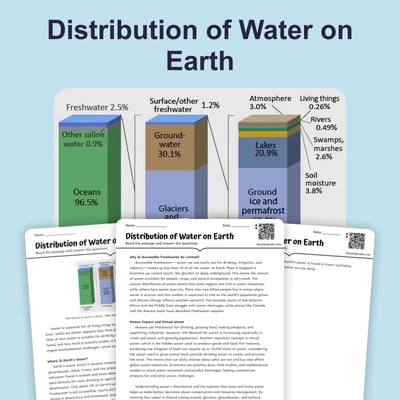
This comprehensive middle school science reading passage examines how water is distributed on Earth, aligning with NGSS standard MS-ESS2-4. Students explore the critical concept that 97% of Earth's water is saltwater found in oceans, while only 3% is freshwater. The passage details where freshwater is stored: approximately 69% in ice caps and glaciers, 30% as groundwater beneath Earth's surface, and less than 1% in lakes, rivers, and streams. Through clear explanations and real-world examples, students understand why water distribution affects human access to usable water. The audio-integrated passage includes differentiated versions for diverse learners, Spanish translations, interactive activities, and graphic organizers. Students engage with vocabulary like hydrosphere, groundwater, glaciers, and aquifers while developing skills in data analysis and scientific reasoning. Multiple-choice questions, writing prompts, and visual organizers reinforce understanding of this essential Earth science concept.
CONTENT PREVIEW
Expand content preview
"Glaciers and surface streams illustrate the distribution of Earth's limited freshwater." Image by Natalia_Kollegova / Pixabay.
Earth contains approximately 1.386 billion cubic kilometers of water, but not all of this water is the same. The hydrosphere, which includes all water on Earth's surface, underground, and in the atmosphere, is divided into two main categories: saltwater and freshwater. Understanding how water is distributed across our planet helps explain why access to usable water varies greatly in different regions.
Saltwater makes up about 97% of all water on Earth. This water is found primarily in oceans, which cover roughly 71% of Earth's surface. Saltwater contains dissolved minerals and salts, with an average concentration of 35 grams of salt per liter of water. While saltwater supports marine ecosystems and influences global climate patterns, humans cannot drink it or use it for agriculture without expensive treatment processes called desalination.
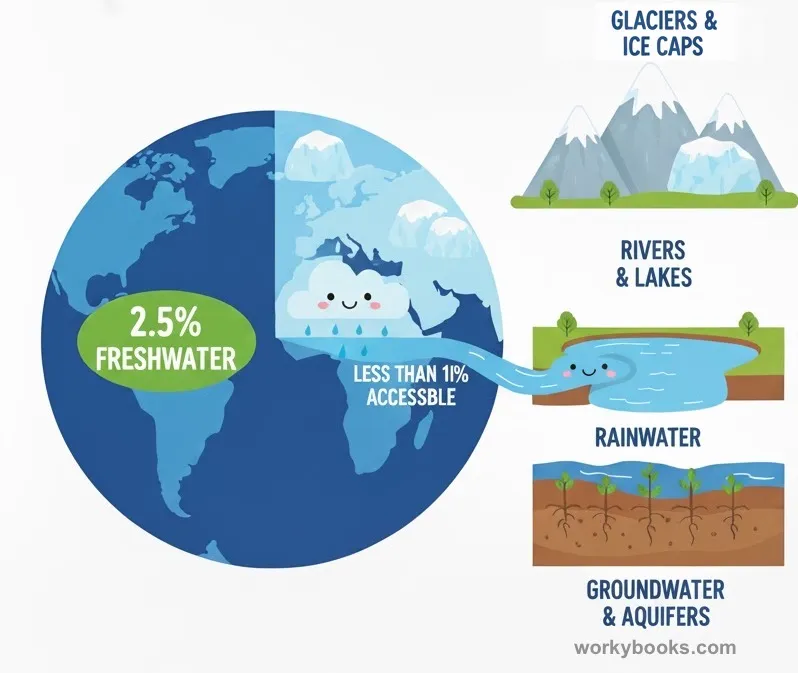
Only 3% of Earth's water is freshwater, meaning it contains very low concentrations of dissolved salts. However, most of this freshwater is not easily accessible. Approximately 69% of Earth's freshwater is frozen in ice caps and glaciers, primarily in Antarctica and Greenland. These massive ice formations store freshwater in solid form, making it unavailable for immediate human use. As global temperatures change, scientists monitor these ice reserves closely because melting ice affects both freshwater availability and sea levels.
About 30% of Earth's freshwater exists as groundwater, which is water stored in spaces between rocks and soil particles beneath Earth's surface. Groundwater collects in underground formations called aquifers, which act like natural storage tanks. People access groundwater by drilling wells, and it provides drinking water for approximately 1.5 billion people worldwide. Some aquifers recharge quickly when rain and melted snow seep through the ground, while others contain ancient water that accumulated thousands of years ago.
Less than 1% of Earth's freshwater exists as surface water in lakes, rivers, streams, and wetlands. Despite representing such a small percentage, surface water is extremely important because it is the most accessible freshwater source. Rivers provide water for drinking, irrigation, and transportation. Lakes store water and support diverse ecosystems. This tiny fraction of Earth's total water supply supports most terrestrial life and human civilizations.
The distribution of water on Earth creates challenges for human populations. While water constantly cycles through evaporation, condensation, and precipitation, freshwater is not evenly distributed geographically. Some regions receive abundant rainfall and have access to rivers and aquifers, while other areas experience water scarcity. Understanding water distribution helps scientists and communities develop strategies for managing this essential resource, including water conservation, efficient irrigation systems, and careful monitoring of groundwater withdrawal rates.
Interesting Fact: If all of Earth's water fit in a gallon jug, available freshwater would equal just over one tablespoon—and most of that would be frozen or underground, leaving only a few drops readily accessible for human use.
What percentage of Earth's water is saltwater?
97%3%69%30%
Where is most of Earth's freshwater stored?
In lakes and riversIn ice caps and glaciersIn underground aquifersIn the atmosphere
What is an aquifer?
A large body of surface waterA frozen mass of freshwaterAn underground formation that stores groundwaterA process for removing salt from water
Based on the passage, why is surface water important even though it represents less than 1% of freshwater?
It contains the most mineralsIt is the most accessible freshwater sourceIt has the highest salt concentrationIt is found only in polar regions
What does the term 'desalination' mean in the context of the passage?
The freezing of freshwater into iceThe movement of water undergroundThe process of removing salt from saltwaterThe evaporation of surface water
Why do scientists monitor ice caps and glaciers closely?
Because they want to measure salt contentBecause melting ice affects freshwater availability and sea levelsBecause ice caps produce groundwaterBecause they contain most of Earth's saltwater
If a community needs to access groundwater, what would they need to do?
Build dams on riversMelt nearby glaciersDrill wells into aquifersCollect rainwater in tanks
Which statement best explains why water scarcity exists in some regions?
All freshwater is frozen in ice capsFreshwater is not evenly distributed geographicallySaltwater cannot be found in those areasSurface water does not exist in dry regions
True or False: Humans can drink saltwater directly from the ocean without any treatment.
TrueFalse
True or False: About 30% of Earth's freshwater exists as groundwater stored beneath the surface.
TrueFalse
Perfect For:
👩🏫 Teachers
• Reading comprehension practice
• Auto-graded assessments
• Literacy skill development
👨👩👧👦 Parents
• Reading practice at home
• Comprehension improvement
• Educational reading time
🏠 Homeschoolers
• Reading curriculum support
• Independent reading practice
• Progress monitoring
Reading Features:
📖
Reading Passage
Engaging fiction or nonfiction text
❓
Comprehension Quiz
Auto-graded questions
📊
Instant Feedback
Immediate results and scoring
📄
Printable Version
Download for offline reading
🔊
Read Aloud
Voice-over with word highlighting
Reviews & Ratings
No reviews yet. Be the first to share your experience!
Related Content
The Intertropical Convergence Zone (ITCZ): Earth's Weather Belt
This science passage explains the Intertropical Convergence Zone (ITCZ), a key equatorial weather system. Covering NGSS ...
MS-ESS2-5MS-ESS2-4RI.6.7
What Type of Cloud Is Associated with Hail?
This NGSS-aligned science reading passage for middle school explains that cumulonimbus clouds are the main cloud type re...
MS-ESS2-4
Earth's Spheres
This middle school science passage introduces students to Earth's four major spheres: the geosphere, hydrosphere, atmosp...
MS-ESS2-4MS-ESS2-6
Surface Water: Rivers, Lakes, and Wetlands
This engaging middle school science passage explores the dynamic world of surface water, focusing on the complex systems...
MS-ESS2-4
Groundwater
This middle school science passage explores the essential topic of groundwater, aligned to NGSS standards MS-ESS2-4 and ...
MS-ESS2-4MS-ESS3-1
Distribution of Water on Earth
This middle school science reading passage explores the distribution of water on Earth, aligned with NGSS standards MS-E...
MS-ESS2-4MS-ESS3-1
Water in Ecosystems
This engaging passage for grades 6-8 explores the essential role of water in ecosystems, tracing its movement through va...
MS-LS2-3MS-ESS2-4
The Ozone Layer
This engaging NGSS-aligned passage explores the science and importance of the ozone layer for middle school students (gr...
MS-ESS2-4MS-ESS3-3
Layers of the Atmosphere
This middle school science reading passage, aligned to NGSS standard MS-ESS2-4, guides students through the structure an...
MS-ESS2-4
How Sonar Maps the Ocean Floor
This comprehensive middle school science reading passage explores how sonar technology maps the ocean floor using sound ...
MS-ESS2-4
How Aquifers Store Groundwater
This comprehensive reading passage explores how aquifers store groundwater, aligned with NGSS standard MS-ESS2-4. Studen...
MS-ESS2-4
How Glaciers Store and Release Water
This comprehensive middle school science passage examines how glaciers store and release water, aligned with NGSS MS-ESS...
MS-ESS2-4
How Does Condensation Form Cloud Droplets
This comprehensive middle school science reading passage explores how condensation forms droplets in Earth's atmosphere,...
MS-ESS2-4
How Do Oceans Drive the Water Cycle
This comprehensive middle school science reading passage examines how oceans drive the water cycle, aligning with NGSS s...
MS-ESS2-4
How Does Solar Energy Drive the Water Cycle
This comprehensive 650-word reading passage explores how solar energy and gravity work together as the dual engines of E...
MS-ESS2-4
How Precipitation Returns Water to Earth
This comprehensive middle school science reading passage examines how precipitation returns water to Earth's surface and...
MS-ESS2-4
What Is Oceanography
This comprehensive reading passage introduces middle school students to the field of oceanography and how scientists stu...
MS-ESS2-4
Freshwater vs. Saltwater
This comprehensive 650-word science reading passage for middle school students (grades 6-8) examines the critical differ...
MS-ESS2-4
How Does Water Evaporate into the Atmosphere
This comprehensive 600-word reading passage explores how water enters the atmosphere through evaporation and transpirati...
MS-ESS2-4
How Does Runoff Flow Across Watersheds
This comprehensive middle school science passage explores how runoff and watersheds drain, aligning with NGSS standard M...