How Mantle Convection Drives Plates
Interactive passage with audio narration, comprehension questions, and printable PDF.
What's included
How Mantle Convection Drives Plates preview and details
About this printable How Mantle Convection Drives Plates science reading passage, NGSS-aligned (Grades 5-8)
Sample passage and quiz from How Mantle Convection Drives Plates
Reading passage and comprehension quiz preview
How Mantle Convection Drives Plates
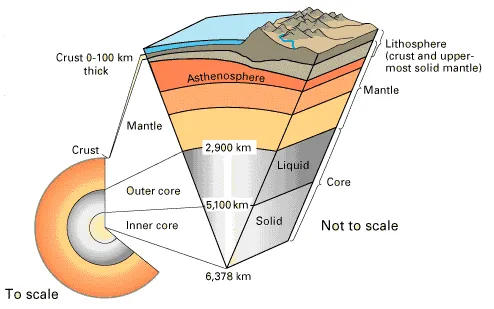
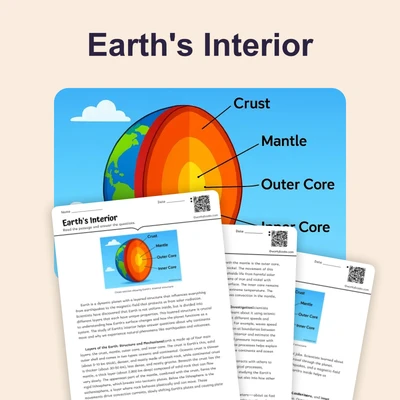
"Earth cutaway schematic-en" by USGS / Wikimedia Commons.
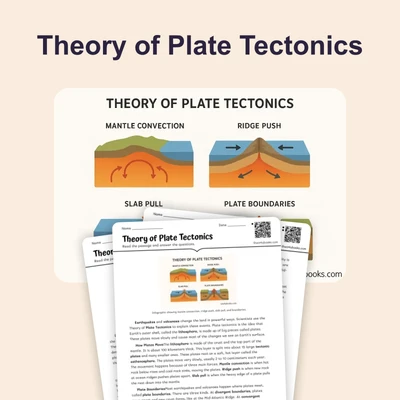
What makes Earth's tectonic plates move across the surface? The answer lies deep inside our planet. Mantle convection is the main engine that drives plate movement. This process occurs in the mantle, the thick layer of hot rock between Earth's core and crust.
The mechanism works because of heat and density differences. Deep in the mantle, rock near the hot core absorbs enormous amounts of thermal energy. This heating causes the rock to expand and become less dense. Scientists explain that less dense material rises, similar to how hot air rises above a candle flame. As this heated rock slowly moves upward, cooler rock near the top of the mantle sinks to take its place.
When the rising rock reaches the area just below the lithosphere, it begins to cool. The cooling rock loses heat to the overlying plates and becomes denser again. This denser rock then spreads sideways beneath the plates before sinking back down into the mantle. The cycle repeats endlessly, creating circular patterns called convection cells. Evidence shows these cells move extremely slowly, only a few centimeters per year.
As the mantle rock creeps along beneath the plates, it drags them across Earth's surface. The tectonic plates float on the upper mantle like rafts on a slowly moving current. This process explains how continents can drift thousands of kilometers over millions of years. The Mid-Atlantic Ridge provides a real example of this mechanism in action. There, rising mantle material pushes the North American and Eurasian plates apart at about 2.5 centimeters per year.
Understanding mantle convection reveals how Earth's internal heat shapes our planet's surface. This same heat drives the rock cycle, melting rock that forms new crust at spreading ridges. Mantle convection connects plate tectonics to volcanic activity, mountain building, and earthquakes. Scientists observe that this churning process has operated for billions of years, constantly reshaping continents and ocean basins.
Interesting Fact: The mantle rock involved in convection is solid, not liquid, but it can flow very slowly over millions of years like thick honey or putty.
Comprehension quiz (10 questions)
1. What is the main force that drives tectonic plate movement?
2. Why does heated mantle rock rise toward the surface?
3. What happens to mantle rock when it reaches the area below the lithosphere?
4. In the passage, what does the term 'convection cells' refer to?
5. Based on the passage, how fast do the North American and Eurasian plates move apart at the Mid-Atlantic Ridge?
6. What can you infer about the relationship between mantle convection and the rock cycle?
7. How does the passage suggest that tectonic plates interact with the mantle?
8. If mantle convection suddenly stopped, what would likely happen to plate movement?
9. True or False: The mantle rock involved in convection is liquid.
10. True or False: Mantle convection has been operating for billions of years.
Perfect for the way you teach
- Build comprehension skills
- Auto-graded quiz
- Differentiated reading
- Read together at home
- Improve fluency
- Quiet reading time
- Reading curriculum support
- Independent practice
- Track Lexile growth