How Does Natural Gas Form
Interactive passage with audio narration, comprehension questions, and printable PDF.
By completing this purchase you agree to our Terms of Use and Privacy Policy. Your subscription renews automatically until you cancel. You can cancel anytime from your account settings. All sales are final and non-refundable. Digital content is available for download in your account immediately upon purchase.
What's included
How Does Natural Gas Form preview and details
About this printable How Does Natural Gas Form science reading passage, NGSS-aligned (Grades 6-8)
Sample passage and quiz from How Does Natural Gas Form
Reading passage and comprehension quiz preview
How Natural Gas Forms
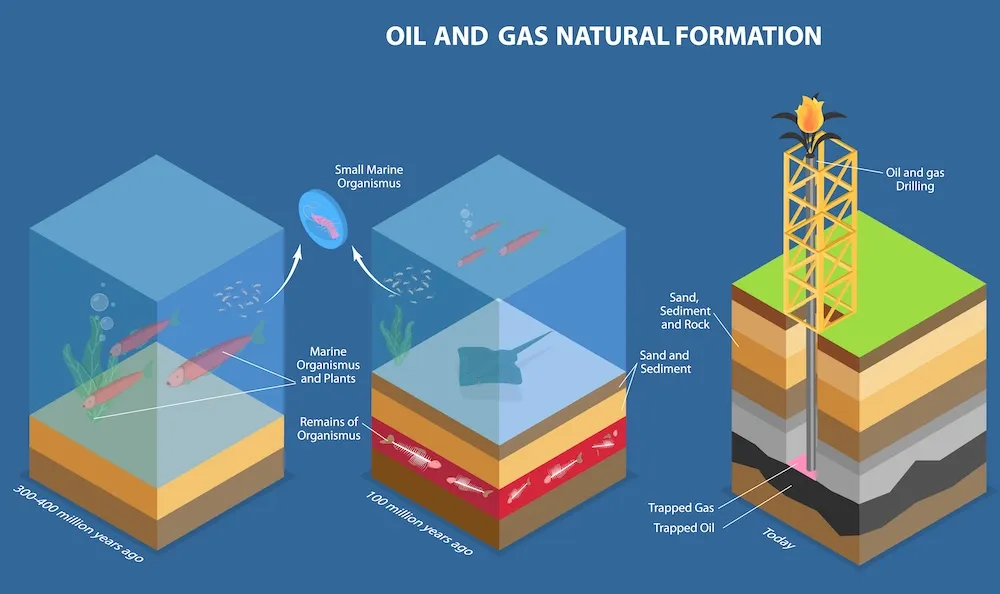
Natural gas is a fossil fuel that forms deep underground over millions of years. It develops from the remains of ancient plants and animals that lived in oceans and seas. When these organisms died, their bodies sank to the ocean floor and mixed with mud and sand. Over time, layer upon layer of sediment buried this organic matter, creating the conditions needed for natural gas formation.
The process of natural gas formation requires specific conditions of heat and pressure. As sediment layers accumulated, they became heavier and pressed down on the organic material below. This pressure, combined with heat from Earth's interior, caused chemical changes in the buried organisms. The temperature typically needs to reach between 90 and 160 degrees Celsius for natural gas to form. At these temperatures, the organic matter breaks down into simpler molecules. The main component of natural gas is methane, a molecule made of one carbon atom and four hydrogen atoms.
Natural gas can form in two main ways. Most commonly, it forms alongside petroleum (crude oil) in the same rock layers. Both substances develop from the same organic material, but temperature determines which forms. At lower temperatures, petroleum forms. At higher temperatures, petroleum breaks down further into natural gas. Natural gas can also form directly from coal beds when plant material is buried and heated. This type is called coalbed methane.
Once natural gas forms, it does not stay in the source rock where it developed. Because natural gas is lighter than the surrounding rock and fluids, it begins to move upward through the Earth's crust. This movement is called migration. Natural gas migrates through tiny spaces and cracks in permeable rocks, which are rocks that allow fluids and gases to pass through them. Sandstone and limestone are examples of permeable rocks that natural gas can move through easily.
Natural gas continues migrating upward until it reaches an impermeable rock layer that blocks its path. These blocking layers are called cap rocks or seal rocks, and they are typically made of shale or clay. When natural gas encounters a cap rock, it becomes trapped underneath and begins to accumulate. The rock formation where natural gas collects is called a reservoir rock. Reservoir rocks must be both porous (containing many small spaces) and permeable (allowing gas to flow through). The natural gas fills the tiny pore spaces in the reservoir rock, similar to how water fills the spaces in a sponge.
The best reservoir rocks have a special structure that prevents the gas from escaping sideways. Anticlines, which are upward-folding rock layers shaped like an arch, are excellent natural gas traps. The gas migrates upward along the sloping layers and becomes concentrated at the highest point of the arch, held in place by the cap rock above. Other geological structures, such as fault traps and salt domes, can also create effective reservoirs for natural gas accumulation.
Understanding how natural gas forms and migrates helps scientists locate new sources of this important energy resource. By studying rock layers, temperatures, and geological structures, geologists can predict where natural gas reservoirs might exist. This knowledge is essential for meeting energy needs while making informed decisions about resource use and environmental impacts.
Interesting Fact: Some natural gas deposits are over 400 million years old, meaning the organisms that became this fuel lived before dinosaurs even existed on Earth.
Comprehension quiz (10 questions)
1. What is the main component of natural gas?
2. What temperature range is needed for natural gas to form?
3. In the context of the passage, what does the term 'migration' mean?
4. What does 'permeable' mean when describing rocks?
5. Why does natural gas move upward through rock layers?
6. What geological structure is described as an excellent natural gas trap shaped like an upward arch?
7. Which statement best explains why both petroleum and natural gas can form from the same organic material?
8. If a geologist finds a layer of impermeable shale above porous sandstone, what can be predicted about natural gas in this area?
9. True or False: Natural gas forms quickly, taking only a few hundred years to develop.
10. True or False: Cap rocks are typically made of materials like shale or clay that prevent natural gas from escaping upward.
Perfect for the way you teach
- Build comprehension skills
- Auto-graded quiz
- Differentiated reading
- Read together at home
- Improve fluency
- Quiet reading time
- Reading curriculum support
- Independent practice
- Track Lexile growth