How Plates Build Mountain Ranges
Interactive passage with audio narration, comprehension questions, and printable PDF.
By completing this purchase you agree to our Terms of Use and Privacy Policy. Your subscription renews automatically until you cancel. You can cancel anytime from your account settings. All sales are final and non-refundable. Digital content is available for download in your account immediately upon purchase.
What's included
How Plates Build Mountain Ranges preview and details
About this printable How Plates Build Mountain Ranges science reading passage, NGSS-aligned (Grades 5-8)
Sample passage and quiz from How Plates Build Mountain Ranges
Reading passage and comprehension quiz preview
How Plates Build Mountain Ranges
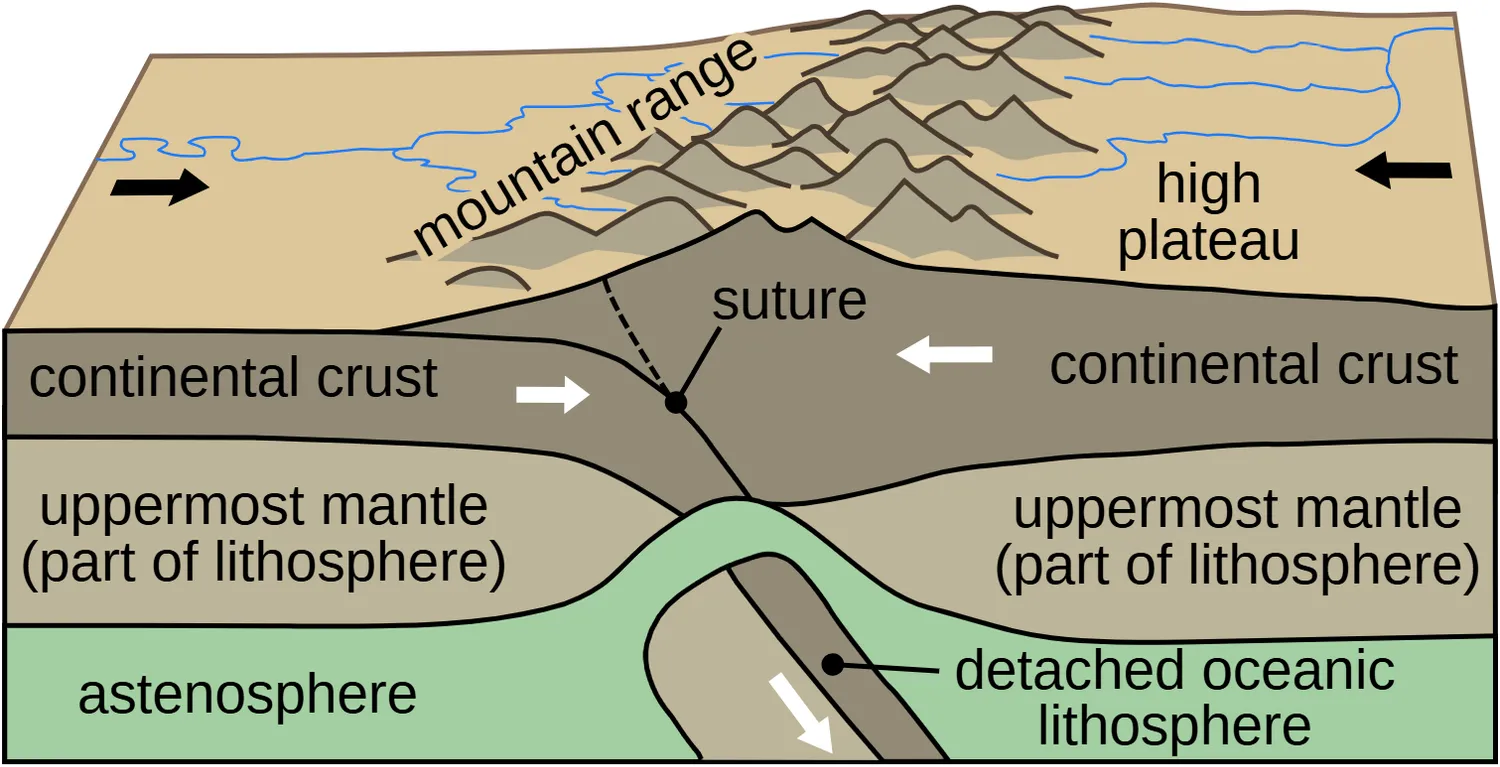
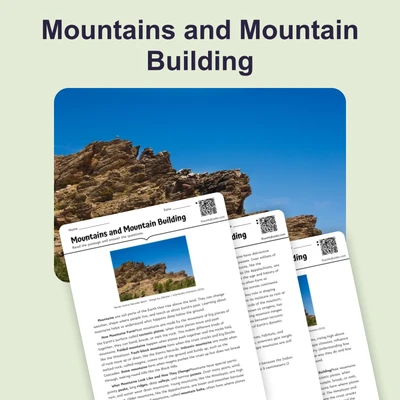
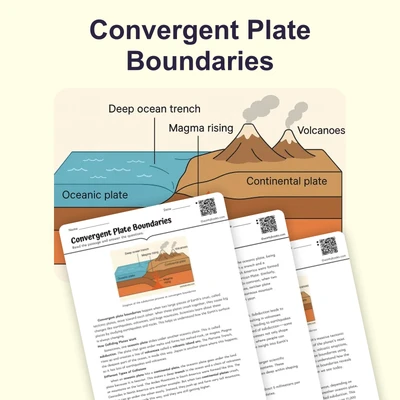
Earth's towering mountain ranges rise where massive tectonic plates collide. These plates float on the planet's hot, flowing mantle and move slowly across the surface. When two plates push together at convergent boundaries, enormous forces compress and lift the crust upward. Over millions of years, this slow collision builds long chains of mountains.
The process begins when plates move toward each other at speeds of only a few centimeters per year. Scientists explain that even this slow movement creates tremendous pressure because the plates cannot easily slide past one another. The crust between the colliding plates gets squeezed and crumpled. This compression causes the rock layers to bend into waves called folds. The crust can also crack along lines called faults, where huge blocks of rock shift upward or sideways. Both folding and faulting push rock higher, creating mountains. This upward movement is called uplift.
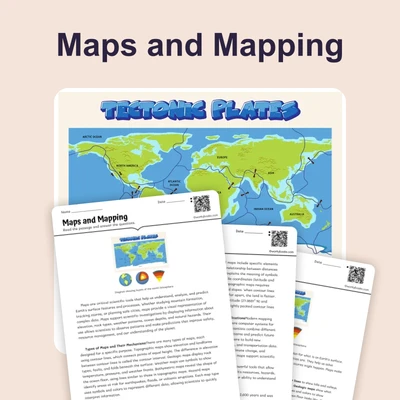
Evidence shows that the world's greatest mountain ranges sit at or near convergent plate boundaries. The Himalayas, Earth's highest range, formed when the Indian plate collided with the Eurasian plate about 50 million years ago. This collision continues today, and the mountains still rise about five millimeters each year. Looking at a world map reveals a clear pattern: major mountain chains line up along the edges where plates meet.
Mountains do not grow forever, though. While tectonic forces push them upward, weathering and erosion constantly wear them down. Wind, water, ice, and temperature changes break rock apart and carry it away. A mountain range's height reflects this ongoing battle between uplift and erosion. When uplift happens faster than erosion, mountains grow taller. When erosion outpaces uplift, mountains shrink. Scientists observe that young mountain ranges like the Himalayas have jagged, tall peaks because uplift still dominates. Older ranges have smoother, lower peaks because erosion has had more time to work.
Understanding how plates build mountains helps explain Earth's changing surface. The same forces that raise mountains also trigger earthquakes and create volcanoes at plate boundaries. Mountain building connects plate tectonics to other Earth processes. It shows how our planet's surface constantly changes through the push and pull of internal forces and surface weathering.
Interesting Fact: Mount Everest, the world's tallest mountain at 8,849 meters, contains fossils of ancient sea creatures. This evidence shows that the rock forming its peak once lay at the bottom of an ocean before plate collision lifted it skyward.
Comprehension quiz (10 questions)
1. Where do Earth's towering mountain ranges typically form?
2. What happens to rock layers when tectonic plates compress the crust?
3. The term 'uplift' in the passage refers to:
4. What does 'compression' mean in the context of mountain building?
5. Why do the Himalayas continue to grow taller today?
6. Based on the passage, what can we infer about older mountain ranges compared to younger ones?
7. A mountain range's height depends on the balance between which two processes?
8. If you wanted to find major mountain ranges on Earth, where would you look?
9. True or False: Tectonic plates move at speeds of several meters per year.
10. True or False: The presence of sea creature fossils on Mount Everest provides evidence that the rock was once at the ocean bottom.
Perfect for the way you teach
- Build comprehension skills
- Auto-graded quiz
- Differentiated reading
- Read together at home
- Improve fluency
- Quiet reading time
- Reading curriculum support
- Independent practice
- Track Lexile growth