How Sedimentary Layers Build Resource Deposits — Reading Comprehension
Rate this|
1
Premium Resource
Present
Present in classroom. No work saved
Assign
Classroom with student accounts, Track progress
Quick Play
No student accounts, assign with a link
Grades
6
7
8
Standards
MS-ESS3-1
PRINT+DIGITAL RESOURCE
This learning resource is available in interactive and printable formats. The interactive worksheet can be played online and assigned to students. The Printable PDF version can be downloaded and printed for completion by hand.
This comprehensive middle school science passage examines how sedimentary processes concentrate economically valuable resources through weathering, transport, and deposition. Students explore sedimentary basins where organic matter accumulates and transforms into fossil fuels, evaporite deposits formed by water evaporation leaving behind concentrated minerals, and placer deposits where dense minerals settle during transport. The passage connects to NGSS standard MS-ESS3-1, helping students understand how natural processes create the distribution of natural resources humans depend on. Audio-integrated features support diverse learners, while differentiated versions ensure accessibility for all reading levels. The content includes real-world examples like salt flats and gold deposits, reinforcing how geological processes shape resource availability. Engaging activities, graphic organizers, and comprehension questions deepen understanding of these essential earth science concepts.
CONTENT PREVIEW
Expand content preview
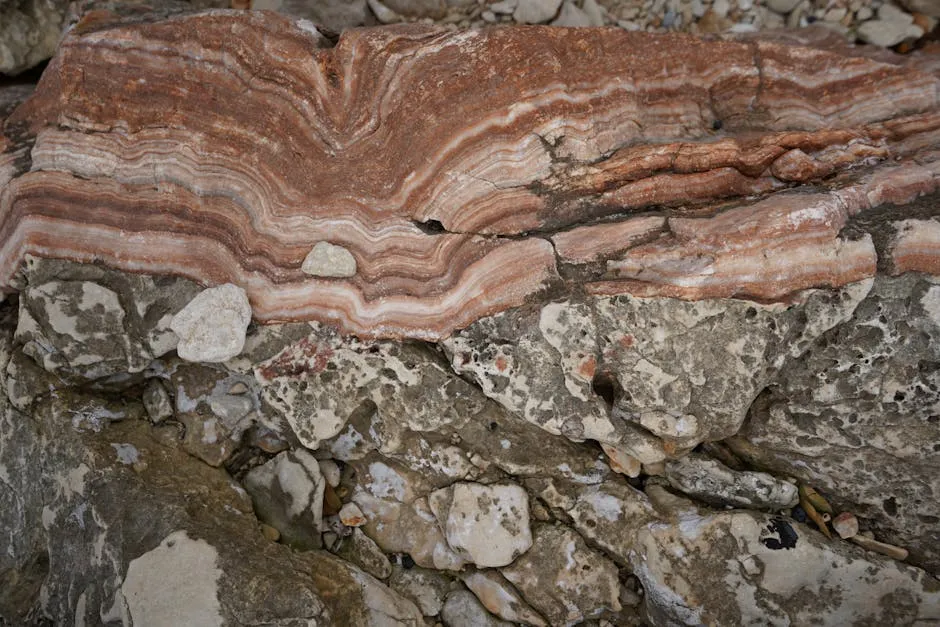
"Banded sedimentary rock." Image by Eli Pluma / Pexels.
Sedimentary processes are natural geological events that break down, move, and deposit rock materials across Earth's surface. These processes play a critical role in concentrating valuable minerals and creating conditions for fossil fuels to form. Understanding how weathering, transport, and deposition work together helps explain why certain resources are found in specific locations.
Weathering breaks down rocks into smaller particles through physical forces like freezing water or chemical reactions with air and water. Once broken down, these particles are transported by wind, water, or ice to new locations. During transport, heavier and denser materials settle out first, while lighter materials travel farther. This sorting process is key to concentrating valuable minerals. Finally, deposition occurs when transported materials settle in layers, often in low-lying areas like ocean basins or lake beds.
Sedimentary basins are large depressions in Earth's crust where sediments accumulate over millions of years. These basins often form in areas where the crust has subsided or sunk down. As sediments pile up, they bury organic matter from dead plants and animals. Over time, heat and pressure transform this organic material into oil and natural gas. The Gulf of Mexico is an example of a sedimentary basin that contains significant fossil fuel deposits formed from ancient marine organisms.
Evaporite deposits form when water containing dissolved minerals evaporates, leaving behind concentrated mineral layers. This process typically occurs in shallow seas or desert lakes where evaporation rates exceed water input. As water evaporates, minerals like salt, gypsum, and potash crystallize and accumulate in thick beds. The Great Salt Lake in Utah demonstrates this process, where evaporation concentrates minerals that were once dissolved in the water.
Placer deposits concentrate valuable minerals through the physical sorting action of moving water. Dense, resistant minerals like gold, diamonds, and tin separate from lighter materials during stream transport. These heavy minerals settle in areas where water slows down, such as behind boulders or in river bends. Over time, these concentrations can become economically valuable deposits. Many historic gold rushes, including California's in 1849, focused on placer deposits in stream beds.
These three types of sedimentary processes demonstrate how natural geological events create the uneven distribution of Earth's resources. Sedimentary basins provide the specific conditions needed for fossil fuel formation through burial and transformation of organic matter. Evaporite deposits concentrate minerals through evaporation in restricted water bodies. Placer deposits use density differences to separate and concentrate heavy, valuable minerals. Each process requires specific geological settings and environmental conditions to concentrate resources effectively.
Interesting Fact: Some evaporite deposits are so thick that they reach depths of over 1,000 meters, representing millions of years of continuous evaporation and mineral accumulation in ancient seas.
What are sedimentary processes?
Natural events that break down, move, and deposit rock materialsProcesses that only create mountainsEvents that only occur in oceansProcesses that destroy all minerals
How do sedimentary basins create fossil fuels?
By evaporating water and leaving mineralsBy burying organic matter and applying heat and pressure over timeBy sorting heavy minerals from light onesBy freezing water in rock cracks
What is the main process that forms evaporite deposits?
Water flowing rapidly over rocksVolcanic eruptions creating mineralsWater evaporation leaving behind concentrated mineralsWind erosion of mountain peaks
In the passage, what does the term 'deposition' mean?
Breaking down rocks into smaller piecesWhen transported materials settle and accumulate in layersThe movement of rocks by wind and waterThe chemical reaction between rocks and air
What does 'weathering' refer to in the context of sedimentary processes?
Predicting rain and stormsThe aging of buildings over timeThe process that breaks down rocks into smaller particlesThe formation of clouds
Why do placer deposits concentrate valuable minerals like gold?
Because gold evaporates with waterBecause dense minerals settle where water slows down while lighter materials wash awayBecause gold is created by heat and pressureBecause gold floats on water
Based on the passage, which geological setting would most likely form evaporite deposits?
A fast-flowing mountain streamA deep ocean trenchA shallow desert lake with high evaporationAn active volcano
If you wanted to find placer gold deposits, where would be the best place to look?
In dry desert salt flatsIn deep sedimentary basinsIn river bends and behind boulders in stream bedsOn top of tall mountains
Sedimentary processes only occur in ocean environments.
TrueFalse
The Gulf of Mexico is an example of a sedimentary basin that contains fossil fuel deposits.
TrueFalse
Perfect For:
👩🏫 Teachers
• Reading comprehension practice
• Auto-graded assessments
• Literacy skill development
👨👩👧👦 Parents
• Reading practice at home
• Comprehension improvement
• Educational reading time
🏠 Homeschoolers
• Reading curriculum support
• Independent reading practice
• Progress monitoring
Reading Features:
📖
Reading Passage
Engaging fiction or nonfiction text
❓
Comprehension Quiz
Auto-graded questions
📊
Instant Feedback
Immediate results and scoring
📄
Printable Version
Download for offline reading
🔊
Read Aloud
Voice-over with word highlighting
Reviews & Ratings
No reviews yet. Be the first to share your experience!
Related Content
How Do Solar Panels Work?
This middle school reading passage explains how solar panels work by turning sunlight into electricity. The passage desc...
MS-ESS3-1
How Do Wind Turbines Work?
This NGSS-aligned reading passage for middle school students explains how wind turbines convert the energy of moving air...
MS-ESS3-1
How Does a Hydroelectric Dam Work?
This NGSS-aligned science passage for middle school students explains how hydroelectric dams work to produce clean, rene...
MS-ESS3-1
What Is Biofuel?
This NGSS-aligned middle school science passage explains what biofuel is, how it is made, and why it is important as a c...
MS-ESS3-1
What Is Tidal Energy?
This engaging reading passage for middle school students introduces tidal energy, a form of renewable energy that uses t...
MS-ESS3-1
What Is Wave Energy?
This passage introduces middle school students to wave energy—a clean, renewable energy source that comes from the movem...
MS-ESS3-1
What Is Green Energy?
This science passage introduces middle school students to the concept of green energy—clean, renewable energy that comes...
MS-ESS3-1
Igneous Rocks
This comprehensive passage introduces middle school students to igneous rocks, focusing on how these rocks form from mol...
MS-ESS2-1MS-ESS3-1
Sedimentary Rocks
This comprehensive middle school science passage introduces students to sedimentary rocks, detailing their step-by-step ...
MS-ESS2-1MS-ESS2-3MS-ESS3-1
Metamorphic Rocks
This engaging middle school science passage introduces students to the fascinating world of metamorphic rocks. Aligned w...
MS-ESS2-1MS-ESS3-1
Topographic Maps
This comprehensive passage introduces middle school students to topographic maps, with a focus on how these maps represe...
MS-ESS2-2MS-ESS3-1SEP.4SEP.7
Minerals and Rocks as Resources
This middle school science passage, aligned to NGSS standards MS-ESS3-1 and MS-ESS3-4, explores the critical role that m...
MS-ESS3-1MS-ESS3-4
Benefits of Volcanic Activity
This middle school science passage explores the many positive impacts of volcanic activity, aligning with NGSS standards...
MS-ESS2-2MS-ESS3-1
Groundwater
This middle school science passage explores the essential topic of groundwater, aligned to NGSS standards MS-ESS2-4 and ...
MS-ESS2-4MS-ESS3-1
Distribution of Water on Earth
This middle school science reading passage explores the distribution of water on Earth, aligned with NGSS standards MS-E...
MS-ESS2-4MS-ESS3-1
Water as a Resource
This middle school science passage examines water as a critical resource, focusing on how it is used, managed, and conse...
MS-ESS3-1MS-ESS3-4
Water Quality
This middle school science reading passage covers the topic of water quality, aligned with NGSS standards MS-ESS3-1 and ...
MS-ESS3-1MS-ESS3-3
How Do Uranium Deposits Form
This informative science reading passage for middle school students (grades 6-8) explains why uranium concentrates in ce...
MS-ESS3-1
How Minerals Are Mined
This comprehensive 650-word informational science reading passage teaches middle school students (grades 6-8) about mine...
MS-ESS3-1
Why Are Resources Unevenly Distributed on Earth
This comprehensive 650-word reading passage explains why natural resources are unevenly distributed across Earth's surfa...