This comprehensive 500-word reading passage for middle school students (grades 6-8) examines how telescopes changed astronomy and our understanding of the universe. Students explore the historical progression from naked-eye observations to Galileo's groundbreaking 1609 telescope discoveries, including Jupiter's moons and lunar craters. The passage explains how different telescope types—refractors, reflectors, and space telescopes—work and what they revealed. Real-world examples include the Hubble Space Telescope and James Webb Space Telescope. Aligned with NGSS standards MS-ESS1-3 and MS-ESS1.B, this audio-integrated passage includes vocabulary development, comprehension questions, writing activities, and graphic organizers. The content helps students understand how technological advancements in telescopes expanded astronomical knowledge and changed scientific understanding of Earth's place in the solar system and universe.
Written by Workybooks TeamPublished by Workybooks
Preview
Sample passage and quiz content
CONTENT PREVIEW
Expand content preview
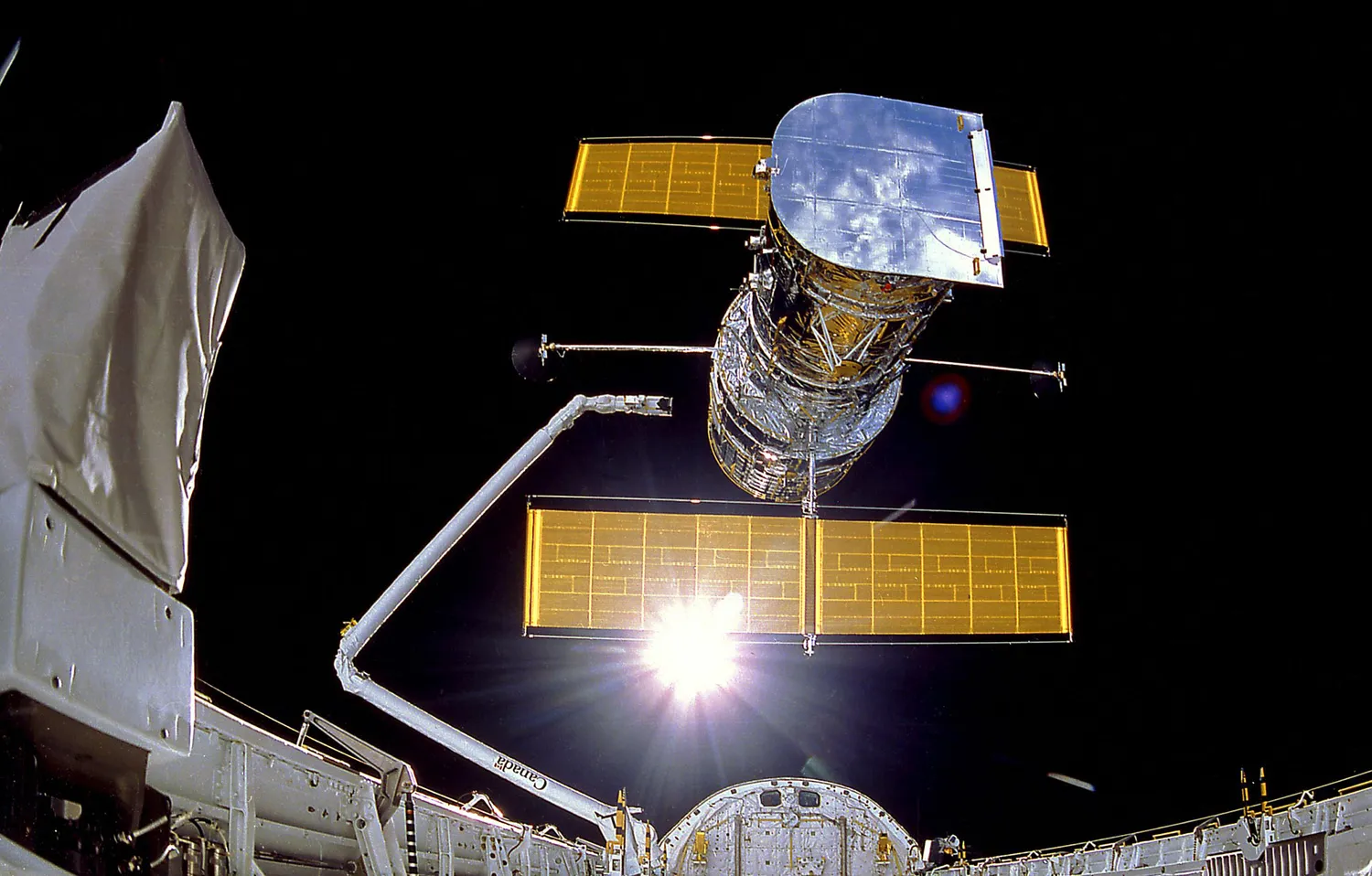
IMAX Cargo Bay Camera view of the Hubble Space Telescope at the moment of release, mission STS-31. by NASA/IMAX / Wikimedia Commons (Public domain).
Before 1609, astronomers could only observe the night sky with their eyes. They saw stars, planets, and the Moon, but details remained hidden. This changed when Italian scientist Galileo Galilei built one of the first telescopes and pointed it toward the heavens. His simple device magnified distant objects and revealed features never seen before.
Galileo's telescope was a refractor, which uses glass lenses to bend and focus light. Through this instrument, Galileo discovered four moons orbiting Jupiter. He observed craters and mountains on Earth's Moon. He also noticed that Venus showed phases like the Moon, which provided evidence that planets orbit the Sun. These observations challenged old ideas about Earth's place in the universe.
Scientists continued improving telescope technology over the centuries. Reflector telescopes, which use curved mirrors instead of lenses, became popular because mirrors can be made larger than lenses. Larger mirrors collect more light, allowing astronomers to see fainter and more distant objects. Ground-based telescopes grew enormous, but Earth's atmosphere limited what they could observe. Air movement causes stars to twinkle and blurs fine details.
Space telescopes solved this problem by orbiting above Earth's atmosphere. The Hubble Space Telescope, launched in 1990, captured incredibly clear images of distant galaxies, nebulae, and stars. Scientists used Hubble's data to calculate the age of the universe and discover that its expansion is accelerating. In 2021, NASA launched the James Webb Space Telescope, which observes infrared light. This allows it to see through cosmic dust and study the earliest galaxies formed after the Big Bang.
Each generation of telescopes has expanded human understanding of the cosmos. Modern telescopes reveal planets orbiting distant stars, black holes at galaxy centers, and the structure of the universe itself. These tools transformed astronomy from simple observation to detailed scientific investigation. They continue to answer fundamental questions about our place in space.
Interesting Fact: The James Webb Space Telescope can detect heat from a bumblebee at the distance of the Moon. Its sensitivity allows scientists to study planets around other stars and search for signs of atmospheres that might support life.
What did Galileo discover when he first pointed his telescope at Jupiter?
Four moons orbiting JupiterRings around JupiterJupiter's red spotJupiter's atmosphere
What type of telescope did Galileo use?
A reflector telescope with mirrorsA space telescopeA refractor telescope with lensesA radio telescope
According to the passage, what does the term 'infrared' refer to?
A type of mirror used in telescopesA type of light with longer wavelengths that can be detected as heatA method of cleaning telescope lensesA way to measure distances in space
Why can reflector telescopes be made larger than refractor telescopes?
Because they are lighterBecause mirrors can be made larger than lensesBecause they don't need glassBecause they work better in space
What problem do space telescopes solve that ground-based telescopes cannot?
They are cheaper to buildThey avoid interference from Earth's atmosphereThey can be made smallerThey use less electricity
Based on the passage, why was Galileo's observation of Venus's phases important?
It proved Venus had an atmosphereIt showed Venus was the largest planetIt provided evidence that planets orbit the SunIt demonstrated that Venus had moons
What can scientists study with the James Webb Space Telescope that they could not study as well before?
The Moon's surfaceEarly galaxies formed after the Big BangEarth's weather patternsThe Sun's temperature
How did each generation of telescopes change astronomy?
They made astronomy more expensiveThey expanded human understanding of the cosmosThey made older telescopes uselessThey proved all old theories wrong
True or False: The Hubble Space Telescope was launched before the year 2000.
TrueFalse
True or False: Earth's atmosphere helps ground-based telescopes see more clearly.
TrueFalse
Who it's for
Perfect for the way you teach
Teachers
Build comprehension skills
Auto-graded quiz
Differentiated reading
Parents
Read together at home
Improve fluency
Quiet reading time
Homeschoolers
Reading curriculum support
Independent practice
Track Lexile growth
Topics
telescopesastronomyGalileoHubble Space TelescopeJames Webb Space Telescoperefractor telescopereflector telescopespace observationNGSS MS-ESS1-3
Reviews & Ratings
No reviews yet. Be the first to share your experience!
More reading you might love
20 more
Sunspots and Solar Flares
This quiz is designed to test your understanding of the fascinating phenomena of sunspots and solar flares, as described...
RI.4.1RI.4.4RI.5.1ESS1.A
The Hottest Planet in the Solar System
This NGSS-aligned middle school reading passage explains why Venus is the hottest planet in our solar system. Students l...
MS-ESS1-3
Mercury: Closest to the Sun
This comprehensive, standards-aligned passage explores Mercury—the smallest and closest planet to the Sun. Students in g...
MS-ESS1-2MS-ESS1-3
Venus: Earth's Twin?
This comprehensive science passage for grades 6-8 examines Venus—often called Earth's twin—by exploring its similarities...
MS-ESS1-2MS-ESS1-3
Mars: The Red Planet
This middle school science passage explores Mars, the Red Planet, providing students in grades 6-8 with a comprehensive ...
MS-ESS1-2MS-ESS1-3
What Is the Solar System?
This passage provides a comprehensive overview of the solar system for grades 6-8, aligned with NGSS standards MS-ESS1-2...
MS-ESS1-2MS-ESS1-3
Structure of the Solar System
This comprehensive science reading passage introduces middle school students (grades 6-8) to the structure of the solar ...
MS-ESS1-2MS-ESS1-3
Scale of the Solar System
This passage, aligned to NGSS standard MS-ESS1-3, helps middle school students grasp the immense scale of the solar syst...
MS-ESS1-3
Exploration of the Solar System
This comprehensive passage for grades 6-8 examines how humans explore the solar system, aligning with NGSS standards MS-...
MS-ESS1-3MS-ETS1-1
Optical Telescopes
This comprehensive passage explores the science of optical telescopes for middle school students, aligning with NGSS sta...
MS-ESS1-3MS-ETS1-1
Future of Alien Search
This informational passage for grades 6-8 explores how scientists are using cutting-edge missions and technology to sear...
MS-ESS1-3MS-ETS1-1
Communicating with Aliens
This middle school science passage, aligned with NGSS standard MS-ESS1-3, examines the scientific and technological chal...
MS-ESS1-3
Measuring Distances in Space
This middle school science passage explores how astronomers measure the vast distances in space, aligning with NGSS stan...
MS-ESS1-3
Astronomy
This comprehensive reading passage introduces middle school students to the science of astronomy, which is the study of ...
MS-ESS1-2MS-ESS1-3MS-PS4-2MS-ETS1-1
The Solar System
This middle school science passage introduces students to the solar system, aligning with NGSS standards MS-ESS1-2 and M...
MS-ESS1-2MS-ESS1-3
The Inner Planets
This comprehensive science passage for grades 6-8 explores the inner (terrestrial) planets of our solar system—Mercury, ...
MS-ESS1-2MS-ESS1-3
The Outer Planets
This engaging science passage for grades 6-8 introduces students to the outer planets—Jupiter, Saturn, Uranus, and Neptu...
MS-ESS1-2MS-ESS1-3
Light-Years and Cosmic Distances
This middle school science passage, aligned to NGSS MS-ESS1-3, explores how astronomers measure the vast distances in sp...
MS-ESS1-3
Space Stations
This informational science reading passage for grades 6-8 explores the complex systems and technology behind space stati...
MS-ESS1-3MS-ETS1-1
Types of Spacecraft
This passage introduces middle school students to the various types of spacecraft used to explore our solar system and b...