How Tides Affect Surfing and Sports
Interactive passage with audio narration, comprehension questions, and printable PDF.
By completing this purchase you agree to our Terms of Use and Privacy Policy. Your subscription renews automatically until you cancel. You can cancel anytime from your account settings. All sales are final and non-refundable. Digital content is available for download in your account immediately upon purchase.
What's included
How Tides Affect Surfing and Sports preview and details
About this printable How Tides Affect Surfing and Sports science reading passage, NGSS-aligned (Grades 5-8)
Sample passage and quiz from How Tides Affect Surfing and Sports
Reading passage and comprehension quiz preview
How Tides Affect Surfing and Sports

Tides shape ocean sports and recreation in powerful ways. The rise and fall of ocean water levels change conditions for surfing, fishing, and beach activities. Understanding tides helps athletes and recreationists plan their activities for the best results and safety.
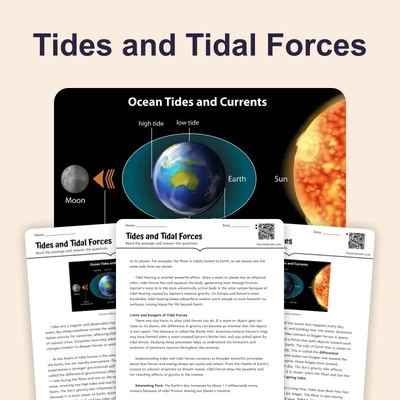
Tides occur because of the gravitational pull from the moon and sun on Earth's oceans. The moon's gravity pulls ocean water toward it, creating a bulge of water on the side of Earth facing the moon. Another bulge forms on the opposite side due to Earth's rotation. These bulges create high tide, while areas between the bulges experience low tide. Most coastal areas have two high tides and two low tides each day. The difference in water height between high and low tide is called the tidal range.
Surfers use tide patterns to find the best waves. Evidence shows that incoming tides often create larger, more powerful waves as water flows toward shore. Many surf breaks work best at specific tide levels because underwater rocks and sandbars shape waves differently at various water depths. Scientists observe that during spring tides, which occur during full and new moons, the tidal range increases and waves can become more dramatic. Experienced surfers check tide tables before heading to the beach to predict optimal surfing conditions.
Fishermen also rely on tide information for success. Fish often feed more actively during tidal currents, especially when tides change direction. The moving water stirs up nutrients and small organisms that attract fish. In Montauk, New York, charter boat captains schedule fishing trips around tide changes because striped bass and bluefish feed most actively during these periods. Tide pool explorers must wait for low tide to safely access rocky areas where sea stars, anemones, and crabs live in shallow pools.
Coastal swimmers and beachgoers need to understand tides for safety. Rising tides can trap people on rock formations or cut off access to shore. Beach erosion increases during high tides, especially during storms. Park rangers at Acadia National Park in Maine warn hikers to check tide schedules before walking to Bar Island, as the sandbar connecting it to the mainland disappears underwater during high tide. Reading tide tables helps people avoid dangerous situations and enjoy coastal areas responsibly.
Interesting Fact: The Bay of Fundy in Canada experiences the world's highest tides, with water levels changing up to 53 feet between high and low tide—enough to cover a four-story building!
Comprehension quiz (10 questions)
1. What causes tides to occur in Earth's oceans?
2. How many high tides do most coastal areas experience each day?
3. What is the tidal range?
4. According to the passage, when do spring tides occur?
5. Why do fishermen prefer to fish during tide changes?
6. What tool do surfers use to predict optimal surfing conditions?
7. Based on the passage, why must tide pool explorers wait for low tide?
8. If a surfer wanted to catch the biggest waves, which tide condition would likely be best based on the passage?
9. Tidal currents stir up nutrients that attract fish.
10. The Bay of Fundy experiences tidal ranges of only a few inches.
Perfect for the way you teach
- Build comprehension skills
- Auto-graded quiz
- Differentiated reading
- Read together at home
- Improve fluency
- Quiet reading time
- Reading curriculum support
- Independent practice
- Track Lexile growth