This learning resource is available in interactive and printable formats. The interactive worksheet can be played online and assigned to students. The Printable PDF version can be downloaded and printed for completion by hand.
This comprehensive middle school science passage examines the multiple threats human actions pose to the world’s oceans, including overfishing, pollution, ocean acidification, warming, and habitat destruction. Students will learn how these processes work, the mechanisms behind each threat, and their effects on marine life and ecosystems. The text integrates scientific thinking, cause-and-effect chains, and real-world data, and also highlights possible solutions such as marine protected areas and sustainable fishing. Aligned with NGSS standards MS-ESS3-3 and MS-ESS3-4, the resource supports reading comprehension, vocabulary development, and critical thinking. Activities include multiple-choice questions, writing prompts, and graphic organizers. The resource also features an audio option to support diverse learners. This engaging, standards-based curriculum tool is ideal for grades 6-8 science classrooms exploring environmental systems and conservation.
CONTENT PREVIEW
Expand content preview
Effects of acidification on marine organisms
Oceans cover more than 70% of Earth’s surface and play a critical role in supporting life, regulating climate, and providing food and resources. In recent decades, scientists have observed dramatic changes in marine environments caused by human activities. Understanding human impact on the oceans is vital because the health of the oceans affects ecosystems, economies, and people worldwide. This passage examines how overfishing, pollution, climate change, and habitat destruction threaten marine life and what can be done to protect our oceans.
Mechanisms of Human Impact
Overfishing occurs when people catch fish faster than populations can reproduce. This depletes fish stocks and has led to collapsed fisheries, where once-abundant species are now rare or even extinct in some regions. Bycatch—catching unintended species like turtles and dolphins—also harms marine biodiversity. Pollution is another major threat. Plastic pollution, such as the Great Pacific Garbage Patch, introduces millions of tons of plastic into the ocean each year. Microplastics, tiny plastic fragments, can enter the food chain and harm animals. Oil spills and agricultural runoff cause ‘dead zones’ with little oxygen, making it impossible for most marine life to survive. Chemical contamination can poison food webs and disrupt reproductive cycles.
Climate Change and Ocean Health
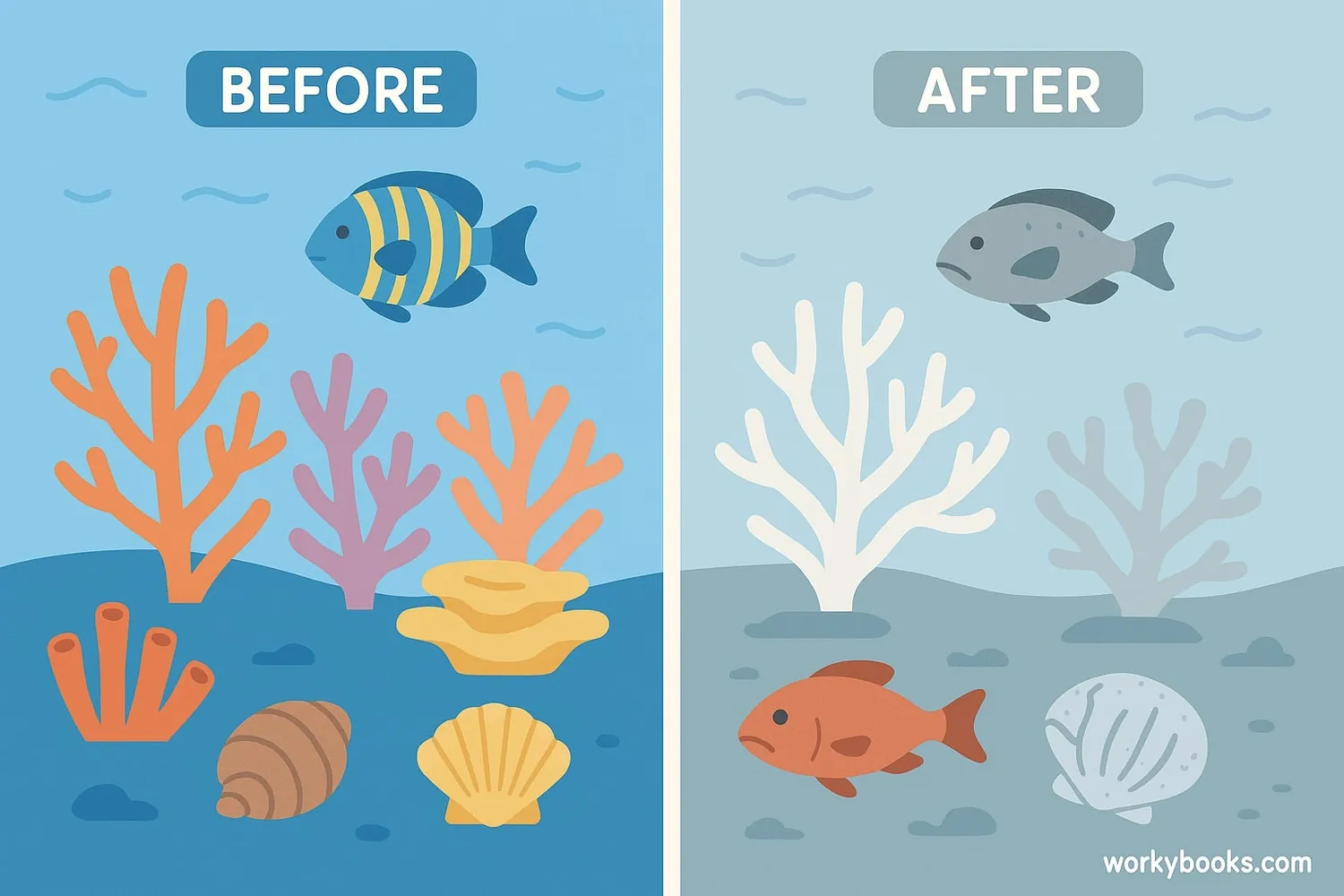
Oceans absorb about 30% of human-produced carbon dioxide (CO₂), which lowers the pH of seawater—a process called ocean acidification. Acidification interferes with the ability of shell-forming organisms, like corals and mollusks, to build their skeletons. Coral reefs, which support 25% of marine species, are especially vulnerable. Warming oceans lead to coral bleaching, where stressed corals lose their color and may die. Rising sea levels and shifting species ranges add to the challenges faced by marine ecosystems.
Habitat Destruction and Solutions
Human development along coasts, destructive fishing practices like bottom trawling, and damage to coral reefs destroy essential marine habitats. These actions break important links in the ocean food web and reduce biodiversity. However, solutions exist. Establishing marine protected areas, enforcing sustainable fishing practices, reducing plastic use, and taking climate action can help restore ocean health. Conservation efforts depend on scientific research, global cooperation, and public awareness.
Protecting the oceans is not just an environmental issue—it is necessary for the survival of countless species, human food security, and Earth’s natural systems.
Interesting Fact: Every minute, the equivalent of one garbage truck of plastic enters the ocean.
What is the main reason overfishing is harmful to the ocean?
It removes fish faster than they can reproduce.It pollutes the water with chemicals.It lowers the temperature of the water.It increases the number of predators.
Which of the following is a major source of plastic pollution in the ocean?
Great Pacific Garbage PatchCoral bleachingRising sea levelsOcean acidification
What is bycatch?
Catching fish that are too small to eatCatching unintended species like turtles or dolphinsPlanting coral reefsCleaning up plastic from the ocean
According to the passage, what causes dead zones in the ocean?
Agricultural runoff and oil spillsCoral bleachingMarine protected areasOverfishing
What does the word 'collapsed fisheries' mean as used in the passage?
Fishing areas where fish populations are too low to continue fishingOceans polluted with chemicalsAreas of ocean protected from fishingPlaces where coral reefs have died
What is ocean acidification and why is it a problem?
The ocean becomes more acidic from absorbing CO₂, making it hard for shell-forming organisms to survive.The ocean becomes warmer due to sun exposure.Plastic dissolves in the ocean, harming fish.The ocean gets saltier and causes fish to leave.
Which solution is suggested in the passage to help protect the ocean?
Establishing marine protected areas.Building more coastal developments.Increasing fishing quotas.Using more plastic products.
If ocean acidification continues, what might happen to coral reefs?
They may struggle to build their skeletons and die.They will grow faster.They will attract more fish.They will become more colorful.
True or False: Marine protected areas are ocean zones where fishing is encouraged.
TrueFalse
True or False: Climate change and pollution are both threats to ocean health.
TrueFalse
Perfect For:
👩🏫 Teachers
• Reading comprehension practice
• Auto-graded assessments
• Literacy skill development
👨👩👧👦 Parents
• Reading practice at home
• Comprehension improvement
• Educational reading time
🏠 Homeschoolers
• Reading curriculum support
• Independent reading practice
• Progress monitoring
Reading Features:
📖
Reading Passage
Engaging fiction or nonfiction text
❓
Comprehension Quiz
Auto-graded questions
📊
Instant Feedback
Immediate results and scoring
📄
Printable Version
Download for offline reading
🔊
Read Aloud
Voice-over with word highlighting
Reviews & Ratings
No reviews yet. Be the first to share your experience!
Related Content
Natural Disaster: Volcanic Eruptions
Volcanoes can erupt with lava and ash, changing the landscape. While dangerous, they also create fertile land and new la...
RI.3.1RI.4.4RI.4.2RI.5.2
Human Impacts: Pollution
This middle school science reading passage, aligned with NGSS standards MS-LS2-4 and MS-ESS3-3, examines the mechanisms ...
MS-LS2-4MS-ESS3-3
Human Impacts: Habitat Destruction
This grade 6-8 science passage explores human impacts on ecosystems, focusing on habitat destruction as the leading caus...
MS-LS2-4MS-LS2-5MS-ESS3-3
Ecosystem Services
This engaging middle school science passage introduces students to the concept of ecosystem services, the vital benefits...
MS-LS2-5MS-ESS3-3
Environmental Problems and Solutions
This passage for grades 6-8 introduces major environmental problems such as habitat loss, pollution, climate change, inv...
MS-LS2-4MS-ESS3-3MS-ESS3-4
Remote Sensing
This middle school science passage introduces students to the concept of remote sensing—the collection of information ab...
MS-ESS3-3MS-PS4-2MS-ETS1-1MS-ETS1-3
Geographic Information Systems (GIS)
This engaging middle school science passage introduces students to Geographic Information Systems (GIS), aligning with N...
MS-ESS3-3MS-ETS1-1MS-ETS1-2MS-ETS1-3
Renewable vs. Nonrenewable Energy
This engaging passage, aligned with NGSS standards MS-PS3-4, MS-ESS3-3, and MS-ESS3-4, helps middle school students diff...
MS-PS3-4MS-ESS3-3MS-ESS3-4
Fossil Fuels: Coal
This middle school science reading passage explores the science behind coal, a major fossil fuel. Students will learn ho...
MS-PS3-4MS-ESS3-3MS-ESS3-4
Solar Energy
This engaging passage for grades 6-8 explores the science of solar energy, focusing on how sunlight is converted into el...
MS-PS3-4MS-ESS3-3MS-ESS3-4
Wind Energy
This comprehensive middle school science passage explores the scientific principles behind wind energy and how wind turb...
MS-PS3-4MS-ESS3-3MS-ESS3-4
Hydroelectric Energy
This comprehensive passage introduces middle school students to the science behind hydroelectric energy, directly aligni...
MS-PS3-4MS-ESS3-3MS-ESS3-4
Geothermal Energy
This comprehensive science passage introduces middle school students to the mechanisms and applications of geothermal en...
MS-PS3-4MS-ESS3-3MS-ESS3-4
Biomass and Biofuels
This NGSS-aligned passage introduces grades 6-8 students to the science of biomass and biofuels, explaining how organic ...
MS-PS3-4MS-ESS3-3MS-ESS3-4
Nuclear Energy as a Resource
This NGSS-aligned informational science passage, designed for grades 6-8, explores nuclear energy as a resource in the c...
MS-PS3-4MS-ESS3-3MS-ESS3-4
Water Quality
This middle school science reading passage covers the topic of water quality, aligned with NGSS standards MS-ESS3-1 and ...
MS-ESS3-1MS-ESS3-3
Florida Everglades
This comprehensive passage introduces middle school students to the Florida Everglades, a distinctive wetland ecosystem ...
MS-LS2-1MS-LS2-4MS-ESS3-3MS-ESS3-4
Congo Rainforest
This middle school science passage explores the Congo Rainforest—Earth’s second-largest rainforest, located in Central A...
MS-LS2-1MS-ESS3-3
Nuclear Power Plants
This comprehensive reading passage introduces middle school students (grades 6-8) to the science of nuclear power plants...
MS-PS3-4MS-ESS3-3
Nuclear Safety and Waste
This middle school science passage explores the critical topic of nuclear safety and waste management, aligned with NGSS...