Leonardo da Vinci
Interactive passage with audio narration, comprehension questions, and printable PDF.
By completing this purchase you agree to our Terms of Use and Privacy Policy. Your subscription renews automatically until you cancel. You can cancel anytime from your account settings. All sales are final and non-refundable. Digital content is available for download in your account immediately upon purchase.
What's included
Leonardo da Vinci preview and details
About this printable Leonardo da Vinci reading passage (Grades 5-8)
Sample passage and quiz from Leonardo da Vinci
Reading passage and comprehension quiz preview
Leonardo da Vinci
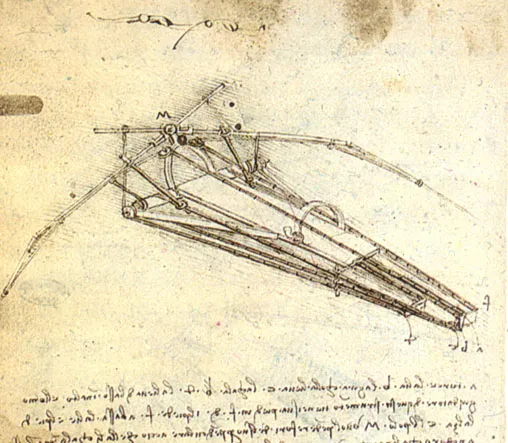
"Design for a Flying Machine" by Leonardo da Vinci / Wikimedia Commons.
Leonardo da Vinci was born in 1452 in Vinci, a small town in the Republic of Florence, Italy. He became one of the most important figures of the Renaissance, a period of great change and creativity in Europe from the 14th to the 17th century. Leonardo is best known as a painter, but he was also an accomplished inventor, architect, engineer, and scientist. His wide range of interests and skills made him the perfect example of a "Renaissance man," someone who is talented in many different fields.
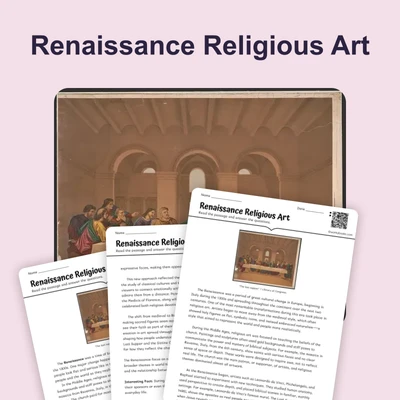
Leonardo’s early training took place in Florence, where he apprenticed under the artist Andrea del Verrocchio. In this workshop, he learned the techniques of drawing, painting, and sculpture. By the age of 20, Leonardo was already earning a reputation as a skilled artist. His art shows a deep understanding of the human anatomy, which he studied by dissecting bodies. This allowed Leonardo to create lifelike figures in his paintings, such as in his famous works the Mona Lisa and The Last Supper. The Mona Lisa, painted between 1503 and 1506, is famous for the subject’s mysterious smile and realistic features. The Last Supper, completed in the 1490s in Milan, shows Jesus and his disciples at a dramatic moment. Both paintings have become symbols of Renaissance art and are studied around the world.
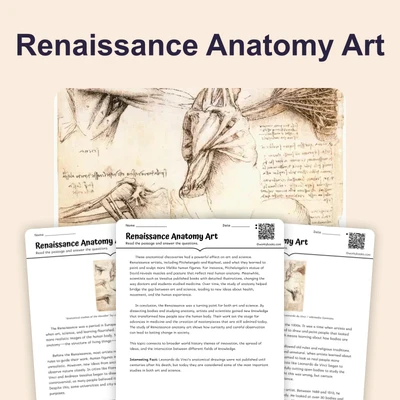
Leonardo’s curiosity extended far beyond art. He filled notebooks with observations and sketches about science, nature, and machines. Leonardo designed flying machines, bridges, and weapons, though most were never built during his lifetime. His studies of geology, botany, and the movement of water showed a scientific approach to understanding the world. For example, in his notebooks, Leonardo drew detailed diagrams of the human heart and compared the flow of blood to the movement of rivers. These observations helped lay the foundation for later scientific discoveries.
Leonardo’s work reflects the values of the Renaissance, especially the belief in human potential and the importance of knowledge. His ability to combine art and science made his work unique and influential. Even today, historians and scientists study Leonardo’s notes for insight into both creativity and the early history of science and technology. By connecting different fields of study, Leonardo da Vinci changed the way people think about art, science, and invention.
Leonardo’s life and achievements connect to the broader theme of how individuals can shape history through creativity and curiosity. His story shows the power of observation and innovation in changing the world.
Interesting Fact: Leonardo wrote his notes in mirror writing, which means the letters appear backwards and can only be read with a mirror.
Comprehension quiz (8 questions)
1. Where was Leonardo born?
2. Which painting shows Jesus and his disciples?
3. When did Leonardo paint the Mona Lisa?
4. Why did Leonardo study human anatomy?
5. What was a major value of the Renaissance?
6. How did Leonardo influence science?
7. Leonardo’s notebooks were written in mirror writing.
8. What does "botany" mean?
Perfect for the way you teach
- Build comprehension skills
- Auto-graded quiz
- Differentiated reading
- Read together at home
- Improve fluency
- Quiet reading time
- Reading curriculum support
- Independent practice
- Track Lexile growth