Linear Perspective
Interactive passage with audio narration, comprehension questions, and printable PDF.
By completing this purchase you agree to our Terms of Use and Privacy Policy. Your subscription renews automatically until you cancel. You can cancel anytime from your account settings. All sales are final and non-refundable. Digital content is available for download in your account immediately upon purchase.
What's included
Linear Perspective preview and details
About this printable Linear Perspective reading passage (Grades 5-8)
Sample passage and quiz from Linear Perspective
Reading passage and comprehension quiz preview
Linear Perspective
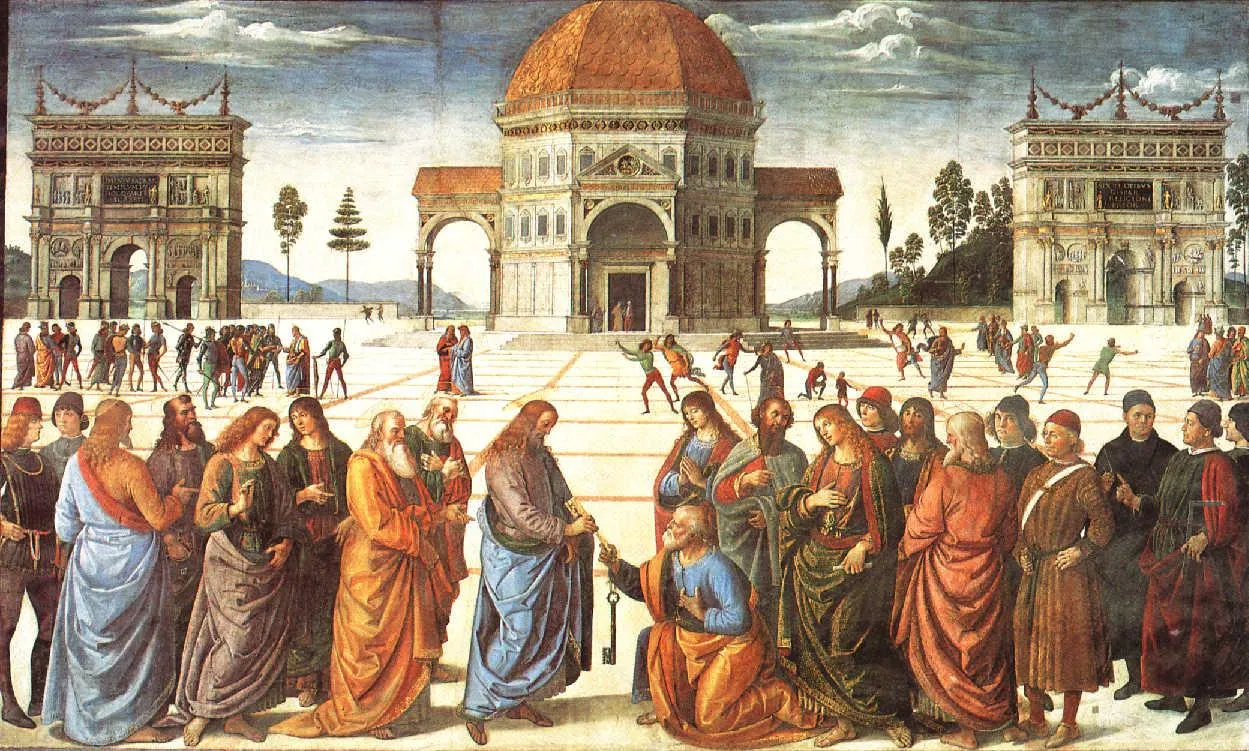
"Perugino Keys" by Pietro Perugino / Wikimedia Commons.
The technique of linear perspective changed the way art was made during the Renaissance in Europe. Artists in the 1400s wanted to create more realistic images that showed depth and space, similar to what the human eye sees. Before this, most paintings appeared flat, and objects did not look smaller as they moved away from the viewer. The breakthrough of linear perspective allowed artists to use mathematical rules to show three-dimensional scenes on two-dimensional surfaces like walls or canvases.
The city of Florence, Italy, became a center for artistic innovation during the early Renaissance. Around 1420, the architect Filippo Brunelleschi performed a famous experiment at the Florence Baptistery. He painted the building using a mirror and a wooden panel with a hole in it. By aligning his eye, the mirror, and the painting, Brunelleschi could prove that parallel lines appear to meet at a single point on the horizon, called the vanishing point. This discovery was described in the writings of Leon Battista Alberti, who published a book about perspective in 1435. Alberti's treatise helped spread the technique across Italy and Europe.
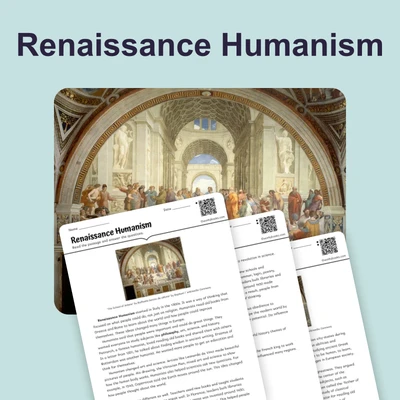
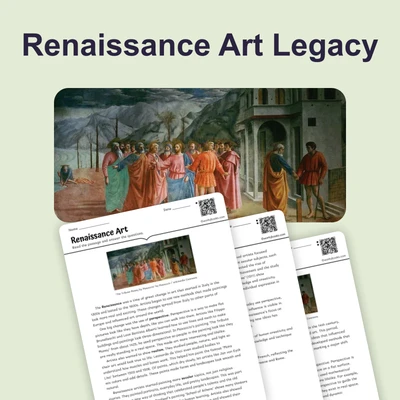
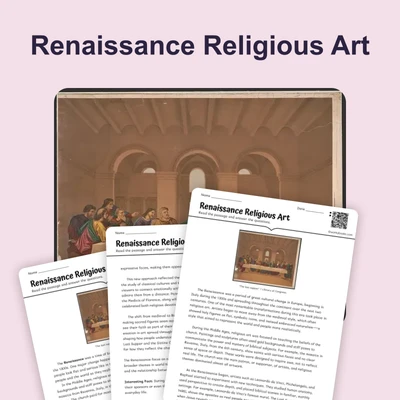
Linear perspective relies on geometry and mathematical calculations. Artists draw lines that converge at the vanishing point to organize objects in their paintings. For example, in Masaccio’s fresco "The Tribute Money" (1420s), the buildings and roads in the background are drawn so they all lead to a common point, making the scene look deep and realistic. This method was also used by Leonardo da Vinci in "The Last Supper," where the lines of the walls and ceiling guide the viewer’s eyes to the center of the composition. Such paintings used orthogonals, or diagonal lines, to create the illusion of space.
The spread of linear perspective marked a major change in European art. Previously, artists used size to show importance, not distance, so kings and saints looked bigger than ordinary people. With perspective, artists could now depict real buildings, streets, and landscapes in accurate proportion. This new approach influenced not just painters, but architects and sculptors as well. Linear perspective made art more scientific and connected it to advances in mathematics, architecture, and even mapmaking. It also reflected the changing society of Renaissance Europe, where people valued observation, reason, and individual creativity.
Linear perspective remains a vital skill for artists today. By making scenes look more realistic, it changed how people understood and represented the world. The invention of linear perspective is a key example of how art and science can work together to transform society.
Interesting Fact: Some Islamic artists in the Middle Ages used geometric patterns and basic forms of perspective, but the single vanishing point technique was first fully developed in Renaissance Italy.
This innovation in art connects to the broader themes of cultural exchange, scientific discovery, and the rise of humanism during the Renaissance period.
Comprehension quiz (8 questions)
1. Who proved linear perspective in Florence?
2. What is a vanishing point?
3. In what year did Alberti publish his treatise?
4. What did linear perspective help artists show?
5. How did perspective change art?
6. Who used orthogonals in 'The Last Supper'?
7. Linear perspective uses curved lines. True or false?
8. What is a 'fresco'?
Perfect for the way you teach
- Build comprehension skills
- Auto-graded quiz
- Differentiated reading
- Read together at home
- Improve fluency
- Quiet reading time
- Reading curriculum support
- Independent practice
- Track Lexile growth