Marine Fossils on Mountains — Reading Comprehension
Rate this
Premium Resource
Present
Present in classroom. No work saved
Assign
Classroom with student accounts, Track progress
Quick Play
No student accounts, assign with a link
Grades
3
4
5
6
PRINT+DIGITAL RESOURCE
This learning resource is available in interactive and printable formats. The interactive worksheet can be played online and assigned to students. The Printable PDF version can be downloaded and printed for completion by hand.
This engaging science passage for grades 4-5 explores the fascinating concept that the mountains we see today were once ancient oceans. Students will learn about plate tectonics, sedimentary rocks, and fossils, and discover how these processes have shaped our planet over millions of years. The passage defines key science vocabulary, explains real-world examples like the Himalayas, and includes an 'Interesting Fact' to spark curiosity. Activities include a multiple-choice quiz, writing prompts, and a glossary to reinforce learning. Aligned to NGSS science standards, this resource is audio integrated and designed for young readers. It encourages students to connect science concepts to everyday life while building essential reading and thinking skills.
CONTENT PREVIEW
Expand content preview
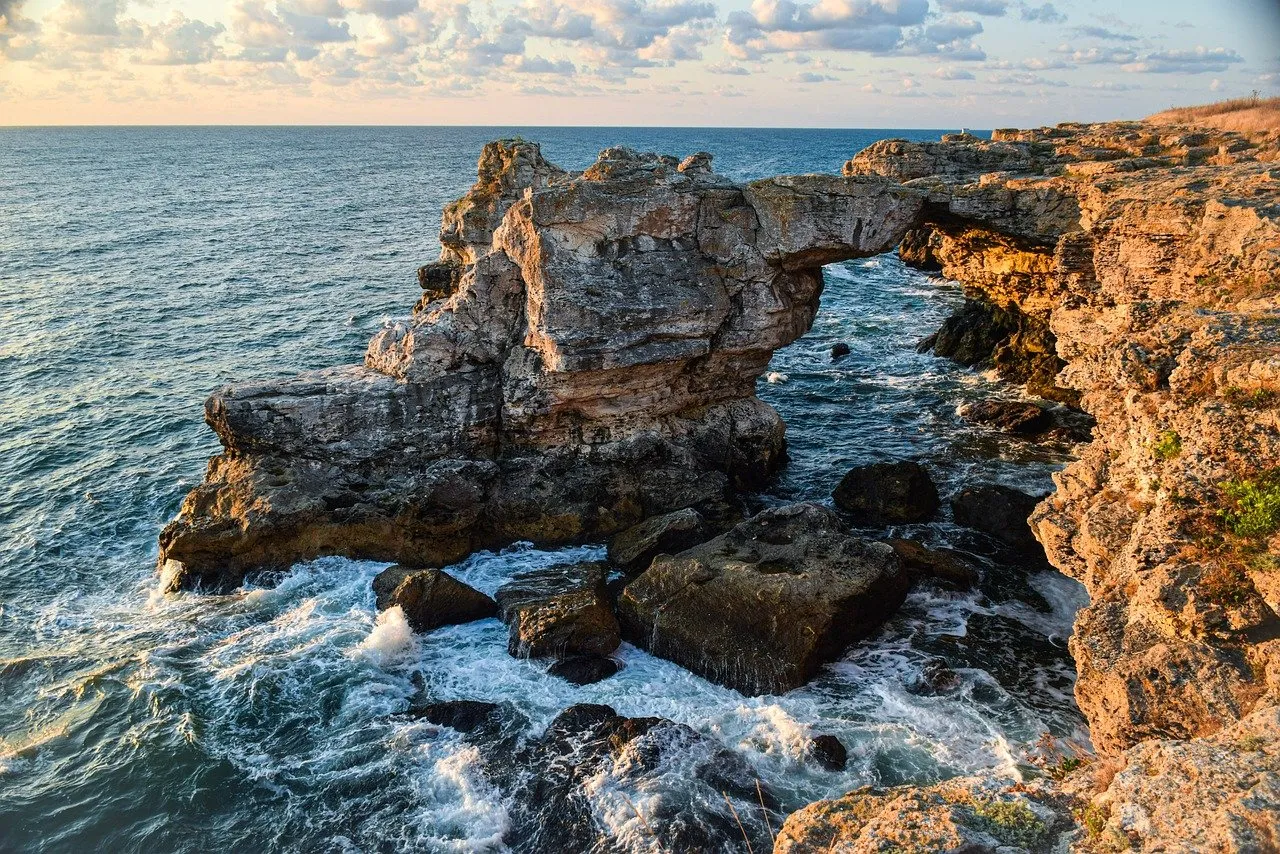
Fossils of a Sea Creatures Found on Mountains. Image by hristom2000 / Source: Pixabay.
Scientists have found fossils—the remains or traces of ancient living things—in some surprising places. Marine fossils, which are fossils of ocean animals like fish, shells, and sea creatures, have been discovered on the tops of mountains. These mountains are far from any ocean today. This discovery helps scientists understand how Earth's surface has changed over millions of years.
How did ocean fossils get to the top of a mountain? The answer lies deep in Earth's history. The rock layers—flat sheets of rock stacked on top of each other—that contain these fossils formed at the bottom of an ancient sea, which is an ocean that existed long ago. Tiny bits of sand, mud, and dead sea creatures settled on the ocean floor. Over millions of years, these materials pressed together and hardened into rock, trapping the fossils inside.
Then something amazing happened. Powerful forces inside Earth pushed the rock layers upward. This is like pushing a stack of pancakes from below—the whole stack rises up. Over millions of years, these forces created tall mountains. The fossils stayed trapped inside the rock as it moved upward. Today, when scientists find marine fossils on mountaintops, they know that spot was once underwater.
This evidence shows that Earth's surface has changed dramatically over time. Mountains that stand tall today were once at the bottom of the sea.
Interesting Fact: The Himalaya Mountains, the tallest mountains on Earth, contain fossils of sea creatures called ammonites that lived over 100 million years ago!
What are marine fossils?
Fossils of ocean animalsFossils of mountain animalsFossils of flying animalsFossils of forest animals
Where have scientists found marine fossils?
Only at the beachOn tops of mountainsInside caves onlyUnder the ocean floor
How long did it take for rocks to form?
A few daysOne yearMillions of yearsOne hundred years
Why do marine fossils on mountains matter?
They show mountains never changeThey prove oceans are shrinkingThey show Earth's surface has changedThey prove animals can climb mountains
What pushed the rock layers upward?
Ocean waves and windPowerful forces inside EarthAnimals digging undergroundRain and snow
What happens when materials press together underwater?
They disappear completelyThey float to the surfaceThey harden into rockThey turn into water
Marine fossils prove mountains were once underwater.
TrueFalse
What does ancient mean in this passage?
Very new and modernFrom long ago in the pastHappening right nowSomething that will happen soon
Perfect For:
👩🏫 Teachers
• Reading comprehension practice
• Auto-graded assessments
• Literacy skill development
👨👩👧👦 Parents
• Reading practice at home
• Comprehension improvement
• Educational reading time
🏠 Homeschoolers
• Reading curriculum support
• Independent reading practice
• Progress monitoring
Reading Features:
📖
Reading Passage
Engaging fiction or nonfiction text
❓
Comprehension Quiz
Auto-graded questions
📊
Instant Feedback
Immediate results and scoring
📄
Printable Version
Download for offline reading
🔊
Read Aloud
Voice-over with word highlighting
Reviews & Ratings
No reviews yet. Be the first to share your experience!
Related Content
Tools and Technology in Earth Science
This middle school science reading passage explores the wide range of tools and technologies used in Earth science, from...
MS-ESS2-2MS-ESS3-2MS-ETS1-1MS-PS4-3
Scientific Inquiry in Earth Science
This passage explores scientific inquiry in Earth science for grades 6-8, aligned with NGSS standards MS-ESS1-4, MS-ESS2...
MS-ESS1-4MS-ESS2-1MS-ESS3-5SEP
What Is Earth Science?
This engaging middle school science passage introduces students to the field of Earth science, aligning with NGSS standa...
MS-ESS1MS-ESS2MS-ESS3SEP
Earth: Our Home in Space
This engaging Grade 4-5 science passage, aligned to NGSS, introduces students to Earth's special place in the solar syst...
Earth's Spheres
This middle school science passage introduces students to Earth's four major spheres: the geosphere, hydrosphere, atmosp...
MS-ESS2-4MS-ESS2-6
What Is Space Weather and How Does It Affect the Earth?
This NGSS-aligned science passage for middle school explains what space weather is and how it affects Earth. Students le...
MS-ESS2-2
Earth's Energy Balance
This engaging, NGSS-aligned science passage for grades 6–8 explores Earth's energy balance, a key process that keeps our...
MS-ESS2-6
Earth's Rotation
This middle school science passage, aligned with NGSS standard MS-ESS1-1, focuses on Earth's rotation—how Earth spins on...
MS-ESS1-1
Earth's Land and Water
This 250-word reading passage introduces fourth-grade students to the fundamental concept of how land and water are dist...
NGSS 4-ESS2-2ESS2.B
Earth's Interior
This comprehensive passage for grades 6-8 explores Earth's layered interior, including the crust, mantle, outer core, an...
MS-ESS2-1MS-ESS2-2
Facts About Earth
This engaging science reading passage introduces Grade 4 and 5 students to Earth, our home planet. Aligned with NGSS sta...
Meteorite Impacts on Earth
This engaging science reading passage for Grades 4-5 explores meteorite impacts on Earth, aligning with NGSS standards. ...
Venus: Earth's Twin?
This comprehensive science passage for grades 6-8 examines Venus—often called Earth's twin—by exploring its similarities...
MS-ESS1-2MS-ESS1-3
Earth Changes Over Millions of Years
This engaging, audio-integrated science passage for Grade 4-5 students explores how Earth has changed over millions of y...
Volcano Patterns on Earth
This Grade 4 science reading passage introduces students to volcano patterns on Earth, aligned with NGSS standard 4-ESS2...
NGSS 4-ESS2-2
Earth's Moon Facts
This engaging science passage, 'The Moon: Earth's Companion,' is designed for Grade 4-5 students and aligns with NGSS ge...
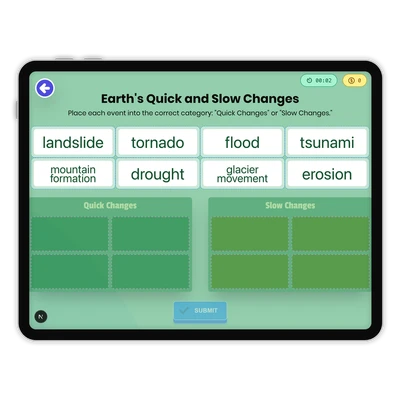
Earth's Quick and Slow Changes
In 'Earth's Quick and Slow Changes,' students categorize 12 Earth events by their speed of occurrence, enhancing underst...
Earth: Our Home Planet
This comprehensive science passage for grades 6-8 explores Earth’s unique characteristics and the interconnected systems...
MS-ESS1-2
Earth's Revolution
This middle school science passage explores the science behind Earth's revolution around the Sun, closely aligned with N...
MS-ESS1-1
Earthquake Patterns on Earth
This engaging 250-word reading passage introduces fourth-grade students to earthquake patterns on Earth, aligned with NG...