What Are Eons and Eras
Interactive passage with audio narration, comprehension questions, and printable PDF.
By completing this purchase you agree to our Terms of Use and Privacy Policy. Your subscription renews automatically until you cancel. You can cancel anytime from your account settings. All sales are final and non-refundable. Digital content is available for download in your account immediately upon purchase.
What's included
What Are Eons and Eras preview and details
About this printable What Are Eons and Eras science reading passage, NGSS-aligned (Grades 5-8)
Sample passage and quiz from What Are Eons and Eras
Reading passage and comprehension quiz preview
What Are Eons and Eras
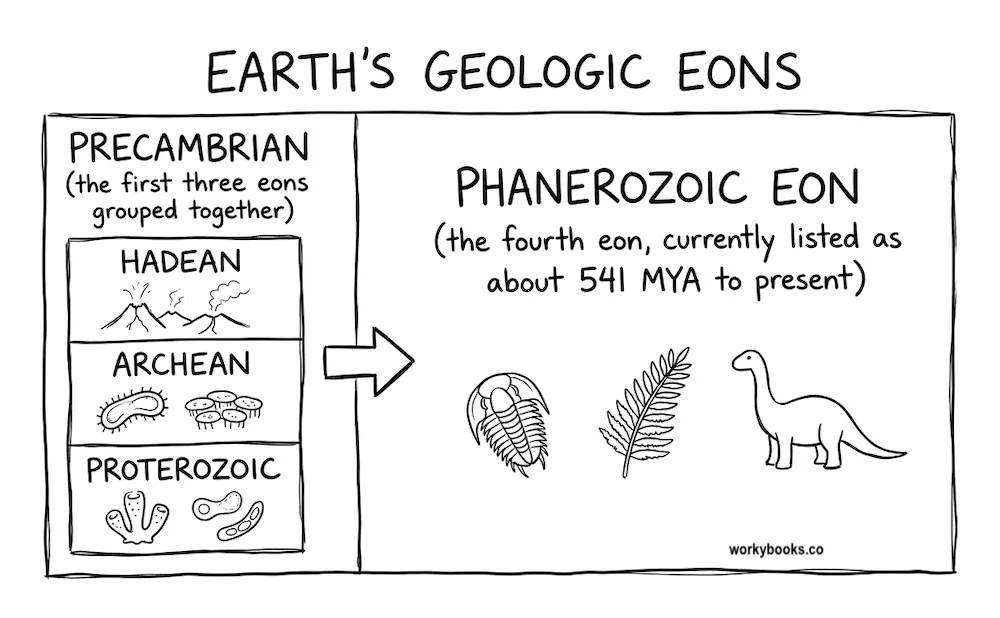
Earth's history stretches back about 4.6 billion years. Scientists divide this immense span of time into large units called eons and eras. These divisions help scientists organize and study major changes in Earth's rocks, climate, and life forms. Eons represent the largest divisions of the geologic time scale. They span hundreds of millions to billions of years.
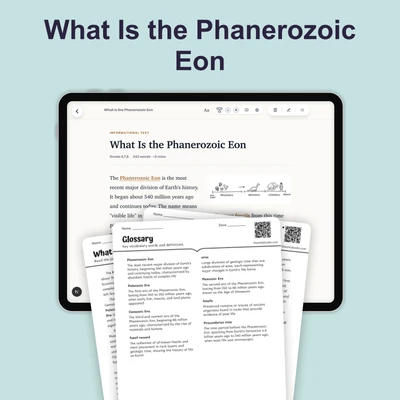
Scientists recognize four major eons in Earth's history. The first three eons—Hadean, Archean, and Proterozoic—are often grouped together as the Precambrian. This long period lasted from Earth's formation until about 541 million years ago. During the Precambrian, life began as simple single-celled organisms. The fourth and current eon is called the Phanerozoic Eon. It began 541 million years ago and continues today. The name Phanerozoic means "visible life" because rocks from this eon contain abundant fossils.
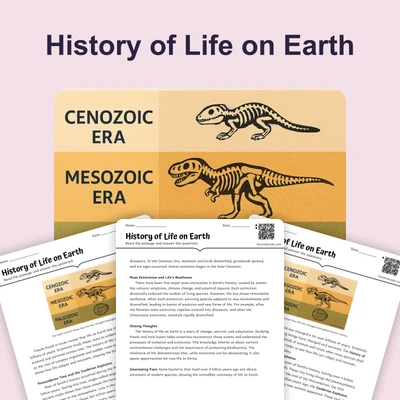
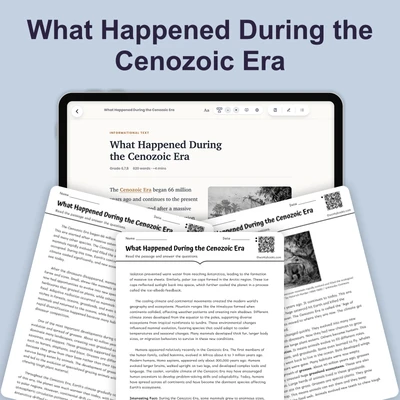
Scientists divide eons into smaller time units called eras. The Phanerozoic Eon contains three major eras. The Paleozoic Era means "ancient life." It lasted from 541 to 252 million years ago. During this era, life exploded in the oceans. Fish, amphibians, and early reptiles appeared. Plants and animals colonized the land. The era ended with Earth's largest mass extinction event. The Mesozoic Era means "middle life." It spanned from 252 to 66 million years ago. Dinosaurs dominated the land during this time. Flowering plants appeared and spread across continents. Another mass extinction ended this era. The Cenozoic Era means "recent life." It began 66 million years ago and continues today. Mammals became the dominant land animals after dinosaurs disappeared.
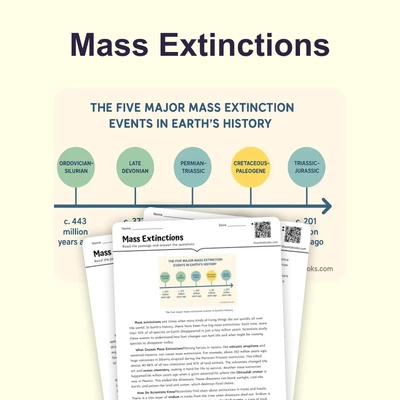
Evidence from fossils and rock layers helps scientists identify boundaries between eras. Major extinction events often mark these transitions. For example, the boundary between the Mesozoic and Cenozoic eras shows a layer of rock rich in the element iridium. Scientists explain that this layer came from an asteroid impact. This event may have caused the extinction of dinosaurs and many other species.
Understanding eons and eras helps scientists reconstruct Earth's history. These time divisions reveal patterns of how life changed over millions of years. They show how Earth's climate, continents, and ecosystems evolved. This knowledge helps scientists predict how Earth's systems might change in the future.
Interesting Fact: Humans have existed for only about 300,000 years. This represents just 0.0065% of Earth's entire 4.6-billion-year history.
Comprehension quiz (10 questions)
1. What are eons?
2. How long ago did the Phanerozoic Eon begin?
3. What does the term 'Paleozoic' mean?
4. Based on the passage, what does the word 'abundant' most likely mean in the sentence 'rocks from this eon contain abundant fossils'?
5. Which animals became dominant after dinosaurs disappeared?
6. Why do scientists think an asteroid impact may have caused the extinction of dinosaurs?
7. How can understanding eons and eras help scientists?
8. What marks the boundaries between different eras?
9. The Precambrian includes Earth's first three eons.
10. Humans have existed for most of Earth's 4.6-billion-year history.
Perfect for the way you teach
- Build comprehension skills
- Auto-graded quiz
- Differentiated reading
- Read together at home
- Improve fluency
- Quiet reading time
- Reading curriculum support
- Independent practice
- Track Lexile growth