Reading PassagePremium

What Are Periods and Epochs

Interactive passage with audio narration, comprehension questions, and printable PDF.

No ratings yet
Grades 5–8ScienceElaEnglish · SpanishInteractive · Printable
Aligned toMS-ESS1-4
Just this resource
$1.50
One-time purchase
Best value
Unlock everything
$49.99$29.99/yr
40% off until Aug 1 — 10,000+ resources
Renews at $49.99/year.
Unlock above to use these actions

What's included

Reading passage
Audio narration
Comprehension quiz
Writing activity
Glossary & flashcards
Differentiated version
Spanish translation

What Are Periods and Epochs preview and details

About this printable What Are Periods and Epochs science reading passage, NGSS-aligned (Grades 5-8)

science,ela
Written by Workybooks TeamPublished by Workybooks
Preview

Sample passage and quiz from What Are Periods and Epochs

Reading passage and comprehension quiz preview

What Are Periods and Epochs
Periods and Epochs

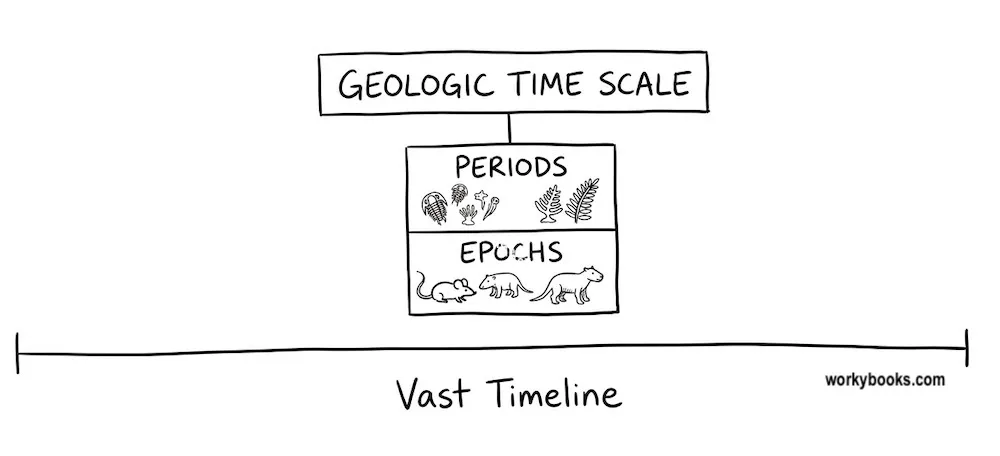
Earth's history stretches back 4.6 billion years. Scientists organize this vast timeline using the geologic time scale. This scale divides Earth's history into manageable chunks of time. Two important divisions within this scale are periods and epochs.

The geologic time scale works like a nested set of containers. The largest divisions are called eons, which contain eras. Eras contain periods, and periods contain epochs. Periods are time divisions that sit within eras. They typically last tens of millions of years. Scientists name many periods after places where rocks from that time were first studied. The Jurassic Period, lasting from 201 to 145 million years ago, is one famous example. During this period, dinosaurs dominated Earth's ecosystems. Evidence shows that the first birds also appeared during Jurassic times.

Epochs are even smaller time divisions within periods. They represent shorter spans of Earth's history. The current epoch is called the Holocene Epoch. It began just 11,700 years ago when the last ice age ended. This epoch covers all of recorded human civilization. Scientists observe that the Holocene has experienced relatively stable climate conditions. These conditions allowed human societies to develop agriculture and complex cultures.

Scientists use evidence from rocks and fossils to define these time divisions. Major changes in life forms help mark boundaries between periods and epochs. For example, the boundary between the Cretaceous and Paleogene periods marks the extinction of non-bird dinosaurs. Rock layers from different periods contain distinct groups of fossils. This pattern helps scientists identify the age of rock formations worldwide.

Understanding periods and epochs matters because it helps us comprehend Earth's long history. These divisions allow scientists to communicate precisely about when events occurred. They can compare environmental conditions across different times. This knowledge helps researchers understand how life and Earth's systems have changed over millions of years.

Interesting Fact: Some scientists propose that we have entered a new epoch called the Anthropocene. This potential epoch would mark the time when human activities began significantly changing Earth's geology and ecosystems.

Comprehension quiz (10 questions)

1. What is the geologic time scale?

A tool for measuring the weight of rocks
A system that organizes Earth's history into divisions
A calendar used only by geologists
A scale for measuring earthquakes

2. How long do periods typically last?

Hundreds of years
Thousands of years
Tens of millions of years
Billions of years

3. Which of the following is the correct order from largest to smallest time division?

Epoch, period, era, eon
Eon, era, period, epoch
Era, eon, epoch, period
Period, epoch, era, eon

4. What does the word 'stable' mean in the context of the Holocene Epoch's climate?

Changing rapidly
Not changing much
Getting colder
Completely frozen

5. Based on the passage, what is the relationship between periods and epochs?

Periods and epochs are the same thing
Epochs are larger divisions than periods
Epochs are smaller divisions within periods
Periods and epochs never overlap

6. What evidence do scientists use to define boundaries between periods and epochs?

Changes in weather patterns only
Major changes in life forms found in rocks and fossils
The color of rock layers
The size of mountains

7. Why might scientists propose a new epoch called the Anthropocene?

Because dinosaurs have returned
Because a new ice age is starting
Because human activities are significantly changing Earth
Because the climate has become completely stable

8. If a scientist discovers fossils of early birds in a rock layer, which period might those rocks be from?

Holocene Epoch
Jurassic Period
Modern times
Last year

9. The Holocene Epoch covers all of recorded human civilization.

True
False

10. Periods are larger time divisions than eras.

True
False
Who it's for

Perfect for the way you teach

Teachers
  • Build comprehension skills
  • Auto-graded quiz
  • Differentiated reading
Parents
  • Read together at home
  • Improve fluency
  • Quiet reading time
Homeschoolers
  • Reading curriculum support
  • Independent practice
  • Track Lexile growth
Topics

Reviews & Ratings

No reviews yet. Be the first to share your experience!

More reading you might love

20 more
Passage
Stratigraphic Columns: Decoding Earth’s Geological Layers - reading educational content
Grades 5–8

Stratigraphic Columns: Decoding Earth’s Geological Layers

science · MS-ESS2-2

Free
Passage
Scientific Inquiry in Earth Science - reading educational content
Grades 5–8

Scientific Inquiry in Earth Science

earth science · MS-ESS1-4

$1.50
Passage
Radiocarbon Dating - reading educational content
Grades 5–8

Radiocarbon Dating

physical science · MS-PS1-1

Free
Passage
Relative Dating - reading educational content
Grades 5–8

Relative Dating

science · MS-ESS1-4

$1.50
Passage
Ice Cores  - reading educational content
Grades 5–8

Ice Cores

weather and climate · MS-ESS3-5

$1.50
Passage
Fossils: Evidence of Past Life - reading educational content
Grades 5–8

Fossils: Evidence of Past Life

science · MS-ESS1-4

$1.50
Passage
Types of Fossils and Preservation - reading educational content
Grades 5–8

Types of Fossils and Preservation

science · MS-ESS1-4

$1.50
Passage
Reading the Fossil Record - reading educational content
Grades 5–8

Reading the Fossil Record

science · MS-ESS1-4

$1.50
Passage
History of Life on Earth - reading educational content
Grades 5–8

History of Life on Earth

science · MS-ESS1-4

$1.50
Passage
Mass Extinctions - reading educational content
Grades 5–8

Mass Extinctions

science · MS-ESS1-4

$1.50
Passage
Interpreting Earth's History from Rock Layers - reading educational content
Grades 5–8

Interpreting Earth's History from Rock Layers

science · MS-ESS1-4

$1.50
Passage
Climate Through Earth's History - reading educational content
Grades 5–8

Climate Through Earth's History

weather and climate · MS-ESS1-4

$1.50
Passage
What Is the Geologic Time Scale - reading educational content
Grades 6–8

What Is the Geologic Time Scale

science · MS-ESS1-4

$1.50
Passage
What Are Index Fossils - reading educational content
Grades 6–8

What Are Index Fossils

science · MS-ESS1-4

$1.50
Passage
What Does the Grand Canyon Record Tell Us - reading educational content
Grades 6–8

What Does the Grand Canyon Record Tell Us

science · MS-ESS1-4

$1.50
Passage
What Happened During the Cenozoic Era - reading educational content
Grades 6–8

What Happened During the Cenozoic Era

science · MS-ESS1-4

$1.50
Passage
Could Mammoths Be Brought Back  - reading educational content
Grades 5–8

Could Mammoths Be Brought Back

earth science · MS-ESS1-4

$1.50
Passage
Are We in Sixth Mass Extinction - reading educational content
Grades 5–8

Are We in Sixth Mass Extinction

earth science · MS-ESS1-4

$1.50
Passage
What Does the Grand Canyon Reveal - reading educational content
Grades 5–8

What Does the Grand Canyon Reveal

earth science · MS-ESS1-4

$1.50
Passage
What Is the Phanerozoic Eon - reading educational content
Grades 5–8

What Is the Phanerozoic Eon

earth science · MS-ESS1-4

$1.50
Copyright © 2026 Workybooks. Made with ♥ in California.