Medieval Hungary
Interactive passage with audio narration, comprehension questions, and printable PDF.
By completing this purchase you agree to our Terms of Use and Privacy Policy. Your subscription renews automatically until you cancel. You can cancel anytime from your account settings. All sales are final and non-refundable. Digital content is available for download in your account immediately upon purchase.
What's included
Medieval Hungary preview and details
About this printable Medieval Hungary reading passage (Grades 5-8)
Sample passage and quiz from Medieval Hungary
Reading passage and comprehension quiz preview
Medieval Hungary
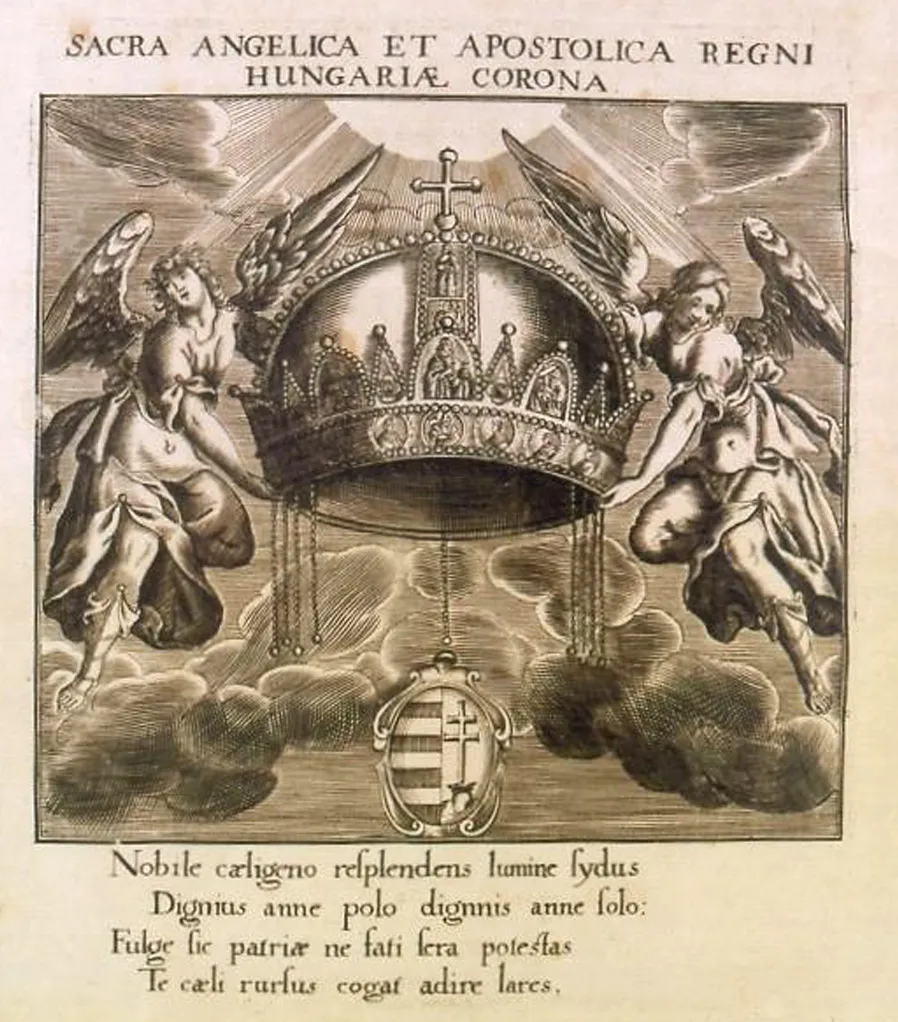
"Engraving of the Holy Crown of Hungary" / Wikimedia Commons.
The Magyars, a nomadic people from the Eurasian steppes, migrated into the Carpathian Basin around 895 CE. By the late 900s, they had established control over much of the region that is now Hungary. The arrival of the Magyars changed the political and cultural landscape of Central Europe. Their early society was organized into tribes led by chieftains, and their religion was based on shamanistic beliefs, different from the Christian kingdoms that surrounded them.
In the late 10th century, the Magyars faced increasing pressure from Christian neighbors like the Holy Roman Empire. To strengthen his position, a Magyar leader named Vajk—later known as Stephen I—sought to unify the tribes and bring stability to his people. Stephen realized that adopting Christianity could help Hungary gain recognition and protection from powerful Western rulers. According to a letter from Pope Sylvester II, Stephen was granted a royal crown and the title "Apostolic King" in 1000 or 1001 CE, marking the foundation of the Kingdom of Hungary.
King Stephen encouraged the spread of Christianity by building churches and establishing dioceses throughout Hungary. He invited Christian missionaries, including Benedictine monks, to teach the faith and organize communities. Stephen also introduced new laws based on Christian principles, such as requiring his subjects to attend church and observe holy days. Archaeological discoveries, like the remains of early churches at Esztergom and Székesfehérvár, provide evidence of these changes. Written sources, such as Stephen’s "Admonitions" to his son Emeric, show his emphasis on justice, charity, and loyalty to the Church.
The conversion to Christianity transformed Hungarian society. Tribal leaders became nobles, and Hungarian law began to resemble Western European systems. The kingdom developed a feudal structure, and ties with Rome and Western Europe grew stronger. However, the process was not always peaceful. Some Magyars resisted the new religion, leading to revolts that Stephen had to suppress. Over time, Christianity became deeply rooted in Hungarian culture, and King Stephen was later canonized as a saint for his role in this transformation.
Hungary’s adoption of Christianity connected it to broader European developments in the Middle Ages. The kingdom’s new identity helped it survive and thrive alongside its powerful neighbors. The story of Hungary’s conversion shows how geography, leadership, and religion can shape the fate of a nation.
Interesting Fact: The crown sent to Stephen I by the Pope is still a symbol of Hungarian national identity and appears on Hungary’s national coat of arms today.
Comprehension quiz (8 questions)
1. Who led the Magyars to Christianity?
2. What year did Stephen I become king?
3. Where did the Magyars settle?
4. Why did Stephen I adopt Christianity?
5. How did King Stephen spread Christianity?
6. What was a result of conversion?
7. The Magyars had a shamanistic religion. True or false?
8. What is a "diocese"?
Perfect for the way you teach
- Build comprehension skills
- Auto-graded quiz
- Differentiated reading
- Read together at home
- Improve fluency
- Quiet reading time
- Reading curriculum support
- Independent practice
- Track Lexile growth