Michelangelo's David
Interactive passage with audio narration, comprehension questions, and printable PDF.
By completing this purchase you agree to our Terms of Use and Privacy Policy. Your subscription renews automatically until you cancel. You can cancel anytime from your account settings. All sales are final and non-refundable. Digital content is available for download in your account immediately upon purchase.
What's included
Michelangelo's David preview and details
About this printable Michelangelo's David reading passage (Grades 5-8)
Sample passage and quiz from Michelangelo's David
Reading passage and comprehension quiz preview
Michelangelo David
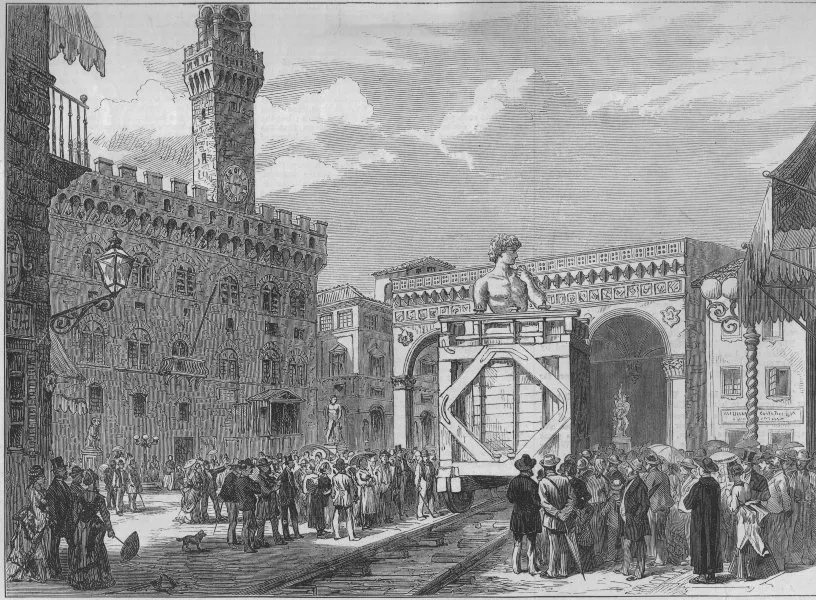
Moving Michelangelo's statue of David from Piazza della Signoria to Galleria.
Wikimedia Commons
The Renaissance was a period of tremendous cultural and artistic growth in Europe from the 14th to the 17th centuries. One of the most famous works of art from this era is the marble statue of David, created by the Italian artist Michelangelo between 1501 and 1504 in Florence. The David is celebrated for its anatomical perfection, technical skill, and deep symbolic meaning for the people of Florence.
Michelangelo began sculpting David from a single block of marble that had been abandoned by earlier artists. The stone, known as the “Giant,” was considered too difficult to use, but Michelangelo’s mastery of sculpting techniques allowed him to create a lifelike and powerful figure. Standing over 17 feet tall, David represents the biblical hero who defeated Goliath. Michelangelo chose to depict David before the battle, tense and alert, rather than after his victory. This choice emphasized the ideas of humanism and individual potential, which were central to Renaissance thinking.
The statue was commissioned by the guild of wool merchants, a powerful group in Florence, to be placed in front of the city’s government building, the Palazzo della Signoria. This location made David a public symbol of Florence’s strength, independence, and willingness to defend its freedom. According to primary sources, such as Giorgio Vasari’s "Lives of the Artists," the people of Florence immediately recognized the statue’s significance. Some even saw David as a representation of the city itself, standing up to larger, more powerful enemies. The figure’s intense gaze and realistic features show Michelangelo’s careful study of the human body, reflecting the Renaissance focus on scientific observation and proportion.
The creation of David marked a turning point in art history. Unlike medieval sculptures, which often looked stiff or unnatural, Michelangelo’s David shows movement, emotion, and realistic anatomy. This change was made possible by advances in understanding the human body through dissections and study. The statue’s influence spread throughout Europe, inspiring other artists to pursue greater accuracy and expressiveness in their work. Even today, David remains a symbol of artistic achievement and civic pride.
In conclusion, Michelangelo’s David is not just a masterpiece of sculpture but also a powerful symbol of the Renaissance itself. It reflects the era’s ideals of humanism, technical skill, and civic responsibility. The statue’s place in Florence and its lasting influence remind us of the important connections between art, history, and society.
This study of David connects to broader themes of world history, such as the rise of city-states, the power of art to express political ideas, and the ongoing influence of the Renaissance on modern culture.
Interesting Fact: When David was first unveiled in 1504, crowds gathered in Florence and some people threw stones at it because they disagreed about its meaning and placement.
Comprehension quiz (8 questions)
1. Who created the statue of David?
2. Where was David originally placed?
3. What material is David made from?
4. Why did Michelangelo show David before the battle?
5. What is one Renaissance ideal shown in David?
6. How did David symbolize Florence?
7. David was sculpted between 1501 and 1504.
8. What does 'proportion' mean in art?
Perfect for the way you teach
- Build comprehension skills
- Auto-graded quiz
- Differentiated reading
- Read together at home
- Improve fluency
- Quiet reading time
- Reading curriculum support
- Independent practice
- Track Lexile growth