Nicolaus Copernicus
Interactive passage with audio narration, comprehension questions, and printable PDF.
By completing this purchase you agree to our Terms of Use and Privacy Policy. Your subscription renews automatically until you cancel. You can cancel anytime from your account settings. All sales are final and non-refundable. Digital content is available for download in your account immediately upon purchase.
What's included
Nicolaus Copernicus preview and details
About this printable Nicolaus Copernicus reading passage (Grades 5-8)
Sample passage and quiz from Nicolaus Copernicus
Reading passage and comprehension quiz preview
Nicolaus Copernicus
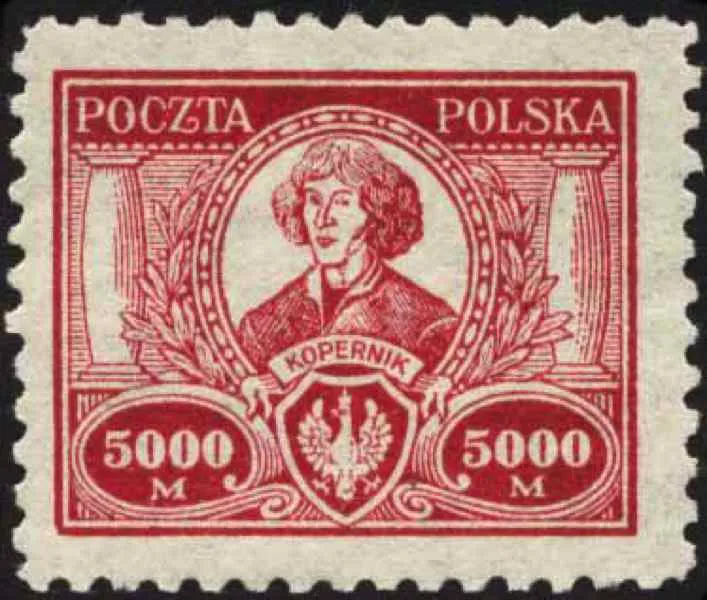
450th birth anniversary of Copernicus Poland 1923/ Wikimedia Commons
Nicolaus Copernicus was a Renaissance astronomer who changed how people understood the universe. Born in 1473 in Toruń, Poland, Copernicus studied mathematics and astronomy at universities in Kraków and Italy. During his lifetime, most Europeans believed in the geocentric model, which said that Earth was at the center of the universe and everything, including the sun and stars, revolved around it. This idea came from ancient Greek thinkers like Ptolemy and was supported by the Catholic Church.
Through careful observation, Copernicus noticed problems with the geocentric model. Planets sometimes moved backward in the sky, a motion called retrograde, which was hard to explain if Earth was at the center. By studying ancient texts and making his own observations, Copernicus developed a new idea: the heliocentric theory. In this sun-centered system, all planets, including Earth, revolve around the sun. He described this theory in his famous book, De revolutionibus orbium coelestium (“On the Revolutions of the Celestial Spheres”), first published in 1543. This was a revolutionary idea because it challenged both ancient authorities and the teachings of the Church.
Copernicus’s theory was based on evidence and calculations. He used mathematics to predict the positions of planets and found that his model matched observations better than the geocentric one. For example, in his book, Copernicus explained that the apparent backward motion of Mars could be understood as a result of Earth overtaking Mars in its orbit. This explanation was much simpler and more accurate than the complicated systems of circles and epicycles used in the old model. By questioning accepted beliefs, Copernicus started a new way of thinking called the Scientific Revolution.
The publication of Copernicus’s work had significant consequences. Some Church leaders rejected the heliocentric theory because it seemed to contradict the Bible, while others were interested in his careful reasoning. Over time, scientists like Galileo Galilei and Johannes Kepler built on Copernicus’s ideas, using new evidence and tools like the telescope. The heliocentric model eventually became widely accepted and transformed humanity’s understanding of the cosmos. Copernicus’s work marked a turning point in history, showing how careful observation and questioning could lead to new discoveries.
Copernicus’s bold proposal is important because it illustrates how scientific ideas can challenge powerful traditions and change society’s view of the world. His theory connected astronomy, religion, and society, and encouraged others to explore and test new ideas. The story of Copernicus links to broader themes in world history, such as the growth of human knowledge and the role of evidence in shaping beliefs.
Interesting Fact: Copernicus delayed publishing his book until the last year of his life, possibly because he feared criticism from Church officials and other scholars.
Comprehension quiz (8 questions)
1. Where was Copernicus born?
2. What is the heliocentric theory?
3. When was De revolutionibus published?
4. Why did Copernicus's theory matter?
5. How did Copernicus explain Mars's motion?
6. What was a consequence of Copernicus’s theory?
7. Copernicus delayed publishing his book. True or false?
8. What does 'geocentric' mean?
Perfect for the way you teach
- Build comprehension skills
- Auto-graded quiz
- Differentiated reading
- Read together at home
- Improve fluency
- Quiet reading time
- Reading curriculum support
- Independent practice
- Track Lexile growth