This learning resource is available in interactive and printable formats. The interactive worksheet can be played online and assigned to students. The Printable PDF version can be downloaded and printed for completion by hand.
This engaging middle school science passage explores the concept of refraction—the bending of light as it moves between different materials. Aligned with NGSS standard MS-PS4-2, the text explains the mechanism behind refraction, introduces the index of refraction, and describes why objects appear bent in water. Students will learn how lenses use refraction to focus light and see examples of lenses in glasses, cameras, and microscopes. The passage integrates scientific thinking by examining how observations and measurements have helped us understand light’s behavior. With a Lexile level appropriate for grades 6-8, audio narration, and differentiated versions for various reading abilities, this resource supports diverse learners. Activities include comprehension questions, writing prompts, and graphic organizers to deepen understanding of light, optics, and technological applications.
CONTENT PREVIEW
Expand content preview
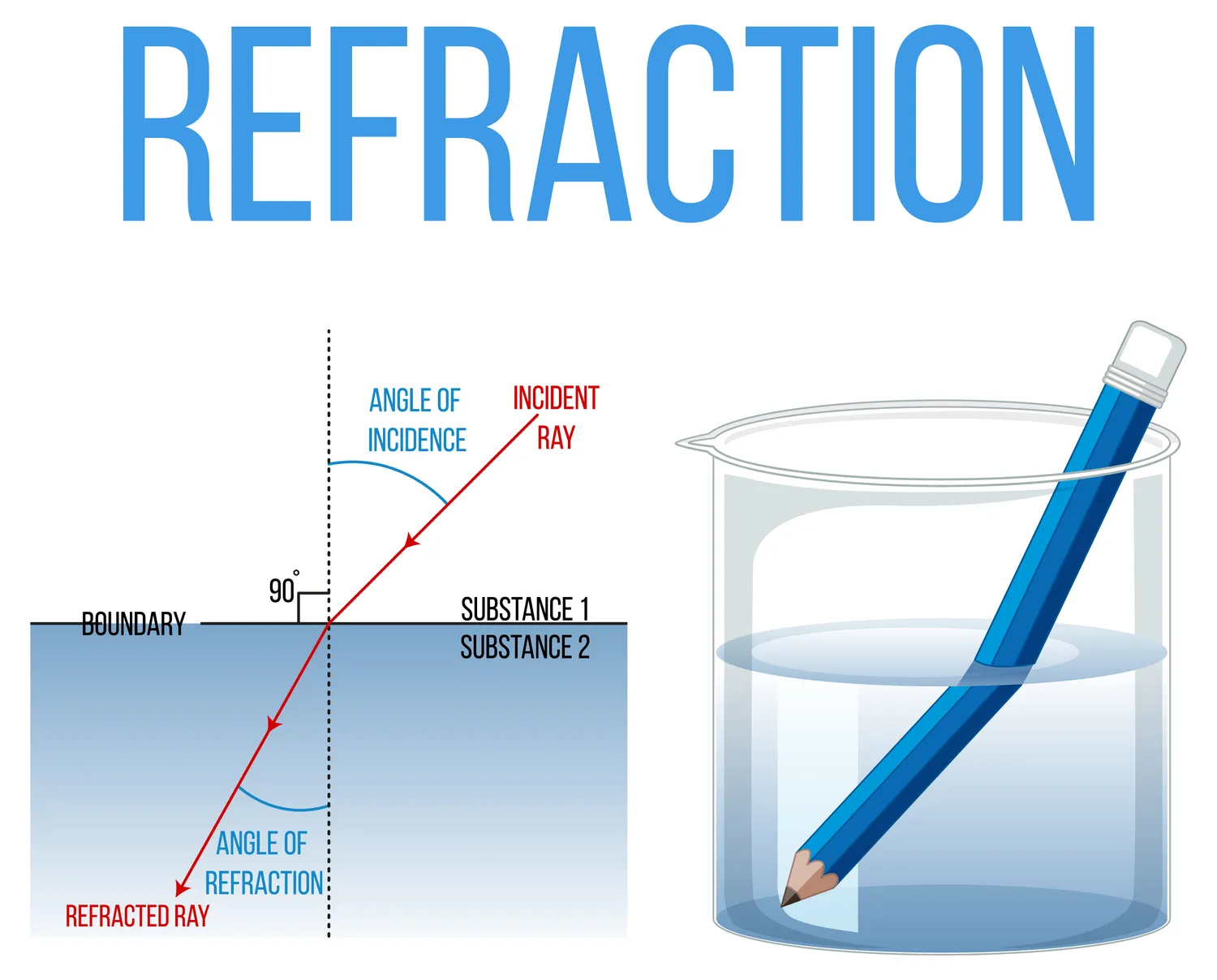
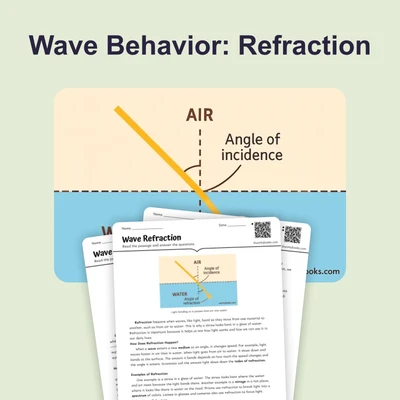
Refraction: light changes direction between substances, distorting object appearance.
Refraction is a key process in understanding how light moves through the world around us. When a beam of light passes from one material, such as air, into another, like water or glass, it doesn’t travel in a straight line. Instead, the light bends at the boundary between the two materials. This bending of light is not just a curious effect—it helps explain why objects look distorted or bent when placed in water and is the principle behind many useful optical devices.
How Refraction Works
Refraction happens because light travels at different speeds in different materials. In air, light moves quickly, but when it enters water or glass, it slows down. The amount by which the light slows is measured by a property called the index of refraction. For example, the index of refraction of air is about 1.0, while for water it is about 1.33. This means that light moves about 33% slower in water than in air. When light enters water at an angle, the change in speed causes it to bend toward the normal line—an imaginary line perpendicular to the surface. This is why a straight stick placed in water appears bent or broken at the surface.
The law that describes this behavior is called Snell’s Law, which relates the angles and the indices of refraction of the two materials. Scientists have confirmed this law through experiments that measure the angle of light before and after it crosses into a new material. These measurements consistently show that the greater the difference in the index of refraction, the more the light bends.
Applications: Lenses and Focusing Light
Lenses make use of refraction to focus or spread light. A lens is a piece of transparent material—usually glass or plastic—shaped to bend light rays in a controlled way. A convex lens is thicker in the middle and bends light rays inward to a point called the focal point. This type of lens is used in magnifying glasses, cameras, and eyeglasses for people who are farsighted. In contrast, a concave lens is thinner in the middle and spreads light rays outward; it is used in devices like glasses for nearsighted individuals.
By adjusting the shape and material of a lens, scientists and engineers can control exactly how much light is bent and where it is focused. This principle is fundamental to technologies like microscopes, telescopes, and even smartphones. The ability to manipulate light through refraction has allowed people to see objects that are very far away or extremely small.
Refraction in Everyday Life and Science
Beyond lenses, refraction explains common phenomena such as the shimmering effect on hot roads (called a mirage) and the way rainbows form when sunlight passes through raindrops. In medicine, optical fibers use controlled refraction to transmit light signals over long distances, enabling high-speed internet and precise medical imaging. Scientists continue to study how light interacts with different materials to improve vision correction, imaging, and communication technologies.
Understanding refraction links directly to broader science concepts like the behavior of waves and the interactions between energy and matter. By investigating how and why light bends, scientists have developed tools that extend human vision and knowledge.
Interesting Fact: Diamonds sparkle brilliantly because they have a very high index of refraction—over 2.4—which bends and splits light into many colors, creating their famous shine.
What is refraction?
The bending of light as it passes from one material to anotherThe reflection of light off a surfaceThe splitting of light into colorsThe absorption of light by a material
Why does a straight stick look bent in water?
Because light bends when it moves from air to waterBecause water reflects the stickBecause water absorbs lightBecause air moves faster than water
Which of the following best describes a convex lens?
Thicker in the middle and bends light inwardThinner in the middle and spreads light outwardReflects light backDoes not affect light
What property measures how much light slows down in a material?
Index of refractionDensityTransparencyColor
In the passage, what is the main function of lenses?
To focus or spread light using refractionTo change the color of lightTo block light from passing throughTo reflect light
What is 'Snell’s Law' as described in the passage?
A rule that describes how light bends when passing between materialsA law that explains how colors form in lightA rule for measuring the brightness of lightA law about the speed of sound
What inference can you make about why lenses are important for technology?
They help us see things clearly and enable devices like microscopes and camerasThey only work underwaterThey are used to block lightThey are not useful in daily life
If the difference in the index of refraction between two materials increases, what happens to the bending of light?
Light bends moreLight bends lessLight does not bendLight reflects
True or False: Refraction only happens in water.
TrueFalse
True or False: Optical fibers use refraction to send light signals for the internet.
TrueFalse
Perfect For:
👩🏫 Teachers
• Reading comprehension practice
• Auto-graded assessments
• Literacy skill development
👨👩👧👦 Parents
• Reading practice at home
• Comprehension improvement
• Educational reading time
🏠 Homeschoolers
• Reading curriculum support
• Independent reading practice
• Progress monitoring
Reading Features:
📖
Reading Passage
Engaging fiction or nonfiction text
❓
Comprehension Quiz
Auto-graded questions
📊
Instant Feedback
Immediate results and scoring
📄
Printable Version
Download for offline reading
🔊
Read Aloud
Voice-over with word highlighting
Reviews & Ratings
No reviews yet. Be the first to share your experience!
Related Content
Remote Sensing
This middle school science passage introduces students to the concept of remote sensing—the collection of information ab...
MS-ESS3-3MS-PS4-2MS-ETS1-1MS-ETS1-3
The Electromagnetic Spectrum
This comprehensive science reading passage introduces middle school students (grades 6-8) to the electromagnetic spectru...
MS-PS4-1MS-PS4-2
Visible Light and Color
This comprehensive science passage for grades 6-8 explores visible light as the part of the electromagnetic spectrum tha...
MS-PS4-2
Light Waves
This middle school science passage introduces students in grades 6-8 to the concept of light as an electromagnetic wave,...
MS-PS4-2
Wave Absorption
This engaging science passage for grades 6-8 explores the mechanism of wave absorption, where waves transfer energy to m...
MS-PS4-2
Wave Behavior: Transmission
This informational science reading passage for grades 6-8 explores the concept of wave behavior, focusing on transmissio...
MS-PS4-2
Wave Refraction
This comprehensive science passage introduces middle school students to the concept of refraction, a key phenomenon in w...
MS-PS4-2
Wave Reflection
This middle school science passage explores the behavior of waves during reflection, focusing on how and why waves bounc...
MS-PS4-2
Reflection and Mirrors
This engaging passage explores the science behind reflection and mirrors, designed for students in grades 6-8. Aligned w...
MS-PS4-2
Lasers
This passage explores the science of lasers for middle school students, aligning with NGSS standard MS-PS4-2. Students l...
MS-PS4-2
How We See
This informational science passage for grades 6-8 explores the mechanisms behind human vision, focusing on how light ent...
MS-PS4-2
Optical Instruments
This passage introduces middle school students to the fascinating world of optical instruments. Aligned to NGSS standard...
MS-PS4-2
What Is Sound?
This passage explores the science of sound for middle school students, aligned with NGSS standards MS-PS4-1 and MS-PS4-2...
MS-PS4-1MS-PS4-2
Speed of Sound
This comprehensive passage for grades 6-8 explores the science behind the speed of sound and how it varies depending on ...
MS-PS4-1MS-PS4-2
Absorption of Sound
This comprehensive passage, aligned to NGSS MS-PS4-2, explores the science behind the absorption of sound. Students in g...
MS-PS4-2
Sound Through Different Materials
This comprehensive middle school science passage, aligned to NGSS standard MS-PS4-2, explores the fascinating topic of h...
MS-PS4-2
Reflection of Sound: Echoes
This comprehensive middle school science passage explores the phenomenon of echoes, focusing on the reflection of sound ...
MS-PS4-2
How We Hear
This engaging middle school science passage explores the fascinating process of how we hear, tracing sound’s journey fro...
MS-PS4-2
Sonar and Echolocation
This engaging middle school science passage explores the science behind sonar and echolocation, aligned to NGSS standard...
MS-PS4-2
Noise Pollution
This comprehensive, NGSS-aligned middle school science passage explores the concept of noise pollution as harmful or unw...