Romeo and Juliet
Interactive passage with audio narration, comprehension questions, and printable PDF.
By completing this purchase you agree to our Terms of Use and Privacy Policy. Your subscription renews automatically until you cancel. You can cancel anytime from your account settings. All sales are final and non-refundable. Digital content is available for download in your account immediately upon purchase.
What's included
Romeo and Juliet preview and details
About this printable Romeo and Juliet reading passage (Grades 5-8)
Sample passage and quiz from Romeo and Juliet
Reading passage and comprehension quiz preview
Romeo and Juliet: Love and Conflict in the Renaissance
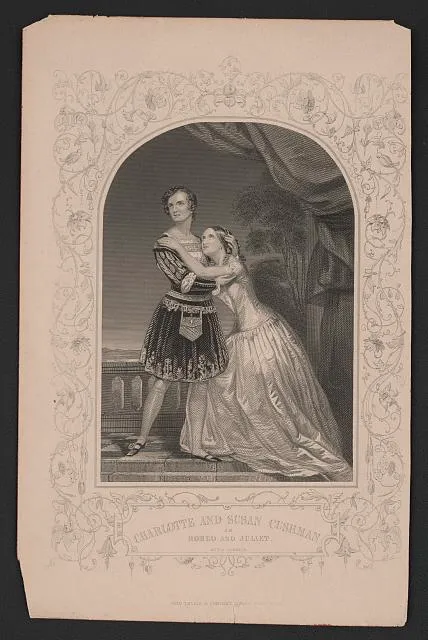
"Charlotte and Susan Cushman as Romeo and Juliet" by John Tallis & Company / Library of Congress.
The play Romeo and Juliet is one of the most famous tragedies written by William Shakespeare during the Renaissance, a period of cultural rebirth in Europe from the 14th to the 17th centuries. The story is set in the city-state of Verona, Italy, and was first performed around 1597. Shakespeare drew inspiration from earlier tales, including Arthur Brooke’s 1562 narrative poem "The Tragical History of Romeus and Juliet." The play centers on two young lovers, Romeo Montague and Juliet Capulet, whose families are bitter enemies.
The Renaissance was a time of great change in Europe. New ideas about art, science, and society spread quickly, especially in Italian cities like Florence, Venice, and Verona. In this era, social hierarchy and family honor were especially important. Families like the Montagues and Capulets held significant power and influence. The intense feud between these families reflects the real rivalries found in many Renaissance city-states, where conflicts sometimes led to violence. Primary sources from the time, such as city records from Verona, mention family disputes and duels, showing that Shakespeare’s story had a basis in historical reality.
In the play, Romeo and Juliet fall in love at first sight, but their relationship is forbidden due to their families’ hatred. Their secret marriage is arranged by Friar Laurence, who hopes to end the feud. However, a series of misunderstandings and tragic events—including the deaths of Mercutio and Tybalt—lead to disaster. The play’s famous balcony scene, where Juliet speaks to Romeo under the night sky, has become a symbol of eternal love. Shakespeare uses the idea of fate, suggesting that the young lovers are "star-crossed"—their destinies are controlled by forces beyond their control. This theme is supported by references to astrology and fortune, which were widely believed in during the Renaissance.
Themes of love, loyalty, and family duty are explored throughout the play. The choices made by Romeo and Juliet challenge the social expectations of their time. The tragic ending, where both lovers die, forces their families to reconsider the cost of hatred and stubborn pride. Shakespeare’s language, including poetic soliloquies and dramatic irony, helps convey the emotions and tensions of Renaissance society. The play has influenced art, music, and literature for over 400 years, proving its enduring cultural impact.
Romeo and Juliet remains significant because it addresses timeless questions about love, conflict, and the consequences of personal and social choices. By setting the story in Renaissance Italy, Shakespeare connects universal human emotions to a specific historical moment. The play’s enduring popularity shows how stories from the past continue to shape our understanding of the world.
This exploration of Romeo and Juliet connects to broader themes in world history, such as the rise of the Renaissance, the power of family and tradition, and the lasting influence of literature on society.
Interesting Fact: The first printed edition of Romeo and Juliet appeared in 1597, and versions of the story have been adapted into hundreds of plays, movies, and ballets around the world.
Comprehension quiz (8 questions)
1. Where is Romeo and Juliet set?
2. Who wrote Romeo and Juliet?
3. What year was the first performance?
4. Why do Romeo and Juliet marry in secret?
5. What theme is shown by their tragic end?
6. How did the families respond after the tragedy?
7. Romeo and Juliet was first printed in 1597.
8. What is a soliloquy?
Perfect for the way you teach
- Build comprehension skills
- Auto-graded quiz
- Differentiated reading
- Read together at home
- Improve fluency
- Quiet reading time
- Reading curriculum support
- Independent practice
- Track Lexile growth