This learning resource is available in interactive and printable formats. The interactive worksheet can be played online and assigned to students. The Printable PDF version can be downloaded and printed for completion by hand.
This engaging world history passage explores Raphael’s 'School of Athens,' a masterful Renaissance fresco that brings together the greatest philosophers of ancient Greece, including Plato and Aristotle, in a powerful celebration of classical learning and human reason. Students will analyze how the painting reflects the values of the Renaissance, the influence of geography and history on its creation, and the connections between art and intellectual achievement. The passage includes a rigorous reading text, glossary, multiple-choice quiz, writing prompts, differentiated version, Spanish translations, and graphic organizers. Aligned to CA HSS 7.8.3 and CCSS RH.6-8.2, this lesson encourages students to think like historians and develop skills in textual analysis and evidence-based reasoning. Read aloud audio and Spanish versions support diverse learners.
CONTENT PREVIEW
Expand content preview
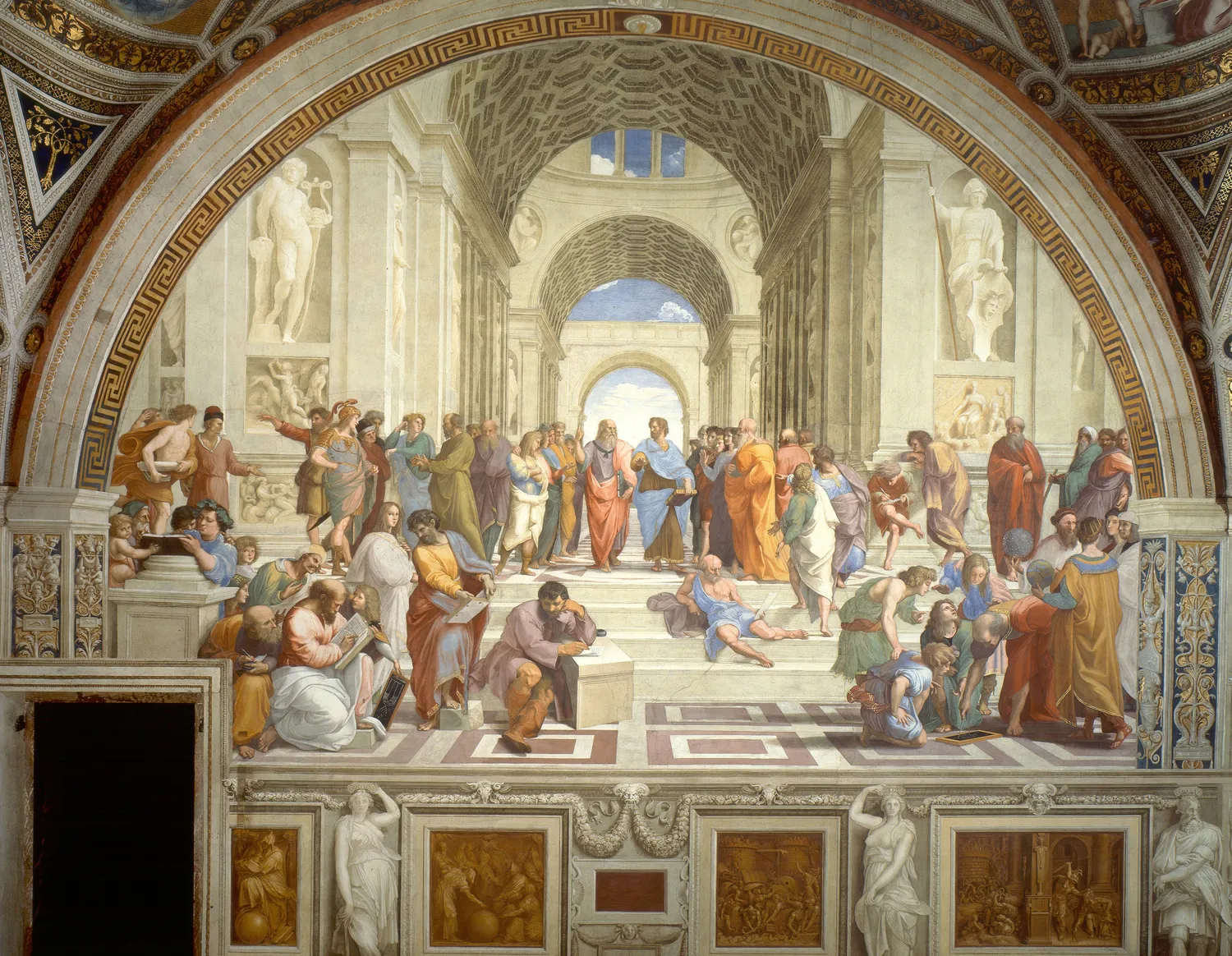
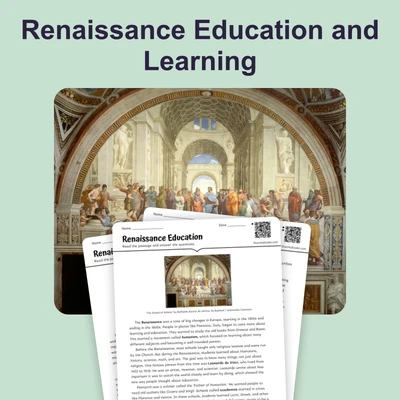
"The School of Athens" by Raffaello Sanzio da Urbino, by Raphael / Wikimedia Commons.
The School of Athens is a famous fresco painted by the Renaissance artist Raphael between 1509 and 1511. It is located in the Vatican, in a room called the Stanza della Segnatura. This masterpiece was created during the Renaissance, a period in Europe when artists and thinkers revived interest in the knowledge and achievements of ancient Greece and Rome. Through his art, Raphael celebrated the power of reason and the importance of learning from the past.
At the center of the painting stand two ancient philosophers: Plato and Aristotle. Plato, on the left, points upward, symbolizing his belief in higher, ideal forms. Aristotle, on the right, gestures toward the earth, showing his focus on practical knowledge and observation. Raphael based their faces on ancient statues, providing historical evidence for how these figures may have appeared. Surrounding them are more than twenty other philosophers and scholars, including Socrates, Pythagoras, and Euclid. Each figure is engaged in discussion, writing, or teaching, demonstrating the lively exchange of ideas in classical times.
The composition of the painting is carefully planned. Raphael used perspective, a mathematical method for creating the illusion of depth, to draw the viewer’s eye toward the main figures. The setting resembles a grand ancient building with arches and columns, reflecting the architecture of Rome. This shows how Renaissance artists connected their own era to the ancient world. The fresco also honors the social hierarchy of learning, with philosophers, mathematicians, and scientists placed in positions of respect. For example, Euclid is shown teaching geometry to eager students, just as he did in ancient Alexandria.
The School of Athens represents the Renaissance idea that knowledge and reason could improve society. It brings together thinkers from different periods and places, uniting them in a timeless search for truth. This blending of past and present was possible because the Renaissance was a time of rediscovery, when people looked to ancient texts and archaeological remains for inspiration. Raphael’s work continues to inspire people today because it celebrates the value of education, discussion, and curiosity about the world.
By analyzing the School of Athens, historians learn how art can reflect social values and intellectual changes over time. The fresco connects the Renaissance to the ancient world and reminds us that ideas from the past continue to shape our lives today.
Interesting Fact: Raphael included a self-portrait in the fresco—he painted himself as one of the scholars, standing among the great thinkers of history.
Who painted School of Athens?
RaphaelLeonardo da VinciMichelangeloDonatello
Where is the School of Athens located?
The VaticanFlorenceAthensParis
When was the fresco completed?
1511149215271485
Why does Plato point upward?
Belief in ideal formsLooking for birdsTo show surpriseTo greet Aristotle
How does Raphael show the importance of learning?
By painting scholars teachingBy adding animalsUsing only dark colorsBy writing poems
What does perspective create in the painting?
Illusion of depthLoud soundsMoving figuresWeather changes
Raphael included himself in the painting. True or false?
TrueFalse
What is a 'fresco'?
A wall painting on wet plasterA statueA type of poemA building
Perfect For:
👩🏫 Teachers
• Reading comprehension practice
• Auto-graded assessments
• Literacy skill development
👨👩👧👦 Parents
• Reading practice at home
• Comprehension improvement
• Educational reading time
🏠 Homeschoolers
• Reading curriculum support
• Independent reading practice
• Progress monitoring
Reading Features:
📖
Reading Passage
Engaging fiction or nonfiction text
❓
Comprehension Quiz
Auto-graded questions
📊
Instant Feedback
Immediate results and scoring
📄
Printable Version
Download for offline reading
🔊
Read Aloud
Voice-over with word highlighting
Reviews & Ratings
No reviews yet. Be the first to share your experience!
Related Content
Renaissance Clothing
This passage explores the fascinating world of Renaissance fashion clothing in Europe, focusing on how clothing reflecte...
Renaissance Poetry
This engaging world history reading passage introduces students to the Renaissance sonnet, focusing on the influential w...
Renaissance Philosophy
This passage explores the main ideas of Renaissance philosophy, which emerged in Europe during the 14th to 16th centurie...
Renaissance Art
This reading passage examines the enduring legacy of Renaissance art in world history, focusing on key techniques such a...
CA HSS 7.8.3CCSS RH.6-8.2CCSS W.6.2
Renaissance Anatomy Art
This engaging passage explores the intersection of art, science, and society during the Renaissance through the lens of ...
French Renaissance
This passage explores the rich culture of the French Renaissance, focusing on the influence of Italian art and architect...
Northern Renaissance
This passage examines the development and significance of Northern Renaissance art, focusing on how Renaissance ideas sp...
Renaissance Art and Artists
This history reading passage delves into the world of Renaissance art, focusing on the revolutionary works and lives of ...
Florence Renaissance
This history reading passage examines Florence during the Renaissance, highlighting its cultural richness, the influence...
Renaissance Humanism
This passage introduces students to the transformative concept of Renaissance Humanism, a philosophical movement that em...
Renaissance Oil Painting
This passage explores the development of oil painting techniques during the Renaissance, focusing on the comparison betw...
Renaissance Impact Today
This engaging world history passage examines the enduring impact of the Renaissance on modern society, focusing on how R...
English Renaissance
This comprehensive passage explores the English Renaissance, a transformative period in England marked by a flourishing ...
Renaissance Education
This engaging history reading passage examines the transformation of education during the Renaissance and its impact on ...
Renaissance Medicine
This engaging world history reading passage explores medical advances during the Renaissance in Europe, focusing on chan...
Renaissance Music
This world history reading passage examines the development of music during the Renaissance, a period of profound cultur...
Renaissance Festivals Celebrations
This passage explores the vibrant role of festivals and celebrations during the Renaissance, focusing on how public spec...
Catholic Church and Renaissance
This passage explores the major role the Catholic Church played as a patron of Renaissance art in Europe. It examines ho...
Renaissance Religious Art
This passage explores the dramatic changes in religious art during the Renaissance, focusing on the shift from medieval ...
Renaissance Women
This reading passage explores the lives and contributions of women during the Renaissance period in Europe. Students wil...