The Amazon Rainforest
Interactive passage with audio narration, comprehension questions, and printable PDF.
By completing this purchase you agree to our Terms of Use and Privacy Policy. Your subscription renews automatically until you cancel. You can cancel anytime from your account settings. All sales are final and non-refundable. Digital content is available for download in your account immediately upon purchase.
What's included
The Amazon Rainforest preview and details
About this printable The Amazon Rainforest science reading passage, NGSS-aligned (Grades 5-8)
Sample passage and quiz from The Amazon Rainforest
Reading passage and comprehension quiz preview
Amazon Rainforest
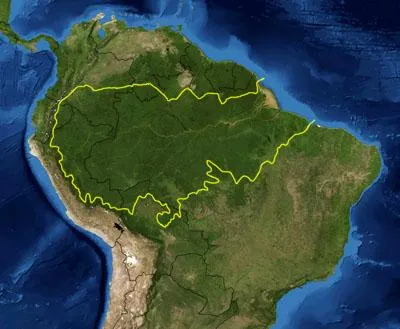
"Amazon rainforest" by Pfly / Wikimedia Commons
Deforestation is transforming the landscape of the Amazon Rainforest, the world's largest tropical rainforest. Stretching across nine South American countries and covering about 5.5 million square kilometers, the Amazon represents a vital system that influences local and global climates. The forest is renowned for its extraordinary biodiversity, hosting nearly 10% of all known plant and animal species on Earth. Scientists study the Amazon to understand how its complex web of life and physical processes interact to support such a rich ecosystem and affect the planet as a whole.
Location, Scale, and the River System
The Amazon Rainforest spans Brazil, Peru, Colombia, Venezuela, Ecuador, Bolivia, Guyana, Suriname, and French Guiana. Its massive scale means it acts as a giant 'lung' for the Earth, exchanging large amounts of carbon dioxide and oxygen through photosynthesis. The Amazon River system, the largest in the world by discharge, carries more water than any other river, moving over 209,000 cubic meters per second. These rivers shape the landscape, form diverse habitats, and allow nutrients to circulate, which supports the region's exceptional biodiversity.
Biodiversity and Ecosystem Interactions
The Amazon's immense biodiversity includes over 16,000 tree species, 2.5 million insect species, and thousands of birds, mammals, and reptiles. Unique species like the jaguar, pink river dolphin, and poison dart frog depend on the rainforest's varied microhabitats. This diversity results from millions of years of evolution and complex interactions among organisms and their environment. For example, trees provide food and shelter for insects and animals, while animals help pollinate plants or disperse seeds. Scientists use field surveys, satellite images, and genetic analysis to track these relationships and monitor changes over time.
Deforestation: Causes, Effects, and Climate Impact
Despite its importance, the Amazon faces alarming rates of deforestation—over 17% of the forest has been lost in the past 50 years. Main causes include agriculture (especially cattle ranching and soy farming), illegal logging, and infrastructure development. Deforestation disrupts the water cycle by reducing evapotranspiration, where trees release water vapor into the air. This leads to less rainfall, affecting both the local ecosystem and distant weather patterns. As trees are removed, stored carbon is released, contributing to global climate change. The Amazon acts as a major carbon sink, so its loss has worldwide consequences.
Understanding the Amazon Rainforest's systems is essential for protecting biodiversity, supporting local communities, and fighting climate change. Scientists, governments, and indigenous groups are working together to find sustainable solutions that balance development with conservation. The future of the Amazon affects not only South America but the stability of Earth's entire climate and ecosystems.
Interesting Fact: A single hectare of Amazon rainforest can contain more species of trees than the entire continent of North America!
Comprehension quiz (10 questions)
1. Which of the following countries does NOT contain part of the Amazon Rainforest?
2. Approximately what percentage of Earth's known species live in the Amazon Rainforest?
3. What is one main cause of deforestation in the Amazon?
4. What does the term <b>evapotranspiration</b> mean as used in the passage?
5. What is a <b>carbon sink</b>?
6. Why does deforestation affect rainfall patterns?
7. How do scientists study biodiversity in the Amazon?
8. If deforestation continues, what is a likely result for Earth's climate?
9. True or False: The Amazon River moves more water than any other river in the world.
10. True or False: Cutting down trees in the Amazon has no impact on the rest of the world.
Perfect for the way you teach
- Build comprehension skills
- Auto-graded quiz
- Differentiated reading
- Read together at home
- Improve fluency
- Quiet reading time
- Reading curriculum support
- Independent practice
- Track Lexile growth