The Last Supper
Interactive passage with audio narration, comprehension questions, and printable PDF.
By completing this purchase you agree to our Terms of Use and Privacy Policy. Your subscription renews automatically until you cancel. You can cancel anytime from your account settings. All sales are final and non-refundable. Digital content is available for download in your account immediately upon purchase.
What's included
The Last Supper preview and details
About this printable The Last Supper reading passage (Grades 5-8)
Sample passage and quiz from The Last Supper
Reading passage and comprehension quiz preview
The Last Supper
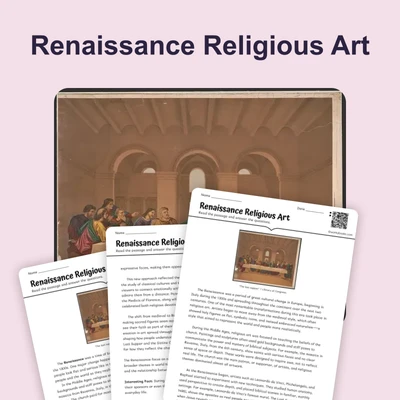
![[The last supper]](https://assets.workybooks.com/INTERACTIVE/media/pd--The-last-supper--1766426764167-929548961.webp)
"[The last supper]" / Library of Congress.
Leonardo da Vinci's fresco known as The Last Supper is one of the most celebrated works of the Renaissance. Painted between 1495 and 1498, this mural covers a dining hall wall in the Convent of Santa Maria delle Grazie in Milan, Italy. The painting captures a key moment from the Christian tradition: the final meal that Jesus shared with his twelve disciples before his arrest. Leonardo's work is famous not only for its religious theme but also for its dramatic composition, detailed emotional expressions, and ground-breaking use of perspective.
The scene shows the instant after Jesus tells his followers that one of them will betray him. Leonardo groups the disciples into four sets of three, each reacting with surprise, disbelief, or concern. The artist paid close attention to gesture and facial expression, making each disciple's emotions clear and unique. For example, Peter looks angry, John appears shocked, and Judas clutches a small bag, hinting at his role as the betrayer. This focus on realistic human emotion was new for the time and set a standard for Renaissance art.
Leonardo experimented with the fresco technique by using both oil and tempera paints on dry plaster, rather than the traditional wet plaster. While this allowed for more detail and brilliant color, it also made the painting fragile. Over centuries, the artwork suffered damage from humidity, war, and even attempts to widen the doorway beneath it. Efforts at restoration have tried to save Leonardo's masterpiece, but only about 20% of the original paint remains today. Early descriptions by visitors and copies made by Leonardo's students, such as the 16th-century painter Giampietrino, help historians understand how the fresco originally looked.
The Last Supper is also famous for its use of linear perspective. Leonardo created the illusion of depth by making all the lines in the room point toward a single spot—Jesus’s head—at the center of the composition. This draws viewers’ eyes to the main figure and creates a sense of unity. The arrangement of figures and the realistic setting reflect Renaissance beliefs in order, balance, and humanism. The painting's survival through centuries of change—including the Napoleonic Wars and World War II—shows its lasting importance.
Today, The Last Supper remains a symbol of both religious faith and artistic innovation. It connects viewers to a moment of human drama and creativity from over 500 years ago. The painting continues to inspire artists, historians, and millions of people around the world.
Interesting Fact: During World War II, the convent housing The Last Supper was bombed, but the wall with the painting survived, protected by sandbags.
This masterpiece connects to broader themes in world history, such as the rise of Renaissance ideas, the blending of art and science, and the enduring power of human expression.
Comprehension quiz (8 questions)
1. Who painted The Last Supper?
2. Where is The Last Supper located?
3. When was The Last Supper completed?
4. Why did Leonardo use linear perspective?
5. What effect did dry plaster have on the fresco?
6. How did historians learn about the original painting?
7. The Last Supper survived bombing in WWII. True or false?
8. What is a fresco?
Perfect for the way you teach
- Build comprehension skills
- Auto-graded quiz
- Differentiated reading
- Read together at home
- Improve fluency
- Quiet reading time
- Reading curriculum support
- Independent practice
- Track Lexile growth