Types of Mirrors
Interactive passage with audio narration, comprehension questions, and printable PDF.
By completing this purchase you agree to our Terms of Use and Privacy Policy. Your subscription renews automatically until you cancel. You can cancel anytime from your account settings. All sales are final and non-refundable. Digital content is available for download in your account immediately upon purchase.
What's included
Types of Mirrors preview and details
About this printable Types of Mirrors science reading passage, NGSS-aligned (Grades 5-8)
Sample passage and quiz from Types of Mirrors
Reading passage and comprehension quiz preview
Types of Mirrors
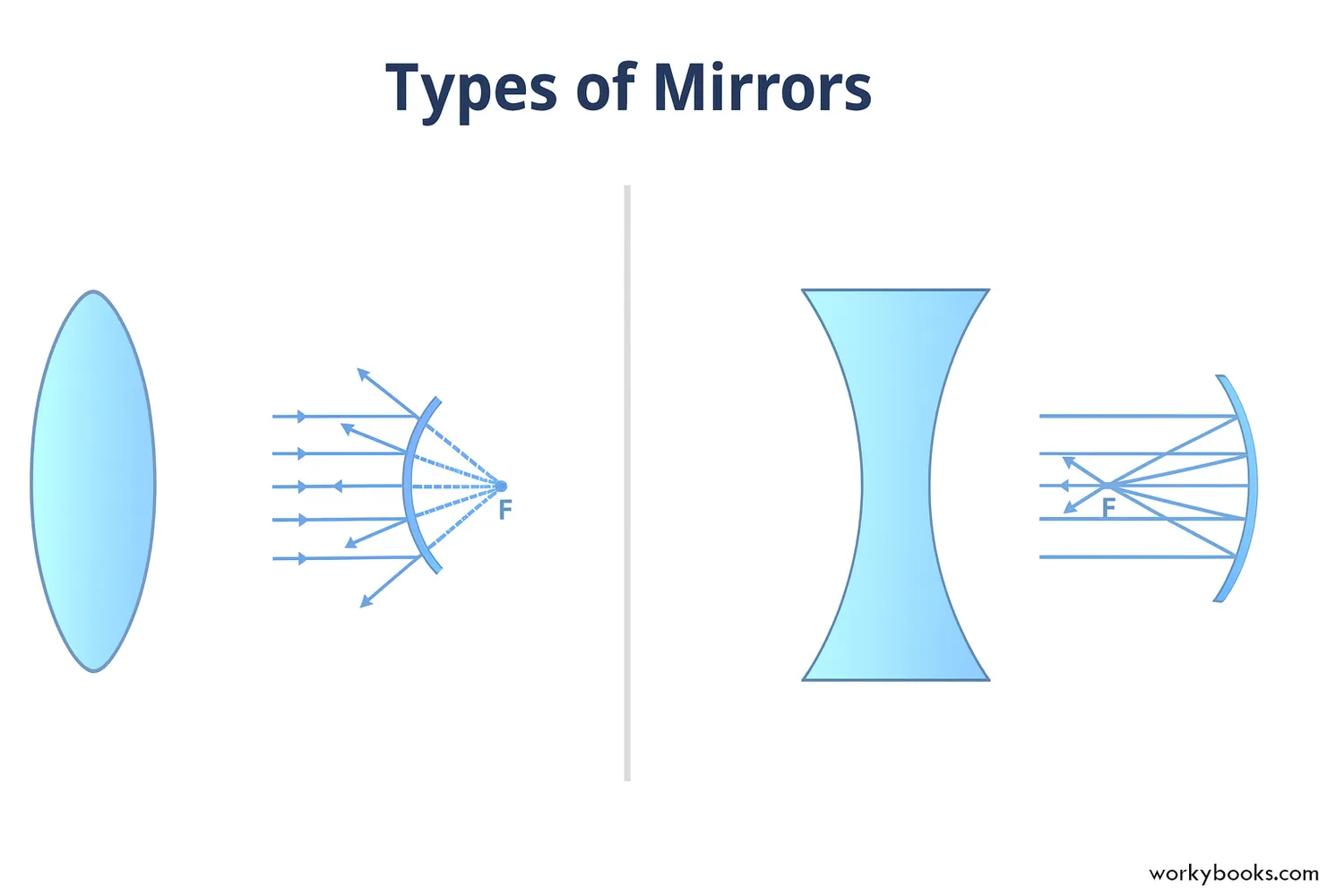
Mirrors play a crucial role in science, technology, and daily life by changing the way we see and use light. There are two primary types of mirrors: concave and convex. Each type interacts with light differently, resulting in unique images and practical uses. Understanding how mirrors work helps scientists and engineers design better tools, from telescopes to car mirrors.
How Concave Mirrors Work
A concave mirror is curved inward like the inside of a bowl. When parallel light rays strike a concave mirror, they reflect and converge at a single point called the focal point. This ability to focus light allows concave mirrors to create either a real image or a virtual image, depending on the object's position. If the object is farther from the mirror than the focal point, a real, inverted image forms. If the object is between the focal point and the mirror, the image appears larger and upright, known as a virtual image. These properties make concave mirrors ideal for uses where magnification and focusing are needed. For example, they are used in makeup mirrors to enlarge faces, in telescopes to collect and focus distant starlight, and in car headlights to direct beams of light forward efficiently.
How Convex Mirrors Work
A convex mirror curves outward like the back of a spoon. When light rays hit a convex mirror, they reflect outward and diverge. This causes images to appear smaller and always virtual, meaning they cannot be projected onto a screen. However, convex mirrors offer a wide field of view, allowing people to see more area in a single glance. Because of this, convex mirrors are commonly used in places where safety and visibility are important. Store security mirrors, which help prevent theft by letting employees see around corners, and car side-view mirrors, which reduce blind spots, are everyday examples. The diverging light also means that objects seem farther away, which drivers must remember when using these mirrors.
Comparing and Applying Mirror Types
The differences between concave and convex mirrors arise from their shapes and the way they control light. Concave mirrors focus light to create real or magnified images, while convex mirrors spread light to provide a broad view. Scientists have measured how the radius of curvature and focal length affect image size, with smaller radii producing stronger focusing or spreading effects. Understanding these mechanisms has led to advances in optics, allowing engineers to design efficient optical devices for astronomy, security, and transportation.
Mirrors demonstrate how mastering physical principles enables society to solve problems and create new technology. The study of mirrors also connects to larger scientific concepts, such as how lenses focus light and how waves behave in different environments. By learning about mirrors, students gain insight into the nature of light and its impact on technology and safety.
Interesting Fact: The largest optical telescope mirrors can be over 8 meters (26 feet) wide, using concave shapes to collect and focus faint light from distant galaxies!
Comprehension quiz (10 questions)
1. Which type of mirror converges light rays to a focal point?
2. What is a common use for convex mirrors?
3. What happens to light rays when they hit a convex mirror?
4. What does the term 'field of view' mean in the context of mirrors?
5. If an object is between the focal point and a concave mirror, what type of image is formed?
6. Why are concave mirrors used in telescopes?
7. What effect does a smaller radius of curvature have on a mirror's ability to focus or spread light?
8. True or False: Convex mirrors always form real images.
9. True or False: Concave mirrors can create both real and virtual images.
10. What is one reason why drivers must be careful when using convex side-view mirrors?
Perfect for the way you teach
- Build comprehension skills
- Auto-graded quiz
- Differentiated reading
- Read together at home
- Improve fluency
- Quiet reading time
- Reading curriculum support
- Independent practice
- Track Lexile growth