What Are Cleavage and Fracture in Minerals — Reading Comprehension
Rate this
Premium Resource
Present
Present in classroom. No work saved
Assign
Classroom with student accounts, Track progress
Quick Play
No student accounts, assign with a link
Grades
6
7
8
Standards
MS-ESS3-1
PRINT+DIGITAL RESOURCE
This learning resource is available in interactive and printable formats. The interactive worksheet can be played online and assigned to students. The Printable PDF version can be downloaded and printed for completion by hand.
This comprehensive middle school science passage explains the difference between cleavage and fracture in minerals, two important diagnostic properties used to identify rocks and minerals. Students explore how atomic bonds determine whether a mineral breaks along smooth, flat planes (cleavage) or in irregular patterns (fracture). The passage uses familiar examples like mica, feldspar, and quartz to illustrate these concepts. Aligned with NGSS standard MS-ESS3-1, this audio-integrated resource includes differentiated versions for struggling readers, Spanish translations, vocabulary glossaries, comprehension questions, writing activities, and graphic organizers. Students develop skills in observation and classification while learning how internal crystal structure affects external physical properties. This passage connects to real-world applications in geology and mineral identification, helping students understand how scientists use breaking patterns as reliable tools for distinguishing different minerals in the field and laboratory.
CONTENT PREVIEW
Expand content preview
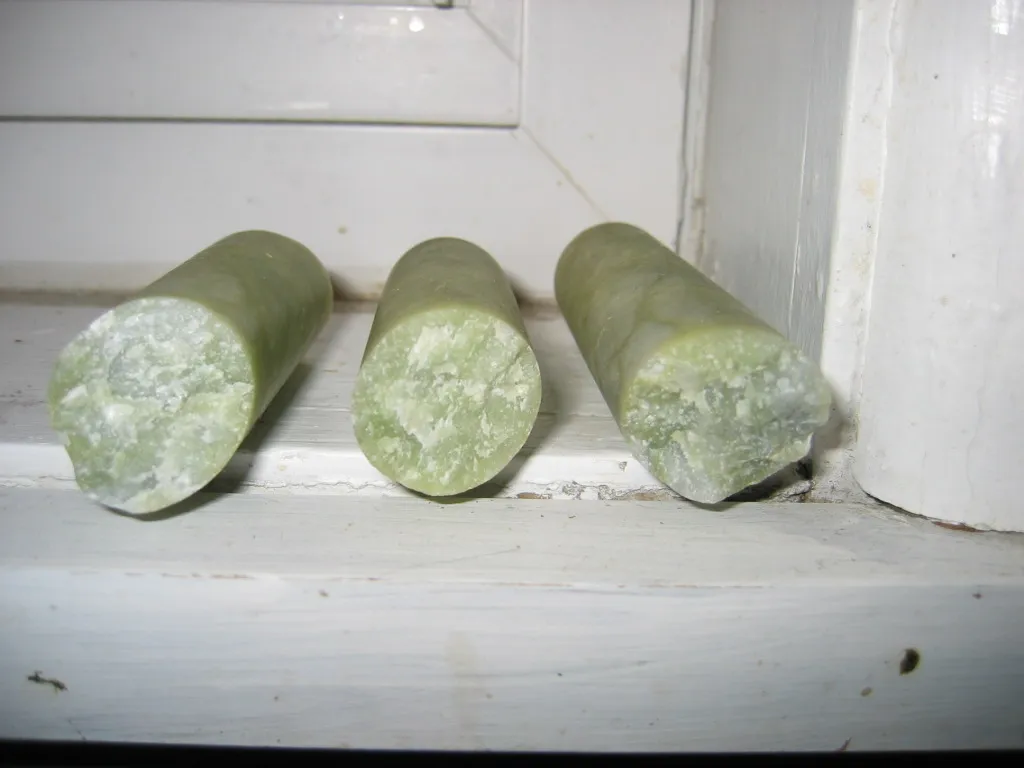
image of an impure jade cylindrical dough rolling pin broken into three roughly equal pieces, showing the mineral fracture and cleavage properties.. Image by AstroImager001 / Wikimedia Commons
Minerals break in predictable ways that help scientists identify them. When you tap a mineral with a hammer, it might split into smooth, flat pieces or shatter into irregular chunks. These different breaking patterns are called cleavage and fracture. Understanding how minerals break reveals important information about their internal structure and makes these properties useful for mineral identification.
Cleavage is the tendency of a mineral to break along flat, smooth surfaces called cleavage planes. These planes form because of weak atomic bonds within the mineral's crystal structure. Think of cleavage like tearing paper along a perforation line—the mineral splits easily in certain directions where atoms are held together less strongly. Mica is an excellent example of cleavage. When you break mica, it separates into thin, flexible sheets that are perfectly flat. This happens because mica has very weak bonds between its layers of atoms. Geologists describe mica as having perfect cleavage in one direction because it always breaks the same way.
Feldspar demonstrates a different type of cleavage. This common mineral breaks along two directions that meet at approximately 90-degree angles. When you examine a broken piece of feldspar, you can see two sets of flat surfaces that intersect like the corner of a room where two walls meet. Feldspar has good cleavage in two directions, making it distinguishable from minerals with different cleavage patterns. The flat, shiny surfaces you see on broken feldspar are cleavage planes, and they always form in the same directions because of the mineral's internal atomic arrangement.
Fracture is the opposite of cleavage. When a mineral fractures, it breaks in irregular patterns with no preferred direction. This happens because the atomic bonds are equally strong in all directions, so there are no weak planes where the mineral tends to split. Quartz is the classic example of fracture. When quartz breaks, it produces curved, shell-like surfaces called conchoidal fracture. These smooth, curved surfaces look similar to the inside of a clamshell. Unlike cleavage, which produces flat planes, fracture creates unpredictable, uneven surfaces.
The difference between cleavage and fracture depends entirely on a mineral's internal atomic structure. Minerals with cleavage have atoms arranged in layers or planes with weaker bonds between them. When force is applied, the mineral breaks along these weak zones. Minerals with fracture have atoms bonded with similar strength in all directions. No matter where you hit the mineral, the bonds are equally strong, so it breaks randomly rather than along specific planes. This makes breaking pattern a reliable diagnostic property—a characteristic that helps identify minerals.
Scientists use cleavage and fracture as identification tools because these properties remain consistent. A piece of mica will always show perfect sheet-like cleavage, feldspar will always break along two directions, and quartz will always fracture irregularly. By observing how a mineral breaks, geologists can narrow down possible identities even without expensive laboratory equipment. In the field, a simple hammer test revealing cleavage or fracture provides valuable information about what mineral you have found.
Interesting Fact: The famous Hope Diamond and other gemstones are cut along cleavage planes. Diamond has perfect cleavage in four directions, and skilled gem cutters use these natural weak planes to split rough diamonds into smaller pieces before shaping them into brilliant jewels.
What is cleavage in minerals?
The tendency to break along flat, smooth surfaces in specific directionsThe breaking of minerals in irregular patternsThe color of a mineral when scratchedThe hardness of a mineral's surface
Which mineral is described as having perfect cleavage in one direction?
QuartzFeldsparMicaDiamond
What causes cleavage to occur in minerals?
Strong atomic bonds in all directionsWeak atomic bonds in specific directionsThe color of the mineralThe size of the mineral crystals
According to the passage, what type of fracture does quartz display?
How many directions of cleavage does feldspar have?
One directionTwo directionsThree directionsFour directions
Why do minerals with fracture break in irregular patterns?
Because they have weak bonds in certain directionsBecause their atomic bonds are equally strong in all directionsBecause they are too softBecause they contain water
What makes cleavage and fracture useful as diagnostic properties?
They change depending on the weatherThey are easy to see with a microscopeThey remain consistent for each mineral typeThey only appear in rare minerals
What do the cleavage planes in feldspar look like?
Curved surfaces like shellsThin, flexible sheetsTwo sets of flat surfaces that meet at about 90 degreesRough, jagged edges
True or False: Minerals with cleavage have atoms arranged in layers with weaker bonds between them.
TrueFalse
True or False: Fracture produces flat, smooth surfaces just like cleavage.
TrueFalse
Perfect For:
👩🏫 Teachers
• Reading comprehension practice
• Auto-graded assessments
• Literacy skill development
👨👩👧👦 Parents
• Reading practice at home
• Comprehension improvement
• Educational reading time
🏠 Homeschoolers
• Reading curriculum support
• Independent reading practice
• Progress monitoring
Reading Features:
📖
Reading Passage
Engaging fiction or nonfiction text
❓
Comprehension Quiz
Auto-graded questions
📊
Instant Feedback
Immediate results and scoring
📄
Printable Version
Download for offline reading
🔊
Read Aloud
Voice-over with word highlighting
Reviews & Ratings
No reviews yet. Be the first to share your experience!
Related Content
How Do Solar Panels Work?
This middle school reading passage explains how solar panels work by turning sunlight into electricity. The passage desc...
MS-ESS3-1
How Do Wind Turbines Work?
This NGSS-aligned reading passage for middle school students explains how wind turbines convert the energy of moving air...
MS-ESS3-1
How Does a Hydroelectric Dam Work?
This NGSS-aligned science passage for middle school students explains how hydroelectric dams work to produce clean, rene...
MS-ESS3-1
What Is Biofuel?
This NGSS-aligned middle school science passage explains what biofuel is, how it is made, and why it is important as a c...
MS-ESS3-1
What Is Tidal Energy?
This engaging reading passage for middle school students introduces tidal energy, a form of renewable energy that uses t...
MS-ESS3-1
What Is Wave Energy?
This passage introduces middle school students to wave energy—a clean, renewable energy source that comes from the movem...
MS-ESS3-1
What Is Green Energy?
This science passage introduces middle school students to the concept of green energy—clean, renewable energy that comes...
MS-ESS3-1
Igneous Rocks
This comprehensive passage introduces middle school students to igneous rocks, focusing on how these rocks form from mol...
MS-ESS2-1MS-ESS3-1
Sedimentary Rocks
This comprehensive middle school science passage introduces students to sedimentary rocks, detailing their step-by-step ...
MS-ESS2-1MS-ESS2-3MS-ESS3-1
Metamorphic Rocks
This engaging middle school science passage introduces students to the fascinating world of metamorphic rocks. Aligned w...
MS-ESS2-1MS-ESS3-1
Topographic Maps
This comprehensive passage introduces middle school students to topographic maps, with a focus on how these maps represe...
MS-ESS2-2MS-ESS3-1SEP.4SEP.7
Minerals and Rocks as Resources
This middle school science passage, aligned to NGSS standards MS-ESS3-1 and MS-ESS3-4, explores the critical role that m...
MS-ESS3-1MS-ESS3-4
Benefits of Volcanic Activity
This middle school science passage explores the many positive impacts of volcanic activity, aligning with NGSS standards...
MS-ESS2-2MS-ESS3-1
Groundwater
This middle school science passage explores the essential topic of groundwater, aligned to NGSS standards MS-ESS2-4 and ...
MS-ESS2-4MS-ESS3-1
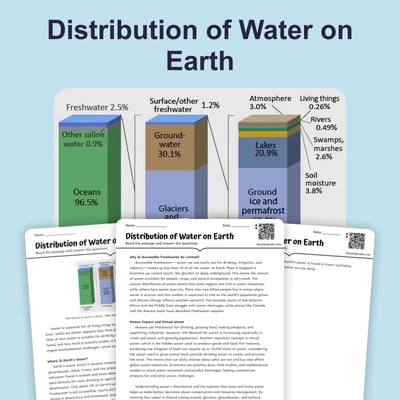
Distribution of Water on Earth
This middle school science reading passage explores the distribution of water on Earth, aligned with NGSS standards MS-E...
MS-ESS2-4MS-ESS3-1
Water as a Resource
This middle school science passage examines water as a critical resource, focusing on how it is used, managed, and conse...
MS-ESS3-1MS-ESS3-4
Water Quality
This middle school science reading passage covers the topic of water quality, aligned with NGSS standards MS-ESS3-1 and ...
MS-ESS3-1MS-ESS3-3
Why Is Uranium Found in Certain Rock Types
This informative science reading passage for middle school students (grades 6-8) explains why uranium concentrates in ce...
MS-ESS3-1
How Minerals Are Mined
This comprehensive 650-word informational science reading passage teaches middle school students (grades 6-8) about mine...
MS-ESS3-1
Why Are Resources Unevenly Distributed on Earth
This comprehensive 650-word reading passage explains why natural resources are unevenly distributed across Earth's surfa...