What Are Divergent Plate Boundaries
Interactive passage with audio narration, comprehension questions, and printable PDF.
By completing this purchase you agree to our Terms of Use and Privacy Policy. Your subscription renews automatically until you cancel. You can cancel anytime from your account settings. All sales are final and non-refundable. Digital content is available for download in your account immediately upon purchase.
What's included
What Are Divergent Plate Boundaries preview and details
About this printable What Are Divergent Plate Boundaries science reading passage, NGSS-aligned (Grades 5-8)
Sample passage and quiz from What Are Divergent Plate Boundaries
Reading passage and comprehension quiz preview
What Are Divergent Plate Boundaries
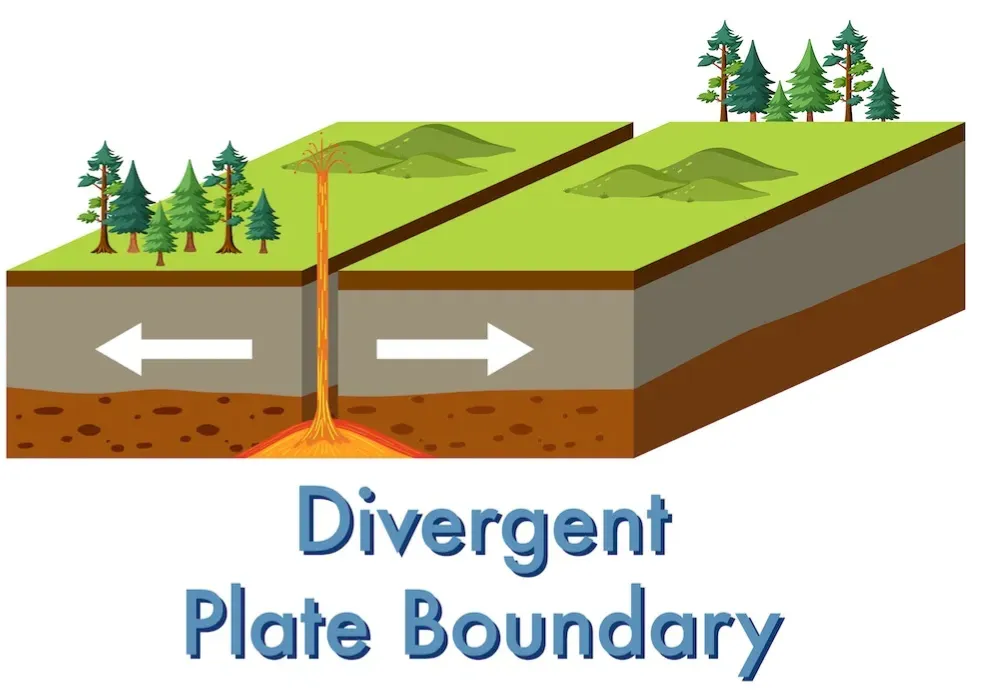
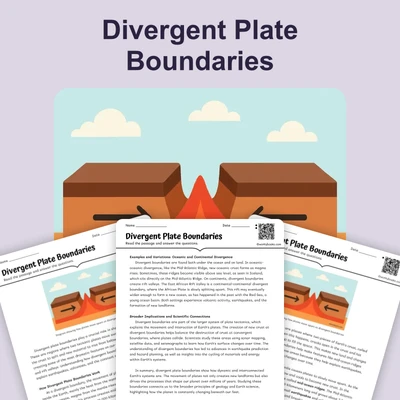
Divergent plate boundaries are places where Earth's tectonic plates move away from each other. As two plates pull apart, they create a gap in Earth's surface. Hot magma from the mantle rises up to fill this space. When the magma cools and hardens, it forms brand-new crust. Scientists explain that divergent boundaries act like a factory for Earth's surface, constantly building new lithosphere.
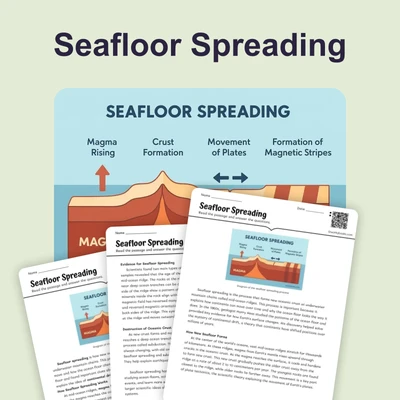
Most divergent boundaries exist deep under the oceans. Evidence shows that these underwater boundaries form long mountain chains called mid-ocean ridges. The Mid-Atlantic Ridge stretches for thousands of kilometers beneath the Atlantic Ocean. At these ridges, the seafloor slowly spreads apart in a process called seafloor spreading. New ocean floor forms as magma pushes up through the gap. The newest crust sits right at the ridge center. Older crust moves away on both sides as more magma rises.
Divergent boundaries can also occur on land, where they tear continents apart. Scientists observe these boundaries forming deep valleys called rift valleys. The East African Rift is one clear example of a continental divergent boundary. This massive crack in Earth's surface stretches through several countries in eastern Africa. The African plate is slowly splitting into two smaller plates. Evidence shows that volcanic activity and earthquakes happen frequently along the rift. If this process continues for millions of years, the rift may widen enough to fill with ocean water. Africa could eventually split into two separate continents.
Understanding divergent boundaries helps scientists explain how Earth's surface changes over time. These boundaries show that our planet remains active and dynamic. New crust forms at divergent boundaries while old crust gets destroyed at other types of plate boundaries. This cycle keeps Earth's surface constantly renewing. The process also affects ocean basins, continent positions, and volcanic activity around the world.
Interesting Fact: The Mid-Atlantic Ridge rises so high in some places that it breaks through the ocean surface to form islands. Iceland sits directly on top of this underwater mountain chain, making it one of the few places where you can stand on a mid-ocean ridge.
Comprehension quiz (10 questions)
1. What happens at divergent plate boundaries?
2. Where do most divergent plate boundaries occur?
3. What is magma?
4. The term 'seafloor spreading' refers to:
5. Why is the East African Rift an important example in the passage?
6. What can scientists infer about Earth based on divergent boundaries?
7. If a divergent boundary continues to widen a rift valley for millions of years, what might happen?
8. How does the process at divergent boundaries affect the entire Earth system?
9. True or False: The newest crust at a mid-ocean ridge is found at the center of the ridge.
10. True or False: Divergent boundaries destroy old crust.
Perfect for the way you teach
- Build comprehension skills
- Auto-graded quiz
- Differentiated reading
- Read together at home
- Improve fluency
- Quiet reading time
- Reading curriculum support
- Independent practice
- Track Lexile growth