Reading PassagePremium

What Are Dome Mountains

Interactive passage with audio narration, comprehension questions, and printable PDF.

No ratings yet
Grades 5–8ScienceElaEnglish · SpanishInteractive · Printable
Aligned toMS-ESS2-2
Just this resource
$1.50
One-time purchase
Best value
Unlock everything
$49.99$24.99/yr
50% off until Sept 15 — 10,000+ resources
Renews at $49.99/year.

By completing this purchase you agree to our Terms of Use and Privacy Policy. Your subscription renews automatically until you cancel. You can cancel anytime from your account settings. All sales are final and non-refundable. Digital content is available for download in your account immediately upon purchase.

Unlock above to use these actions

What's included

Reading passage
Audio narration
Comprehension quiz
Writing activity
Glossary & flashcards
Differentiated version
Spanish translation

What Are Dome Mountains preview and details

About this printable What Are Dome Mountains science reading passage, NGSS-aligned (Grades 5-8)

This comprehensive 400-500 word reading passage explains dome mountain formation for middle school students in grades 6-8. Students learn how large bodies of magma push upward from below Earth's surface without erupting, creating broad, rounded domes in overlying rock layers. The passage connects underground magma bodies (batholiths) with erosion processes that gradually expose harder rock beneath. Using the Black Hills of South Dakota as a real-world example, the lesson demonstrates how mountains can form without volcanic eruptions. Aligned to NGSS standards MS-ESS2-2 and MS-ESS2.B, this audio-integrated passage helps students understand plate tectonics, Earth's systems interactions, and the role of geoscience processes in shaping landscapes. The content includes foundational knowledge about uplift, erosion, and igneous intrusions, preparing students to analyze how Earth's surface changes over millions of years through the interaction of internal heat energy and surface processes.
Written by Workybooks TeamPublished by Workybooks
Preview

Sample passage and quiz from What Are Dome Mountains

Reading passage and comprehension quiz preview

What Are Dome Mountains
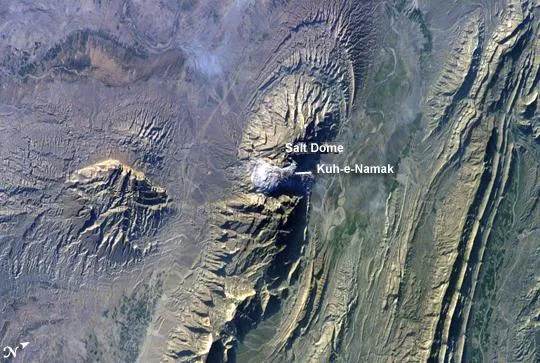
Jashak Salt Dome in the Zagros Mountains - Iran

"Jashak Salt Dome in the Zagros Mountains - Iran" by NASA / Wikimedia Commons.

Dome mountains are mountains that form when a large mass of magma pushes upward from deep within Earth but never breaks through the surface to erupt. Instead, the rising magma bulges the overlying rock layers upward into a broad, rounded shape. This process can be compared to inflating a balloon underneath a blanket. The blanket rises into a gentle dome, but the balloon itself stays hidden beneath. Over millions of years, the magma cools and hardens into solid rock underground, forming what scientists call a batholith.

The process of dome mountain formation begins deep in Earth's crust where temperatures and pressures are extremely high. Scientists explain that magma rises because it is less dense than the surrounding rock. As the magma pushes upward, it causes uplift of the rock layers above it. The overlying rocks bend and arch rather than break. This creates a dome-shaped bulge at Earth's surface. The magma may rise several kilometers but stops before reaching the surface. Evidence shows that the cooling process can take millions of years as heat slowly escapes into the surrounding rock.

After the dome forms, erosion begins its patient work. Wind, water, and ice gradually wear away the softer outer layers of uplifted rock. This process exposes the harder igneous rock that formed from the cooled magma below. Scientists observe that erosion can remove thousands of meters of rock over time. The Black Hills of South Dakota provide a well-known example of dome mountains. This region formed about 60 million years ago when magma pushed upward beneath layers of sedimentary rock. Today, erosion has removed much of the overlying material, revealing the ancient granite core beneath.

Dome mountains matter because they demonstrate how Earth's internal heat energy and surface processes work together to shape landscapes. These mountains connect underground magma activity with the power of erosion. They show that mountain building can occur without volcanic eruptions. Understanding dome mountains helps scientists explain how different forces interact to change Earth's surface over geological time.

Interesting Fact: Mount Rushmore, the famous monument with carved presidential faces, is located in the Black Hills dome mountain range. The sculptors chose this location because the exposed granite was hard enough to carve and resist erosion for thousands of years.

Comprehension quiz (10 questions)

1. What are dome mountains?

Mountains formed by volcanic eruptions
Mountains formed when magma pushes upward but does not erupt
Mountains formed by earthquakes
Mountains formed by folding rock layers

2. What happens to the magma that creates dome mountains?

It erupts as lava on Earth's surface
It disappears back into the mantle
It cools and hardens into solid rock underground
It melts the surrounding rocks completely

3. In the passage, what does the term 'batholith' refer to?

A type of sedimentary rock layer
A large mass of igneous rock that cooled underground
The process of erosion
A volcanic mountain

4. What does 'uplift' mean in the context of dome mountain formation?

The downward movement of rock layers
The breaking apart of rock layers
The upward movement of rock layers caused by forces from within Earth
The sideways movement of tectonic plates

5. Why does magma rise toward Earth's surface?

Because it is denser than surrounding rock
Because it is less dense than surrounding rock
Because earthquakes push it upward
Because erosion pulls it upward

6. What role does erosion play in dome mountain formation?

It creates the magma that forms the dome
It prevents the magma from rising
It wears away softer outer rock layers to expose harder rock beneath
It causes the magma to erupt

7. Which real-world location is given as an example of dome mountains?

The Rocky Mountains
The Appalachian Mountains
The Black Hills of South Dakota
Mount St. Helens

8. How can dome mountain formation occur without volcanic eruptions?

The magma pushes upward but stops before reaching the surface
The magma is too cold to erupt
Erosion prevents eruptions from happening
The rock layers are too thick to break

9. Dome mountains form only through volcanic eruptions.

True
False

10. The Black Hills formed approximately 60 million years ago.

True
False
Who it's for

Perfect for the way you teach

Teachers
  • Build comprehension skills
  • Auto-graded quiz
  • Differentiated reading
Parents
  • Read together at home
  • Improve fluency
  • Quiet reading time
Homeschoolers
  • Reading curriculum support
  • Independent practice
  • Track Lexile growth

Topics

Reviews & Ratings

No reviews yet. Be the first to share your experience!

More reading you might love

20 more
Passage
Talus Slopes: Formation and Features - reading educational content
Grades 5–8

Talus Slopes: Formation and Features

science · MS-ESS2-1+2

Free
Passage
Stratigraphic Columns: Decoding Earth’s Geological Layers - reading educational content
Grades 5–8

Stratigraphic Columns: Decoding Earth’s Geological Layers

science · MS-ESS2-2+2

Free
Passage
Frost Wedging: How Ice Splits Rock - reading educational content
Grades 5–8

Frost Wedging: How Ice Splits Rock

earth and space science · MS-ESS2-1+2

$1.50
Passage
Chemical Weathering: The Breakdown of Rocks Through Chemical Reactions - reading educational content
Grades 5–8

Chemical Weathering: The Breakdown of Rocks Through Chemical Reactions

earth and space science · MS-ESS2-1+2

Free
Passage
What Is Space Weather and How Does It Affect the Earth? - reading educational content
Grades 3–7

What Is Space Weather and How Does It Affect the Earth?

earth and space science · MS-ESS2-2

$1.50
Passage
When Was The Last Ice Age - reading educational content
Grade 6

When Was The Last Ice Age

earth and space science · MS-ESS2-2

$1.50
Passage
Tools and Technology in Earth Science - reading educational content
Grades 5–8

Tools and Technology in Earth Science

science · MS-ESS2-2+4

$1.50
Passage
Maps and Mapping - reading educational content
Grades 5–8

Maps and Mapping

earth and space science · MS-ESS2-2

$1.50
Passage
Latitude and Longitude - reading educational content
Grades 5–8

Latitude and Longitude

earth and space science · MS-ESS2-2

$1.50
Passage
Topographic Maps - reading educational content
Grades 5–8

Topographic Maps

earth and space science · MS-ESS2-2+3

$1.50
Passage
Contour Lines and Elevation - reading educational content
Grades 5–8

Contour Lines and Elevation

earth and space science · MS-ESS2-2+3

$1.50
Passage
Maps and Their Uses - reading educational content
Grades 5–8

Maps and Their Uses

earth and space science · MS-ESS2-2+5

$1.50
Passage
Mountains and Mountain Building - reading educational content
Grades 5–8

Mountains and Mountain Building

earth and space science · MS-ESS2-1+1

$1.50
Passage
Earth's Interior - reading educational content
Grades 5–8

Earth's Interior

earth and space science · MS-ESS2-1+1

$1.50
Passage
Continental Drift Theory - reading educational content
Grades 5–8

Continental Drift Theory

earth and space science · MS-ESS2-2+1

Free
Passage
Seafloor Spreading - reading educational content
Grades 5–8

Seafloor Spreading

science · MS-ESS2-2+1

$1.50
Passage
Theory of Plate Tectonics - reading educational content
Grades 5–8

Theory of Plate Tectonics

earth and space science · MS-ESS2-2

$1.50
Passage
Divergent Plate Boundaries - reading educational content
Grades 5–8

Divergent Plate Boundaries

earth and space science · MS-ESS2-2

$1.50
Passage
Convergent Plate Boundaries - reading educational content
Grades 5–8

Convergent Plate Boundaries

earth and space science · MS-ESS2-2

$1.50
Passage
Transform Plate Boundaries - reading educational content
Grades 5–8

Transform Plate Boundaries

earth and space science · MS-ESS2-2

$1.50
Copyright © 2026 Workybooks Classroom. Made with ♥ in California.