What Are Fault-Block Mountains
Interactive passage with audio narration, comprehension questions, and printable PDF.
By completing this purchase you agree to our Terms of Use and Privacy Policy. Your subscription renews automatically until you cancel. You can cancel anytime from your account settings. All sales are final and non-refundable. Digital content is available for download in your account immediately upon purchase.
What's included
What Are Fault-Block Mountains preview and details
About this printable What Are Fault-Block Mountains science reading passage, NGSS-aligned (Grades 5-8)
Sample passage and quiz from What Are Fault-Block Mountains
Reading passage and comprehension quiz preview
What Are Fault-Block Mountains
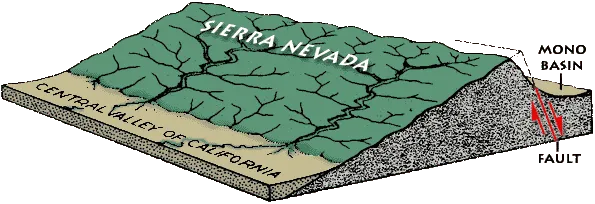
"Sierra Fault Block" by USGS / Wikimedia Commons.
Fault-block mountains are mountain ranges that form when Earth's crust is pulled apart or stressed until it cracks. These cracks, called faults, can extend for many miles through solid rock. Along these faults, enormous blocks of rock shift and move. Some blocks tilt and push upward while others drop down. The uplifted blocks become mountains with distinctive features.
Scientists explain that tension forces cause fault-block mountains to form. Tension occurs when tectonic plates pull away from each other. This pulling creates stress in the crust until it breaks along a normal fault. In a normal fault, the rock above the fault surface slides downward. The block that drops is called the hanging wall. The block that stays up or rises is called the footwall. When the footwall tilts upward, it creates a mountain.
Fault-block mountains often have one steep, dramatic face and a gentler slope on the opposite side. The steep face forms where the fault broke the crust. Evidence shows these mountains can rise thousands of feet above the surrounding land. The tilted blocks create a distinctive profile that geologists can recognize. These mountains differ from fold mountains, which form when compression squeezes rock layers together.
California's Sierra Nevada provides a clear example of fault-block mountains. This range stretches over 400 miles along eastern California. The eastern face rises sharply from the valleys below. Wyoming's Grand Tetons also formed as tilted fault blocks. Scientists observe that both ranges show the characteristic steep face created by faulting. These mountains continue to change as tectonic forces remain active.
Understanding fault-block mountains helps scientists explain how plate tectonics shapes Earth's surface. The same forces that create these mountains can also cause earthquakes along active faults. Studying these landforms reveals that mountains can form through different processes. Some mountains fold, while others break and tilt along faults. This knowledge shows that Earth's crust responds to forces in multiple ways.
Interesting Fact: The Sierra Nevada fault block tilts so dramatically that the western slope rises gradually over 60 miles, while the eastern face shoots up nearly 2 miles in just a few miles of horizontal distance.
Comprehension quiz (10 questions)
1. What causes fault-block mountains to form?
2. In a normal fault, which block moves downward?
3. What is a characteristic feature of fault-block mountains?
4. Which mountain range is given as an example of fault-block mountains?
5. What does the term 'tension' mean in the context of fault-block mountains?
6. What is a 'fault' as described in the passage?
7. How do fault-block mountains differ from fold mountains?
8. Based on the passage, what can scientists learn from studying fault-block mountains?
9. Fault-block mountains can only form near ocean coastlines.
10. The same forces that create fault-block mountains can also cause earthquakes.
Perfect for the way you teach
- Build comprehension skills
- Auto-graded quiz
- Differentiated reading
- Read together at home
- Improve fluency
- Quiet reading time
- Reading curriculum support
- Independent practice
- Track Lexile growth