Reading PassagePremium

What Are Fold Mountains

Interactive passage with audio narration, comprehension questions, and printable PDF.

No ratings yet
Grades 5–8ScienceElaEnglish · SpanishInteractive · Printable
Aligned toMS-ESS2-2
Just this resource
$1.50
One-time purchase
Best value
Unlock everything
$49.99$24.99/yr
50% off until Sept 15 — 10,000+ resources
Renews at $49.99/year.

By completing this purchase you agree to our Terms of Use and Privacy Policy. Your subscription renews automatically until you cancel. You can cancel anytime from your account settings. All sales are final and non-refundable. Digital content is available for download in your account immediately upon purchase.

Unlock above to use these actions

What's included

Reading passage
Audio narration
Comprehension quiz
Writing activity
Glossary & flashcards
Differentiated version
Spanish translation

What Are Fold Mountains preview and details

About this printable What Are Fold Mountains science reading passage, NGSS-aligned (Grades 5-8)

This 400-500 word reading passage explains how fold mountains form through the collision of tectonic plates at convergent boundaries. Aligned with NGSS MS-ESS2-2 and MS-ESS2.B, the lesson helps middle school students understand how immense pressure from colliding plates compresses and folds rock layers upward into Earth's greatest mountain ranges. Students explore real-world examples including the Himalayas, Alps, and Andes, and learn why marine fossils appear at mountain peaks. The passage connects to previous learning about sedimentary rock and plate boundaries. Audio-integrated features support diverse learners, while differentiated versions ensure accessibility for English Language Learners and struggling readers. The curriculum includes comprehension questions, writing activities, and graphic organizers that reinforce understanding of plate tectonics and mountain-building processes.
Written by Workybooks TeamPublished by Workybooks
Preview

Sample passage and quiz from What Are Fold Mountains

Reading passage and comprehension quiz preview

What Are Fold Mountains
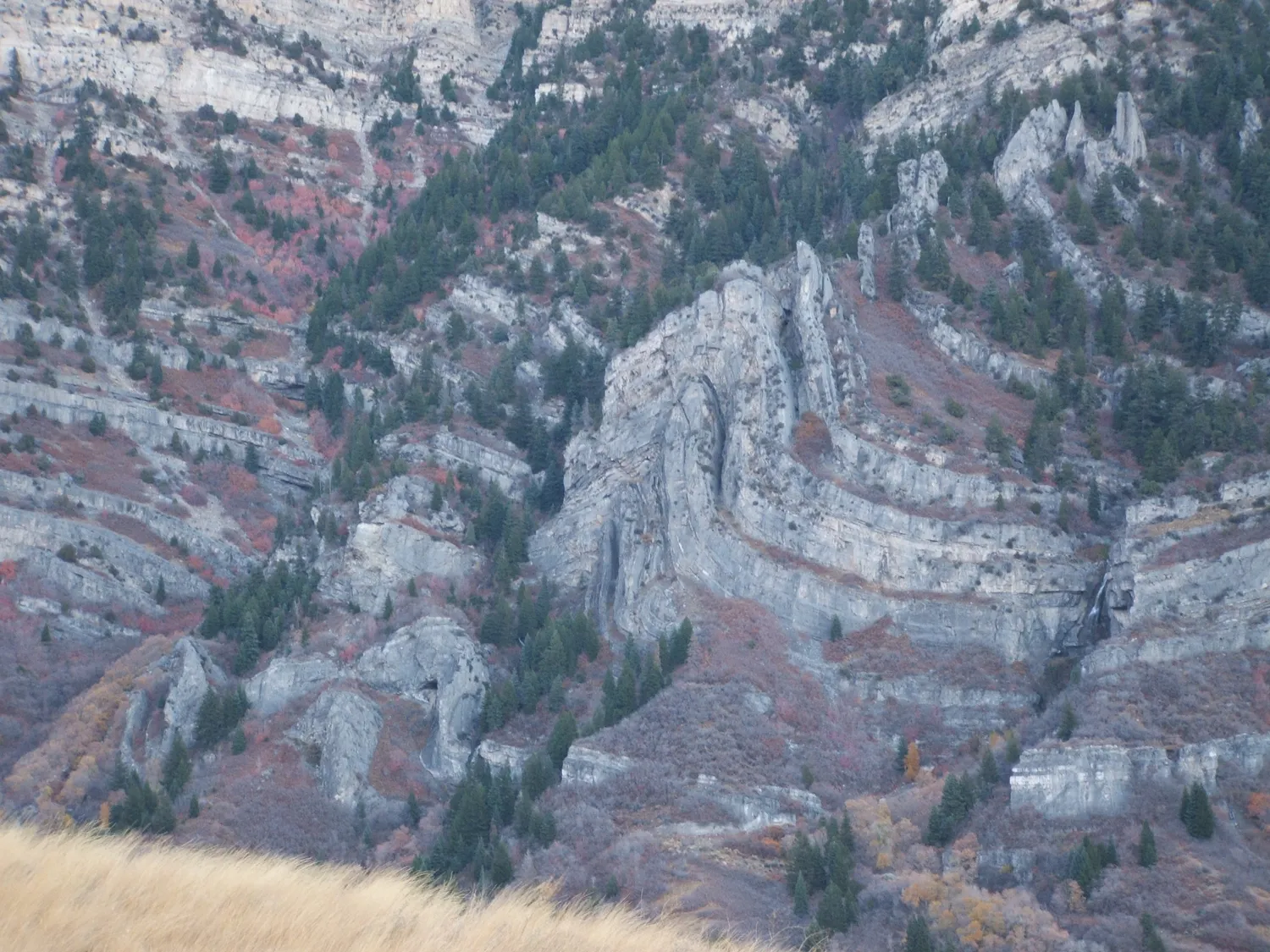
Folded Rock Provo Canyon

"Folded Rock Provo Canyon" by Kerk Phillips / Wikimedia Commons.

Fold mountains are the largest and most common type of mountain on Earth. They form when two tectonic plates push together at convergent boundaries. The immense pressure from the colliding plates compresses and crumples the rock layers between them. This process bends and folds the rock upward into towering mountain ranges.

Scientists explain that fold mountain formation works like pushing both ends of a rug toward the center. The rug bunches up into ridges and folds. In the same way, when tectonic plates collide, flat layers of sedimentary rock bend and fold upward. The pressure can be so great that rock layers thousands of meters thick get squeezed into folds. Some folds are gentle curves, while others are tight bends. Evidence shows that this folding process takes millions of years as plates continue to push against each other.

The world's greatest mountain ranges are largely fold mountains. The Himalayas in Asia formed when the Indian plate collided with the Eurasian plate about 50 million years ago. The plates continue to push together today, causing the Himalayas to grow taller by several millimeters each year. The Alps in Europe and the Andes in South America are also fold mountains. Scientists observe that these ranges all formed at convergent boundaries where plates crashed together.

One remarkable feature of fold mountains is the presence of marine fossils near their peaks. Rocks that once lay at the bottom of ancient seas now sit thousands of meters above sea level. When plates collided, they folded these sedimentary layers upward. This evidence helps scientists understand Earth's dynamic history. The fossils prove that mountain-building can lift ocean floor rocks to great heights.

Understanding fold mountains matters because they shape Earth's surface and affect millions of people. These mountains influence weather patterns, create natural barriers, and provide resources. The folding process also helps scientists study plate tectonics and Earth's changing surface. Fold mountains demonstrate how powerful forces beneath Earth's crust can transform flat landscapes into towering peaks over geologic time.

Interesting Fact: Mount Everest, the world's highest peak, contains limestone with marine fossils from ancient sea creatures. These rocks formed at the bottom of an ocean millions of years ago before being folded upward to over 8,800 meters above sea level.

Comprehension quiz (10 questions)

1. What are fold mountains?

Mountains formed by volcanic eruptions
Mountains formed when tectonic plates collide and fold rock layers upward
Mountains formed by erosion of flat land
Mountains formed by meteorite impacts

2. At what type of plate boundary do fold mountains form?

Divergent boundaries
Transform boundaries
Convergent boundaries
Passive boundaries

3. What does the term 'sedimentary rock' mean in the passage?

Rock formed from cooled magma
Rock formed from layers of sediment that harden over time
Rock formed from extreme heat and pressure
Rock formed from volcanic ash

4. Which comparison does the passage use to explain how fold mountains form?

Stacking blocks on top of each other
Pushing both ends of a rug toward the center
Folding a piece of paper in half
Squeezing a sponge

5. Why are marine fossils found at the peaks of fold mountains?

Sea creatures climbed to the mountain tops
Ancient seas covered the mountain peaks
Rock layers that once lay at the bottom of seas were folded upward
Rivers carried the fossils to the peaks

6. Which of the following is an example of a fold mountain range mentioned in the passage?

The Rocky Mountains
The Appalachian Mountains
The Himalayas
The Sierra Nevada

7. Based on the passage, what can you infer about the age of fold mountains?

They form quickly in just a few years
They take millions of years to form through continuous plate movement
They form only during earthquakes
They stop growing once they are formed

8. If two tectonic plates continue to push together at a convergent boundary, what would likely happen to the fold mountains there?

The mountains would shrink and disappear
The mountains would stop changing
The mountains would continue to grow taller
The mountains would split apart

9. True or False: The Himalayas continue to grow taller today because the Indian and Eurasian plates are still pushing together.

True
False

10. True or False: Fold mountains are rare and only found in one or two places on Earth.

True
False
Who it's for

Perfect for the way you teach

Teachers
  • Build comprehension skills
  • Auto-graded quiz
  • Differentiated reading
Parents
  • Read together at home
  • Improve fluency
  • Quiet reading time
Homeschoolers
  • Reading curriculum support
  • Independent practice
  • Track Lexile growth
Topics

Reviews & Ratings

No reviews yet. Be the first to share your experience!

More reading you might love

20 more
Passage
Talus Slopes: Formation and Features - reading educational content
Grades 5–8

Talus Slopes: Formation and Features

science · MS-ESS2-1+2

Free
Passage
Stratigraphic Columns: Decoding Earth’s Geological Layers - reading educational content
Grades 5–8

Stratigraphic Columns: Decoding Earth’s Geological Layers

science · MS-ESS2-2+2

Free
Passage
Frost Wedging: How Ice Splits Rock - reading educational content
Grades 5–8

Frost Wedging: How Ice Splits Rock

earth and space science · MS-ESS2-1+2

$1.50
Passage
Chemical Weathering: The Breakdown of Rocks Through Chemical Reactions - reading educational content
Grades 5–8

Chemical Weathering: The Breakdown of Rocks Through Chemical Reactions

earth and space science · MS-ESS2-1+2

Free
Passage
What Is Space Weather and How Does It Affect the Earth? - reading educational content
Grades 3–7

What Is Space Weather and How Does It Affect the Earth?

earth and space science · MS-ESS2-2

$1.50
Passage
When Was The Last Ice Age - reading educational content
Grade 6

When Was The Last Ice Age

earth and space science · MS-ESS2-2

$1.50
Passage
Tools and Technology in Earth Science - reading educational content
Grades 5–8

Tools and Technology in Earth Science

science · MS-ESS2-2+4

$1.50
Passage
Maps and Mapping - reading educational content
Grades 5–8

Maps and Mapping

earth and space science · MS-ESS2-2

$1.50
Passage
Latitude and Longitude - reading educational content
Grades 5–8

Latitude and Longitude

earth and space science · MS-ESS2-2

$1.50
Passage
Topographic Maps - reading educational content
Grades 5–8

Topographic Maps

earth and space science · MS-ESS2-2+3

$1.50
Passage
Contour Lines and Elevation - reading educational content
Grades 5–8

Contour Lines and Elevation

earth and space science · MS-ESS2-2+3

$1.50
Passage
Maps and Their Uses - reading educational content
Grades 5–8

Maps and Their Uses

earth and space science · MS-ESS2-2+5

$1.50
Passage
Mountains and Mountain Building - reading educational content
Grades 5–8

Mountains and Mountain Building

earth and space science · MS-ESS2-1+1

$1.50
Passage
Earth's Interior - reading educational content
Grades 5–8

Earth's Interior

earth and space science · MS-ESS2-1+1

$1.50
Passage
Continental Drift Theory - reading educational content
Grades 5–8

Continental Drift Theory

earth and space science · MS-ESS2-2+1

Free
Passage
Seafloor Spreading - reading educational content
Grades 5–8

Seafloor Spreading

science · MS-ESS2-2+1

$1.50
Passage
Theory of Plate Tectonics - reading educational content
Grades 5–8

Theory of Plate Tectonics

earth and space science · MS-ESS2-2

$1.50
Passage
Divergent Plate Boundaries - reading educational content
Grades 5–8

Divergent Plate Boundaries

earth and space science · MS-ESS2-2

$1.50
Passage
Convergent Plate Boundaries - reading educational content
Grades 5–8

Convergent Plate Boundaries

earth and space science · MS-ESS2-2

$1.50
Passage
Transform Plate Boundaries - reading educational content
Grades 5–8

Transform Plate Boundaries

earth and space science · MS-ESS2-2

$1.50
Copyright © 2026 Workybooks Classroom. Made with ♥ in California.